
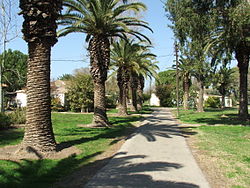
A kibbutz is a collective community in Israel that was traditionally based on agriculture. The first kibbutz, established in 1909, was Degania. Today, farming has been partly supplanted by other economic branches, including industrial plants and high-tech enterprises. Kibbutzim began as utopian communities, combining socialism and Zionism. In recent decades, some kibbutzim have been privatized and changes have been made in the communal lifestyle. A member of a kibbutz is called a kibbutznik.
As of 2010, there were 270 kibbutzim in Israel. Their factories and farms accounted for 9% of Israel’s industrial output, worth US$8 billion, and 40% of its agricultural output, worth over $1.7 billion. Some kibbutzim have also developed substantial high-tech and military industries. For example, in 2010, Kibbutz Sasa, with around 200 members, generated $850 million in annual revenue from its military-plastics industry.
The first kibbutzim

The kibbutzim were founded by members of the Bilu movement who emigrated to Palestine. Like the members of the First Aliyah who came before them, most members of the Second Aliyah wanted to be farmers. Joseph Baratz, one of the pioneers of the kibbutz movement, wrote a book about his experiences:
“We were happy enough working on the land, but we knew more and more certainly that the ways of the old settlements were not for us. This was not the way we hoped to settle the country—this old way with Jews on top and Arabs working for them; anyway, we thought that there shouldn’t be employers and employed at all. There must be a better way.”
Though Baratz and others wanted to farm the land themselves, becoming independent farmers was not a realistic option in 1909. As Arthur Ruppin, a proponent of Jewish agricultural colonization of the Trans-Jordan, would later say:
“The question was not whether group settlement was preferable to individual settlement; it was rather one of either group settlement or no settlement at all.”
Development of kibbutz movements
In 1927, the United Kibbutz Movement (HaqKibbutz HamMeuhad) was established. Several HaShomer Hatzair kibbutzim banded together to form HaKibbutz HaArtzi. In 1936, the Socialist League of Palestine was founded and served as an urban ally of HaKibbutz HaArtzi. In 1946, HaKibbutz HaArtzi and the Socialist League combined to form the Hashomer Hatzair Workers Party of Palestine, which in 1948, merged with Ahdut HaAvoda-Poalei Zion to form the left-wing Mapam party.

In 1928, Degania and other small kibbutzim formed “Hever Hakvutzot” (“association of kvutzot”). Kvutzot were deliberately small, not exceeding 200 members, in the belief that this was imperative for maintaining trust. Kvutzot did not have youth-group affiliations in Europe. Kibbutzim affiliated with Hakibbutz Hameuhad took in as many members as they could. Givat Brenner eventually came to have more than 1,500 members. Artzi kibbutzim were also more devoted to equality of the sexes than other kibbutzim. Women called their husbands ishi (“my man”) rather than the customary Hebrew word for husband ba’ali (lit. “my owner”). The children slept in children’s houses and visited their parents only a few hours a day.
Types of kibbutzim
There are three kibbutz movements:
1.The Kibbutz Movement, which constitutes an umbrella organization of two separate movements and ideologies:
The United Kibbutz Movement, founded in 1979 as a merger of two older movements: the United Kibbutz and Union of Kvutzot and Kibbutzim.
Kibbutz Artzi Hashomer Hatzair.
2. Religious Kibbutz Movement Hapoel HaMizrachi.
Many kibbutzim were initially established by Nahal groups affiliated with Israeli youth movements, among them HaNoar HaOved VeHaLomed, Hashomer Hatzair, and HaMachanot HaOlim.
Following many changes the kibbutzim went through over the years and following the appeal made to the Israeli High Court of Justice by the Mizrahi Democratic Rainbow Coalition in 2001, the state was required to redefine the exact definition of a kibbutz to determine the rightful benefits kibbutz members should be granted by law. The reactivated legal definition was given to the Industry, Trade, and Labour Minister of Israel on December 15, 2005. According to this classification, there are three types of kibbutzim:
1. Kibbutz Shitufi: A kibbutz still preserving a cooperative system.
2. Kibbutz MitChadesh: A community with a number of cooperative systems in its intentions (guaranteed minimal income within the community, partnership in the ownership of the production means, partnership in the ownership of the lands, etc.).
3. Urban Kibbutz: A community existing within an existing settlement (city). Since the 1970s, around 100 urban kibbutzim have been founded within existing Israeli cities. They have no enterprises of their own, and all of their members work in the non-kibbutz sector. Examples include Tamuz in Beit Shemesh, Horesh in Kiryat Yovel, Jerusalem, Beit Yisrael in Gilo, Jerusalem, and Migvan in Sderot.
Where Are They Today? Kibbutzim, Moshavim & Community Centers in Israel
An estimated 80,000 people of Indian Jewish descent live in Israel today. Most live in ordinary towns and cities rather than agricultural communities, but a handful of moshavim were resettled directly by specific waves of Indian immigration and still carry that identity, and a few heritage sites keep the culture visible to visitors.
1. Nevatim — Cochin Jews
- Type: Moshav
- Location: Southern District, Bnei Shimon Regional Council, about 10 minutes south of Beersheba
- Founded: 1946 by Jewish immigrants from Hungary; re-established in 1954 at a nearby site by Cochin Jewish immigrants from Kochi, India
- Population today: 1,174 residents (2024)
- Community center: The Cochin Jewry Heritage Center, a museum of Kerala Jewish life, with an adjoining synagogue modeled on the historic Kerala synagogues. Wheelchair accessible and open to visitors.
- Learn more: Nevatim (Wikipedia)
2. Shahar — Indian Jewish immigrants
- Type: Moshav
- Location: Southern District, Lakhish Regional Council, about 3 km west of Kiryat Gat
- Founded: 1955, by Jewish immigrants from India settled alongside North African Jewish families
- Population today: 812 residents (2023)
- Notable: Longtime resident Eliahu Bezalel built the moshav’s flower-export industry and received India’s Pravasi Bharatiya Divas award for Non-Resident Indians in recognition of it
- Learn more: Shahar (Wikipedia)
3. Yuval — Cochin Jews
- Type: Moshav
- Location: Northern District, Upper Galilee
- Founded: 1953 by Kurdish Jewish evacuees from Jerusalem’s Old City; repopulated in the early 1960s by Cochin Jewish immigrants
- Population today: 886 residents (2024)
- Learn more: Yuval (Wikipedia)
4. Mesilat Zion — Cochin Jews
- Type: Moshav
- Location: Jerusalem District, Mateh Yehuda Regional Council, near Beit Shemesh
- Founded: 1950 by Yemenite Jewish immigrants; repopulated within a few years by Cochin Jewish families
- Population today: 942 residents (2024)
- Learn more: Mesilat Zion (Wikipedia)
Bnei Menashe: A More Recent, More Scattered Aliyah
Unlike the Cochin and Bene Israel communities, the Bnei Menashe of Manipur and Mizoram have arrived mostly since the 2000s, and Israel has settled them across many towns rather than into a handful of agricultural moshavim. Documented Bnei Menashe communities exist in Nof HaGalil (formerly Nazareth Illit), Kiryat Arba, Sderot, Karmiel, Migdal HaEmek, Afula, Ma’alot, Beit El, Ofra, and Nitzan, among other towns. On November 23, 2025, the Israeli government approved a plan to bring essentially all of the community’s remaining members to Israel: about 1,200 people by 2026 (at a cost of 90 million shekels), and a further 4,600 by 2030, on top of the roughly 5,500 who have already immigrated over the past two decades. Most newcomers are expected to settle in Nof HaGalil and other northern cities.
Two organizations do most of the on-the-ground work: Shavei Israel, founded by Michael Freund, which organizes aliyah flights and funds Jewish education in Aizawl and Imphal before departure, and Degel Menashe, which focuses on absorption and advocacy for Bnei Menashe already living in Israel.
Learn more: Bnei Menashe (Wikipedia)
The Bigger Picture
Beersheba was an early hub for Indian Jewish newcomers as far back as 1951, and Nevatim’s Cochin Jewry Heritage Center remains the community’s most visible living monument today. If your family’s own community isn’t listed above, or you know of another moshav, synagogue, or heritage center with a documented Indian Jewish connection, let us know so we can add it here — fact-checked, sourced, and correctly captioned.