
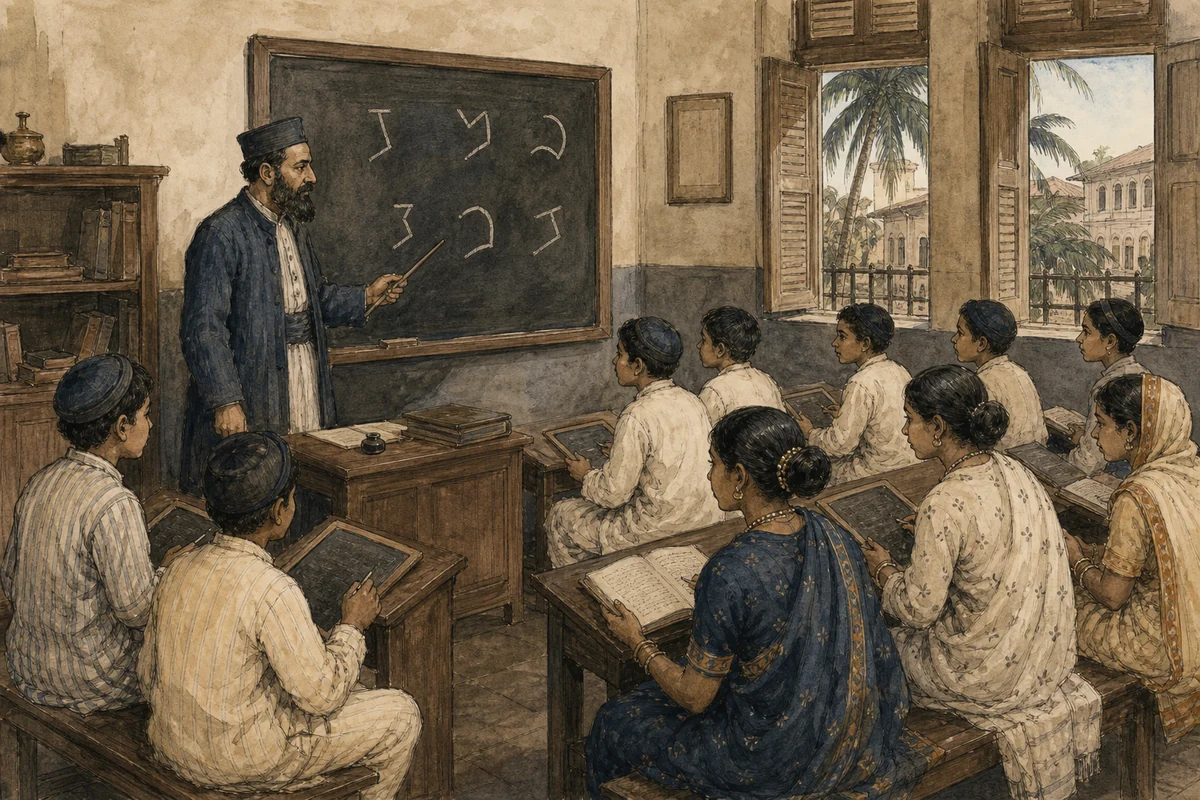
Featured image: original historical editorial illustration created for JewsOfIndia.com, 2026.
The Bene Israel — the “Sons of Israel” — are the oldest and largest Jewish community in India, with a history on the subcontinent stretching back at least two thousand years and possibly much longer. Their story, captured in the topic of “Hebrew School in Nineteenth-Century Bombay: The Education of the Bene Israel,” is one of remarkable perseverance and cultural creativity: a Jewish community that maintained its identity across centuries of geographic isolation, developing a way of life that was simultaneously deeply Jewish and thoroughly Indian.
Education and the Bene Israel Community
Education has been a central value and a defining characteristic of the Bene Israel community throughout the modern period. The establishment of Jewish schools in Bombay and other centers of Bene Israel life in the nineteenth century represented a significant investment in the community’s future and contributed enormously to the educational attainments that became characteristic of the community. Hebrew language instruction, religious education, and secular academic subjects were combined in these schools to produce graduates who were prepared both for participation in Jewish communal life and for the professional opportunities that the modernizing Indian economy was beginning to offer.
The role of missionary organizations, particularly Christian missions, in the development of Bene Israel education in the nineteenth century is a complex and somewhat controversial aspect of this history. Some missionaries established schools in Bene Israel communities that provided valuable education while also attempting religious conversion. The response of the community was nuanced: accepting the educational benefits while largely resisting the religious pressure. This episode illustrates the pragmatic intelligence with which the Bene Israel navigated their complex social environment.
Hebrew Language and Jewish Learning
The maintenance of Hebrew as a language of prayer and learning within the Bene Israel community is particularly notable given the community’s centuries of relative isolation from the wider Jewish world. While Marathi became the community’s everyday language, Hebrew retained its sacred function in the synagogue and in the study of Jewish texts. This commitment to Hebrew as a sacred language both preserved a crucial link to the broader Jewish tradition and eventually facilitated the community’s integration into Israeli society, where Hebrew is the national language.
The establishment of dedicated Hebrew schools and the efforts of both internal community leaders and external Jewish organizations to improve Hebrew and religious education among the Bene Israel in the nineteenth and twentieth centuries reflect a persistent concern with maintaining the community’s Jewish authenticity and connection to global Jewish life. These educational efforts were partly successful, and they contributed to the community’s self-confidence in asserting its Jewish identity in the face of occasional challenges from other Jewish communities.
The Bene Israel Today
The contemporary Bene Israel community is primarily located in Israel, where it forms one of the most distinctive components of the diverse Israeli Jewish population. Communities also exist in other countries — the United States, the United Kingdom, Canada, and Australia — where Indian Jewish immigrants have settled in the post-independence period. In India itself, the community has shrunk dramatically, with only a few hundred elderly Bene Israel remaining in Mumbai and a handful of other locations.
The future of the Bene Israel community depends on its ability to transmit its heritage to younger generations growing up far from the maharashtrian villages and Mumbai neighborhoods where that heritage was formed. Community organizations, scholars, and committed individuals are working on this transmission through every available means: publications, cultural events, educational programs, oral history projects, and the use of digital media. The story of the Bene Israel — two thousand years of Jewish life on the Indian subcontinent — deserves to be known, celebrated, and preserved for future generations.
Preserving Indian Jewish Heritage for Future Generations
The task of preserving Indian Jewish heritage is one of the most urgent cultural projects in the contemporary Jewish world. As the communities that created this heritage continue to shrink through emigration and natural attrition, the window for capturing living memories, traditional practices, and community knowledge is narrowing rapidly. Every year, elderly community members pass away, taking with them irreplaceable firsthand knowledge of how Jewish life was actually lived in the Bene Israel villages of Maharashtra, the Jewish neighborhoods of Cochin, or the commercial districts of Calcutta and Bombay where Baghdadi Jewish families built their businesses and synagogues.
The response of scholars, community organizations, and cultural institutions to this challenge has been energetic and multifaceted. Oral history projects have recorded interviews with elderly community members in India, Israel, and the diaspora. Digital archives have made historical photographs, documents, and recordings accessible to researchers and community members around the world. Museum exhibitions have introduced Indian Jewish heritage to audiences who might otherwise never encounter it. And writers, artists, and filmmakers from within and outside the community have created new works that carry Indian Jewish stories and traditions into the contemporary cultural conversation.
The Place of Indian Jews in the Larger Jewish Story
The history of India’s Jewish communities occupies a distinctive and important place in the broader story of the Jewish diaspora. Unlike the often traumatic histories of Jewish communities in Europe and the Middle East — marked by persecution, pogroms, forced conversions, and the Holocaust — the Indian Jewish story is predominantly one of peaceful coexistence, communal autonomy, and cultural creativity within a tolerant host society. This positive experience does not diminish or contradict the difficult experiences of other Jewish communities; it demonstrates that the relationship between Jews and their host societies is shaped by specific historical circumstances rather than by any inevitable dynamic of conflict.
The Indian Jewish communities offer evidence that Jewish identity can be maintained across many centuries of geographic isolation and cultural interchange without requiring either segregation from the surrounding society or assimilation into it. The Bene Israel maintained their Jewish identity across what may be two thousand years of life in Maharashtra while becoming genuinely Indian in language, culture, and social orientation. The Cochin Jews built a thriving community under the protection of local Hindu rulers while maintaining Hebrew literacy and connections to the broader Jewish world. The Baghdadi Jews created cosmopolitan communities in Calcutta and Bombay that participated fully in both the British imperial system and the commercial networks of the Indian Ocean world while maintaining the religious traditions of the ancient Jewish communities of Iraq.