
Most visitors who come looking for Jewish heritage in India head straight for Mumbai’s Byculla or Kochi’s Jew Town. Pune is quieter, but it holds two working synagogues within about two kilometers of each other, and both are still in active use by the city’s small remaining Bene Israel and Baghdadi Jewish community. Neither is a museum piece. Both still hold prayer services, and both require a little planning to visit.
A City With Two Synagogues, Not One
Pune’s Jewish history runs on two separate tracks that happen to have converged in the same city. The Bene Israel, the largest and oldest Jewish community on the subcontinent, settled across the Konkan coast and inland Maharashtra centuries ago, and Pune (then Poona) became an important garrison town for Bene Israel soldiers serving in the British Indian Army. The Baghdadi Jews, merchant families who arrived from Iraq and the Middle East beginning in the eighteenth century, built their fortunes in Bombay and Calcutta but also invested in Pune, then a favored hill-country retreat for the British colonial elite. Ohel David and Succath Shelomo are the physical record of those two separate arrivals, one Baghdadi and one Bene Israel, standing a short walk apart in the same city.
Ohel David: The “Lal Deul”
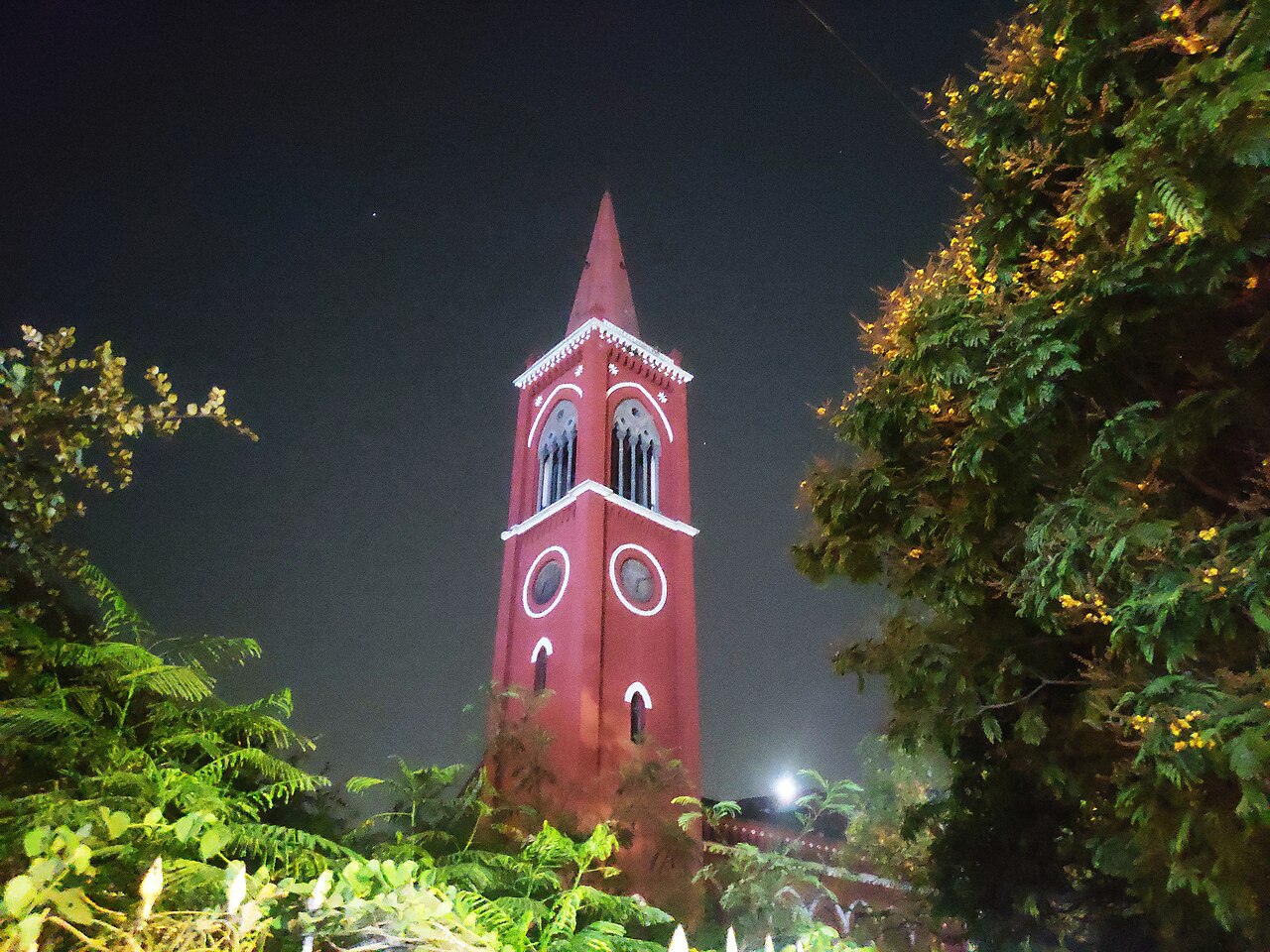
Ohel David is the more famous of the two, and the more visible. Construction began in 1863 and finished in 1867, funded by David Sassoon, the Baghdad-born patriarch of the Sassoon merchant dynasty who had built one of British India’s great trading fortunes. Sassoon did not live to see it finished. He died in Pune in 1864, three years before the building’s consecration on September 29, 1867, and his tomb stands today in the synagogue compound.
The building itself was designed by Henry Saint Clair Wilkins, a British colonial architect and East India Company officer, in English Gothic-revival style: red brick and trap rock, a ninety-foot tower with a London-made four-faced clock, and a pitched slate roof that looks more like a English parish church than a synagogue from a distance. That resemblance is exactly why Puneites nicknamed it Lal Deul, “Red Temple” in Marathi, and locals still use that name more often than its proper one. Inside, the sanctuary can seat over a hundred families, and the raised heckal (ark) holds space for more than a hundred Torah scrolls in decorated silver cases, evidence of how large and prosperous the Baghdadi congregation once was here. The synagogue sits on Moledina Grant Road, near the S.G.S. Mall in Pune’s Camp area, and carries a PMC Heritage Grade I designation.
Ohel David remains active, with regular prayer services and holiday observances maintained for what is now a much smaller Baghdadi community. Since a security tightening in 2008, it is not open to walk-in visitors; entry requires arranging permission in advance. Even from the street, though, the tower and red brick facade are worth the detour.
Succath Shelomo, on Jew Lane
Succath Shelomo tells a different story. It belongs to the Bene Israel, not the Baghdadi community, and it grew out of a 1916 merger of four separate Bene Israel congregations in Pune into one body, Hebrath Beth Yaacov. The land was contributed by Subedar Major Solomon Balaji Jhiradkar, a Bene Israel officer, and the synagogue was formally inaugurated in 1921. It sits on Lakerya Maruti Lane in the Rasta Peth neighborhood, a street still informally known as Jew Lane.
Where Ohel David is a grand colonial monument, Succath Shelomo is modest and unassuming, built for a working congregation rather than as a display of wealth, which in its own way tells you as much about the difference between the Bene Israel and Baghdadi communities as any history book. It also continues to hold services today, with a smaller but active congregation, and like Ohel David it asks visitors to arrange permission ahead of time rather than walk in unannounced.
Planning a Visit
Both synagogues are working houses of worship, not tourist attractions, and both communities have tightened access over the years for straightforward security reasons. If you want to see the interiors rather than just the street facades, the practical approach is the same one used across India’s remaining Jewish communities: contact the congregation or a local Jewish heritage guide in advance, explain who you are and why you are visiting, and be respectful of prayer times and holidays when scheduling. Ohel David’s tower and facade on Moledina Grant Road can be appreciated from the street without an appointment, and the same is true of Succath Shelomo on Jew Lane, so even a walking pass by both sites makes for a short, worthwhile afternoon even without arranging entry.
Travelers who want to go deeper into Pune’s Jewish history can pair a visit to the two synagogues with the Jewish section of the city’s old cemeteries, where Bene Israel and Baghdadi graves, including some of Pune’s original community benefactors, are increasingly at risk of neglect as the community here has shrunk. That story is its own, more troubling chapter in Pune’s Jewish history.
A Small Community, Still Here
Pune’s Jewish population today is a fraction of what it once was, as most Bene Israel and Baghdadi families emigrated to Israel, the United Kingdom, or elsewhere in the decades after Indian independence. Those who remain still gather for holidays and life-cycle events, and the two synagogues are the anchor for that. Visiting them is not just a chance to see two distinct strands of Indian Jewish architecture side by side. It is a reminder that Pune’s Jewish story, unlike so much of the heritage tourism built around it, is not entirely in the past tense.
For more on the architecture and history of Ohel David, see its entry on Wikipedia.