
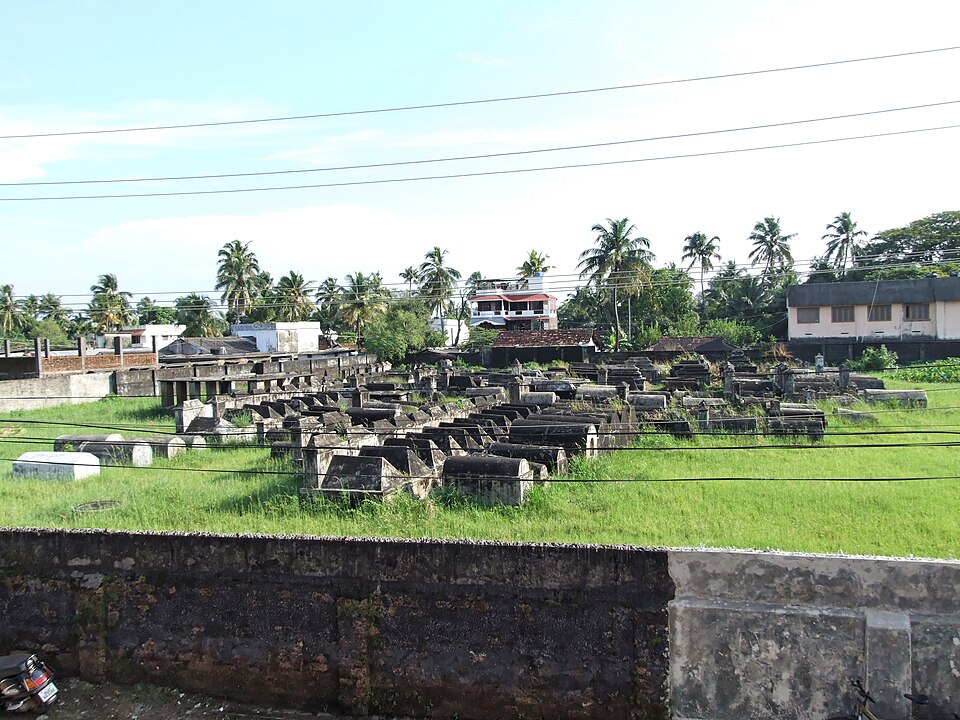
Kerala’s Jews living far apart after two thousand years together is not just a poetic summary, it is close to the literal subject of one of the most important pieces of scholarship on this community: anthropologist Barbara C. Johnson’s 1985 doctoral dissertation, “‘Our Community’ in Two Worlds: The Cochin Paradesi Jews in India and Israel,” completed at the University of Massachusetts and cited in academic work on Indian Jewish life ever since.
Two Communities, One Port City
The story begins on the Malabar Coast, where a Jewish presence is traditionally dated back as far as the era of King Solomon, though the first solid documentary evidence comes from copper plates recording rights granted to a Jewish merchant leader, Joseph Rabban, by a local Hindu ruler around 1000 CE. That original community, later known as the Malabar or “Black” Jews, was joined many centuries later by a second, smaller group: Sephardi Jews fleeing the Alhambra Decree’s expulsion from Spain and Portugal in 1492, who arrived in Cochin in the 16th century and became known as the Paradesi, or “Foreign,” Jews. The two groups shared a port city and a faith but kept largely separate synagogues, customs, and social structures for centuries, each group even claiming, at various points, to be the community’s true and original inheritors, both eventually adopting the local Judeo-Malayalam language while maintaining their own distinct identities. A third group, known as the Meshuchrarim, descended from manumitted servants and converts associated with Paradesi households, complicated the community’s internal social hierarchy further still, and Johnson’s later work specifically pushed back against oversimplified outside accounts of how rigid or fixed those internal distinctions actually were.
A Scholar’s Two Worlds
It is the Paradesi community specifically that Barbara Johnson spent decades studying, first in Kerala and later among the same families after they resettled in Israel. Her dissertation title captures the community’s defining rupture better than almost any other academic work on the subject: an “our community” that now exists simultaneously “in two worlds,” separated by thousands of miles yet still bound by shared memory, ritual, and genealogy. Johnson’s fieldwork treated the Cochin Paradesi Jews not as a vanished historical curiosity but as a living, transplanted community, one whose customs from Kerala continued to shape daily life in Israeli moshavim and towns decades after emigration.
Johnson went on to co-write, with community member Ruby Daniel, the 1995 memoir Ruby of Cochin: An Indian Jewish Woman Remembers, and later contributed the chapter on Kerala’s synagogues to the 2021 anthology Growing Up Jewish in India, edited by Ori Z. Soltes, making her one of the few scholars to have documented this community across three distinct works spanning more than three decades.
Ruby Daniel’s Testimony
Ruby Daniel, born in Cochin and among the last generation to grow up within the historic Jewish quarter before mass emigration, gave Johnson firsthand access to a way of life that was disappearing even as it was being recorded. Her memoir moves through childhood rituals, wedding customs, and synagogue life in Kerala before following her own path to Israel, offering exactly the kind of personal testimony that turns Johnson’s academic “two worlds” framework into lived experience rather than abstraction.
The Great Dispersal After 1948
The rupture Johnson documented did not happen gradually. After India’s independence in 1947 and the establishment of Israel in 1948, the overwhelming majority of Kerala’s Jews left within a few years, with most of the Malabar Jewish community making aliyah in the mid-1950s. The Paradesi Jews, being of Sephardi and often more recent European extraction, more frequently chose Australia, the United Kingdom, or other Commonwealth countries, following a pattern of migration similar to Anglo-Indian communities of the same era. Many of those who left for Israel joined newly formed agricultural moshavim with names like Nevatim, Shahar, Yuval, and Mesilat Zion, while others settled in Jerusalem’s Katamon neighborhood or in the towns of Beersheba, Ramla, Dimona, and Yeruham, the same towns where many Bene Israel migrants from Bombay also resettled.
The “Jewish Gandhi” and Internal Divisions
Johnson’s “two worlds” framing describes geography, but Kerala’s Jewish community was also long divided internally, most notably around the status of the meshuchrarim, families descended from manumitted servants and converts, who faced discrimination from Paradesi congregants for generations. The most prominent figure to challenge this was Abraham Barak Salem, a lawyer born in 1882 and later nicknamed the “Jewish Gandhi” for adapting Mahatma Gandhi’s satyagraha methods, including a boycott of the Paradesi Synagogue, to fight for meshuchrarim equality from within the community itself. Salem was both an Indian nationalist and a committed Zionist, and by the mid-1930s many of the older social restrictions he had campaigned against had substantially eased.
Synagogues Turned Museums
Physical traces of that vanished density remain scattered across Kerala. Of roughly eight synagogues that were still functioning in the community’s mid-20th century heyday, only the Paradesi Synagogue in Mattancherry continues to hold a congregation today, alongside its role as a major heritage tourist site. Others have been repurposed: the synagogue at Chendamangalam was restored in 2006 and now operates as the Kerala Jews Lifestyle Museum, the synagogue at Paravur has become the Kerala Jews History Museum, and the Kadavumbhagam Synagogue in Ernakulam was restored in 2018 and now hosts occasional services led by one of the few Cochin Jews still living locally. Each building is, in effect, a small monument to the same divide at the center of Johnson’s dissertation, a community’s built heritage staying in place while its people scattered elsewhere.
What “Two Thousand Years Together” Actually Means
The claim of a two-thousand-year history rests on a layered set of traditions and evidence rather than a single clean data point. Some community traditions trace the first arrivals to Solomon-era trade voyages nearly three thousand years ago; others point to Jewish refugees reaching the port of Cranganore after the Second Temple’s destruction in 70 CE, a migration substantial enough that later Cochin rabbis described roughly ten thousand people settling across several Malabar towns. The oldest artifact-based evidence, the Kollam copper plates, is more modest in scope but still remarkable, dating West Asian mercantile activity, including Jewish and Christian merchants, in the region to at least the 9th century CE. Whichever starting point one accepts, the community’s presence in Kerala vastly outlasted the presence of most other diaspora communities anywhere in the world, which is precisely what makes its rapid mid-20th century dispersal so historically striking.
The Jewish traveler Benjamin of Tudela mentioned Jews on the Malabar coast as early as the 12th century, and by the following centuries the community had built synagogues at Kochangadi, Ernakulam, Chendamangalam, Mala, and Parur in addition to Cochin itself, an unusually dense concentration of Jewish institutional life for a community that likely never numbered more than a few thousand people at any one time.
A Community Now Measured in Single Digits
The scale of that dispersal is stark in the numbers. As of recent counts, only a small handful of Cochin Jews, by some estimates around 15 people, remain in India, almost all elderly, while an estimated 8,000 people of Cochin Jewish descent live in Israel, where they maintain community associations, synagogues, and, in some families, the Judeo-Malayalam songs and recipes their grandparents carried out of Kerala. Johnson’s “two worlds” have not merged back into one; if anything, each generation born in Israel grows a little further from the Kerala side of that equation, even as interest in documenting the community, through books, museum synagogues, and academic studies, has only grown. That renewed interest reaches even children’s literature: the 2024 picture book The Blue Butterfly of Cochin, published by Kalaniot Books, retells the community’s emigration story with artwork by Siona Benjamin, the Bene Israel-born painter whose own family history and Fulbright-funded research into Indian Jewish identity is explored elsewhere on this site.
A Royal Relationship Remembered
Part of what makes the Kerala story distinct from other Jewish diasporas is the relationship the community maintained with local rulers for most of its history. In February 2005, the Cochin Royal Family Heritage Historical Society and the Jewish American Society for Historic Preservation unveiled a historical marker inside Kalikota Palace in Ernakulam, placed beneath a portrait of the last Maharaja of Cochin. The marker’s text, drawing on a 1949 address the Maharaja gave at the Paradesi Synagogue, memorializes centuries of royal protection extended to the Jewish community, protection that Johnson’s own research treated as one reason Kerala’s Jews never developed the survival strategies, or the traumas, of European Jewish communities facing organized persecution. That relatively peaceful history is precisely what makes the community’s rapid, voluntary dispersal after 1948 so different from the expulsions and flights that shaped Jewish emigration elsewhere: Kerala’s Jews were not driven out, they left a place that had largely protected them, for a state that offered something Kerala never could.
Further Reading
- Barbara C. Johnson, “‘Our Community’ in Two Worlds: The Cochin Paradesi Jews in India and Israel,” PhD dissertation, University of Massachusetts, 1985
- Ruby Daniel and Barbara C. Johnson, Ruby of Cochin: An Indian Jewish Woman Remembers (1995)
- Cochin Jews, Wikipedia
- The Jews of Cochin
- The Bene Israel of Maharashtra
- The Art of Siona Benjamin: A Bene Israel Story