
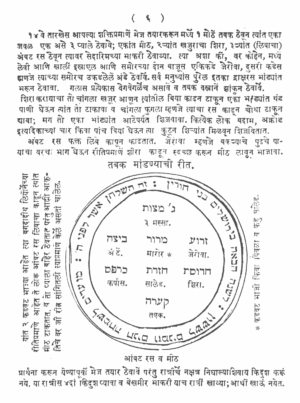
One of the most remarkable aspects of the Jewish communities of India is the distinct languages they developed over centuries of living within Indian society. Each major Indian Jewish community created its own Jewish dialect — a language that combined Hebrew, Aramaic, and biblical vocabulary with the grammar and vocabulary of the surrounding Indian tongue. These languages are living evidence of how deeply the Indian Jewish communities were integrated into their local environments while maintaining their distinct Jewish identity.
Judeo-Marathi: The Language of the Bene Israel
The Bene Israel of Maharashtra developed Judeo-Marathi, a dialect of Marathi written in Hebrew characters and laced with Hebrew and Aramaic words for religious concepts, prayers, and communal life. Judeo-Marathi was the language of the home, the synagogue, and the community. Prayer books, including the famous 1890 Haggadah printed in Bombay, were published in Judeo-Marathi so that community members who could not read Hebrew directly could follow the Passover Seder in their own language. Judeo-Marathi declined through the 20th century as the community shifted to standard Marathi and then to English, but scholars continue to document and study surviving texts.
Judeo-Malayalam: The Language of the Cochin Jews
The Cochin Jewish community developed Judeo-Malayalam, a form of the Malayalam language of Kerala enriched with Hebrew vocabulary. Judeo-Malayalam served as the everyday language of the Cochin Jewish community for centuries, coexisting with their liturgical Hebrew. Songs, poetry, and oral traditions were composed and transmitted in Judeo-Malayalam. The community’s distinctive song tradition — the Cochin Jewish piyyutim — blends Hebrew religious poetry with Malayalam linguistic patterns, creating a musical form found nowhere else in the Jewish world.
Judeo-Arabic: The Language of the Baghdadi Jews
The Baghdadi Jews brought Judeo-Arabic with them from Iraq, Syria, and other parts of the Arab world. In Calcutta and Bombay, Judeo-Arabic served as the community’s internal language in the early generations. Over time, as the Baghdadi Jews became more integrated into British colonial society, English became the primary language of the community, while Hebrew remained the language of prayer. Some community members also learned Hindustani and Bengali to conduct business with local merchants.
Hebrew Across All Communities
Despite their different everyday languages, all Indian Jewish communities maintained a connection to Hebrew as the sacred language of the Torah and prayer. Each community had its own Hebrew pronunciation, influenced by its particular linguistic background — so Bene Israel Hebrew sounds different from Cochin Hebrew, which sounds different from Baghdadi Hebrew. These variations in pronunciation are themselves historical records, preserving features of ancient Hebrew speech that have been lost in other Jewish communities.
Language Loss and Revival
The mass emigration of Indian Jews to Israel during the 20th century accelerated the decline of these distinctive Jewish languages. In Israel, communities were encouraged to adopt Modern Hebrew as their everyday language, and the Indian Jewish dialects rapidly became languages of the elderly. Linguists and community activists have worked to document Judeo-Marathi, Judeo-Malayalam, and related dialects before their last fluent speakers pass away. Their survival in texts, recordings, and scholarly studies ensures that this remarkable linguistic heritage is not entirely lost.
For more about the history of Indian Jewish communities, explore the Articles section of this website.