
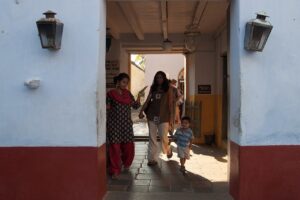
The Kadavumbhagam synagogue in Ernakulam (Kochi) was the principal place of worship for the Malabari (Black) Jewish community of Cochin — the older, indigenous Jewish community of Kerala that had lived on the Malabar Coast for over a millennium before the arrival of the Paradesi (foreign-origin) Jews in the 16th century. While the Paradesi Synagogue in Mattancherry has received most of the international attention as a heritage site, the Kadavumbhagam synagogue represents the deeper, older layer of Cochin Jewish history.
Malabari vs. Paradesi: Two Communities, One Town
The Cochin Jewish community was historically divided into two distinct groups: the Malabari Jews (also called Black Jews) and the Paradesi Jews (also called White Jews). The Malabari Jews were the older community, descendants of Jews who had arrived in Kerala in the first centuries of the Common Era and had integrated into Kerala society over many generations. The Paradesi Jews were later arrivals, descendants of Jews who had fled persecution in Spain, Portugal, and the Middle East and arrived in Cochin from the 16th century onward. Despite their shared religion, the two groups maintained separate synagogues and did not traditionally intermarry, a division that reflected both caste dynamics in Indian society and the social hierarchies of the Sephardic Jewish world.
The Kadavumbhagam Synagogue Building
The Kadavumbhagam synagogue in Ernakulam was built in the traditional Kerala Jewish style, with a central bimah (reading platform), a women’s gallery on the upper level, and an ornate Torah ark facing Jerusalem to the west. The interior featured hanging oil lamps, wooden benches, and decorative elements that blended Jewish and Kerala artistic traditions. The name “Kadavumbhagam” refers to the neighborhood where the synagogue was located — a Malabari Jewish quarter that has since been absorbed into the expanding city of Ernakulam.
The Community’s Emigration to Israel
The Malabari Jewish community of Ernakulam began emigrating to Israel in large numbers after the establishment of the State of Israel in 1948. By the 1950s and 1960s, most Malabari Jewish families had left Kerala for Israel, settling in moshavim (cooperative farming villages) in central and southern Israel. The Kadavumbhagam synagogue fell out of regular use as the community departed, and it eventually became a heritage site maintained by the state. Today, the building stands as a museum and tourist attraction, preserved but no longer used for regular worship.
Legacy and Heritage Preservation
The Malabari Jewish heritage of Ernakulam is preserved through multiple channels. The synagogue building has been designated a protected monument. Photographs, manuscripts, and ritual objects from the community are held in Israeli museums and in the Paradesi Synagogue’s collection in Mattancherry. Descendants of the Ernakulam Malabari Jewish community in Israel maintain cultural organizations that document and celebrate their Kerala Jewish heritage. The community’s distinctive piyyutim, costumes, and culinary traditions continue to be practiced and studied by the second and third generations born in Israel.
For more on the Cochin Jewish community, see the Cochin Jews section of this website.