
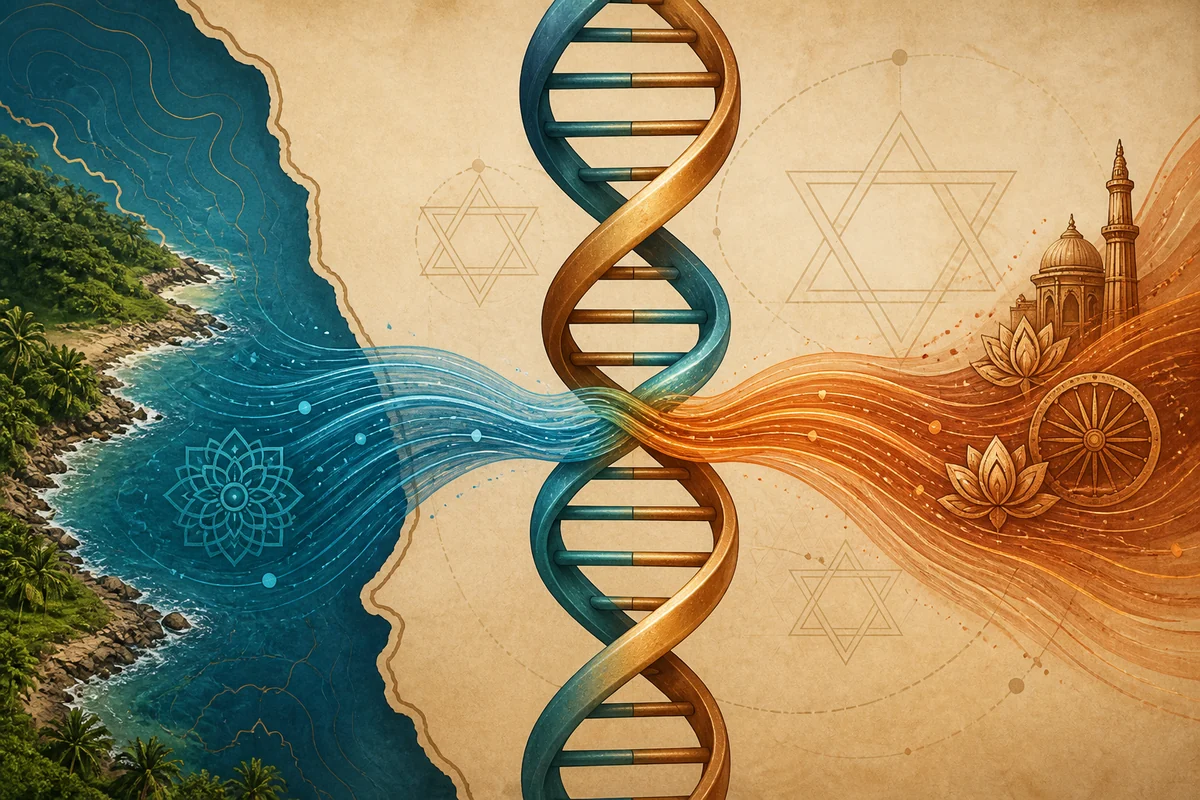
Featured image: original scientific editorial illustration created for JewsOfIndia.com, 2026.
The Bene Israel — the “Sons of Israel” — are the oldest and largest Jewish community in India, with a history on the subcontinent stretching back at least two thousand years and possibly much longer. Their story, captured in the topic of “Bene Israel genetically descended from Jews, scientific study finds,” is one of remarkable perseverance and cultural creativity: a Jewish community that maintained its identity across centuries of geographic isolation, developing a way of life that was simultaneously deeply Jewish and thoroughly Indian.
The Question of Origins
The question of the Bene Israel’s origins has fascinated scholars and community members for generations. The community’s own tradition holds that their ancestors arrived on the Konkan coast of Maharashtra following a shipwreck, part of a larger group of Jews fleeing persecution in ancient Israel. Cut off from contact with other Jewish communities for many centuries, they maintained their Jewish identity while adopting many aspects of the surrounding Maharashtrian culture — speaking Marathi, following local customs in dress and food, and working primarily as oil pressers, earning them the name “Shanwar Telis” (Saturday oil pressers) from their neighbors who noticed they did not work on the seventh day.
Modern genetic research has provided remarkable evidence in support of the community’s ancient Jewish origins. Studies examining the DNA of Bene Israel individuals have found evidence of substantial Middle Eastern ancestry consistent with an origin in the ancient Jewish communities of the Levant. The genetic signature shows a pattern of mixing: a founding population with clear Middle Eastern Jewish characteristics that over the centuries absorbed significant Indian genetic ancestry through intermarriage and conversion. This finding aligns well with the community’s own historical narrative and with the patterns of Indian Jewish history as documented in other sources.
What the Genetics Tell Us
The genetic studies of the Bene Israel community are notable not just for what they reveal about this particular community but for what they demonstrate about the nature of Jewish identity more broadly. The Bene Israel maintained a clearly Jewish religious and cultural identity across many centuries of geographic isolation and genetic admixture with the surrounding Indian population. They continued to observe the Sabbath, to circumcise their male children, to maintain dietary laws (adapted to the Indian environment), to celebrate the Jewish festivals, and to identify themselves as Jews — all without the benefit of continuous contact with wider Jewish world and its institutions.
This demonstrated capacity for maintaining Jewish identity under conditions of isolation and admixture is both historically remarkable and theologically significant. It suggests that Jewish identity is carried not primarily by genetic purity but by commitment to practice, tradition, and communal identification — a conclusion with broad implications for understanding the nature and persistence of Jewish community across the diaspora.
The Bene Israel Today
The contemporary Bene Israel community is primarily located in Israel, where it forms one of the most distinctive components of the diverse Israeli Jewish population. Communities also exist in other countries — the United States, the United Kingdom, Canada, and Australia — where Indian Jewish immigrants have settled in the post-independence period. In India itself, the community has shrunk dramatically, with only a few hundred elderly Bene Israel remaining in Mumbai and a handful of other locations.
The future of the Bene Israel community depends on its ability to transmit its heritage to younger generations growing up far from the maharashtrian villages and Mumbai neighborhoods where that heritage was formed. Community organizations, scholars, and committed individuals are working on this transmission through every available means: publications, cultural events, educational programs, oral history projects, and the use of digital media. The story of the Bene Israel — two thousand years of Jewish life on the Indian subcontinent — deserves to be known, celebrated, and preserved for future generations.
Preserving Indian Jewish Heritage for Future Generations
The task of preserving Indian Jewish heritage is one of the most urgent cultural projects in the contemporary Jewish world. As the communities that created this heritage continue to shrink through emigration and natural attrition, the window for capturing living memories, traditional practices, and community knowledge is narrowing rapidly. Every year, elderly community members pass away, taking with them irreplaceable firsthand knowledge of how Jewish life was actually lived in the Bene Israel villages of Maharashtra, the Jewish neighborhoods of Cochin, or the commercial districts of Calcutta and Bombay where Baghdadi Jewish families built their businesses and synagogues.
The response of scholars, community organizations, and cultural institutions to this challenge has been energetic and multifaceted. Oral history projects have recorded interviews with elderly community members in India, Israel, and the diaspora. Digital archives have made historical photographs, documents, and recordings accessible to researchers and community members around the world. Museum exhibitions have introduced Indian Jewish heritage to audiences who might otherwise never encounter it. And writers, artists, and filmmakers from within and outside the community have created new works that carry Indian Jewish stories and traditions into the contemporary cultural conversation.
The Place of Indian Jews in the Larger Jewish Story
The history of India’s Jewish communities occupies a distinctive and important place in the broader story of the Jewish diaspora. Unlike the often traumatic histories of Jewish communities in Europe and the Middle East — marked by persecution, pogroms, forced conversions, and the Holocaust — the Indian Jewish story is predominantly one of peaceful coexistence, communal autonomy, and cultural creativity within a tolerant host society. This positive experience does not diminish or contradict the difficult experiences of other Jewish communities; it demonstrates that the relationship between Jews and their host societies is shaped by specific historical circumstances rather than by any inevitable dynamic of conflict.
The Indian Jewish communities offer evidence that Jewish identity can be maintained across many centuries of geographic isolation and cultural interchange without requiring either segregation from the surrounding society or assimilation into it. The Bene Israel maintained their Jewish identity across what may be two thousand years of life in Maharashtra while becoming genuinely Indian in language, culture, and social orientation. The Cochin Jews built a thriving community under the protection of local Hindu rulers while maintaining Hebrew literacy and connections to the broader Jewish world. The Baghdadi Jews created cosmopolitan communities in Calcutta and Bombay that participated fully in both the British imperial system and the commercial networks of the Indian Ocean world while maintaining the religious traditions of the ancient Jewish communities of Iraq.