
In 2013, the Bene Israel Heritage Museum and Genealogical Research Centre in India published Bombay: Exploring the Jewish Urban Heritage, a study by the geographer Sha’ul Sapir documenting the physical, architectural legacy that more than two centuries of Jewish settlement left on the city now known as Mumbai. Where most scholarship on the Bene Israel and Baghdadi Jewish communities of Bombay focuses on social history, religious practice, or demographic change, Sapir’s book takes urban geography and architecture as its primary lens, mapping how Jewish communal life shaped, and was shaped by, the physical fabric of India’s largest city.
A Geographer’s Approach to Jewish History
Sapir’s academic training as a geographer gives the book a distinctive method: rather than organizing the material chronologically around political events or religious developments, as most histories of the Bene Israel do, Sapir maps Jewish Bombay spatially, tracing how successive waves of settlement – the Bene Israel arriving from Konkan villages from the late eighteenth century onward, and Baghdadi Jewish merchants arriving from Iraq and elsewhere in West Asia somewhat later – produced distinct, identifiable Jewish neighborhoods, synagogue clusters, and institutional centers across the growing colonial city. This spatial approach allows the book to address questions that a purely social or religious history might not emphasize: where, specifically, within Bombay’s rapidly expanding urban geography did Jewish communities settle, why did they settle where they did, and how did the physical proximity or distance between Bene Israel and Baghdadi neighborhoods reflect or reinforce the social distinctions between the two communities.
Synagogues as Anchors of Jewish Neighborhoods
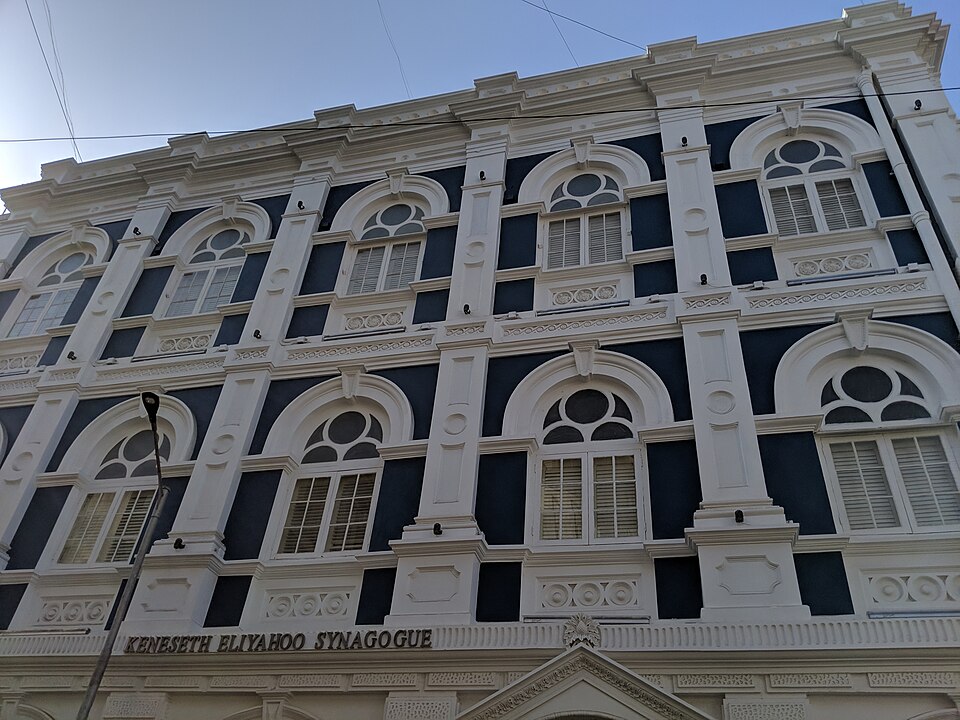
Central to Sapir’s urban-geographic account are the synagogues that anchored Bombay’s various Jewish neighborhoods, each functioning simultaneously as a religious institution and as a landmark around which residential and commercial Jewish life clustered. The Baghdadi Jewish community built some of the grandest synagogues in the city, including the Knesset Eliyahoo Synagogue in the Fort area, an ornate structure reflecting the considerable wealth of Bombay’s Baghdadi merchant elite, and the Magen David Synagogue in Byculla, among the largest synagogues built by any Jewish community in Asia. The Bene Israel, meanwhile, established a much larger number of smaller synagogues across the city as their population grew through the nineteenth and twentieth centuries, reflecting both their considerably larger total numbers in Bombay compared to the Baghdadi community and their more dispersed pattern of settlement across multiple neighborhoods rather than concentration in one or two wealthy enclaves.
Mapping these synagogues geographically, as Sapir’s book does, reveals patterns not always visible in a purely institutional or biographical history: which neighborhoods supported enough of a Jewish population to sustain a synagogue at all, how synagogue locations shifted as the city’s Jewish population grew and then, in the later twentieth century, contracted through emigration, and how the relative wealth and social position of the Baghdadi and Bene Israel communities translated into visibly different scales and styles of religious architecture within the same city.
Occupational Geography and Urban Change
Beyond synagogues, Sapir’s urban-geographic approach extends to the occupational and economic geography of Bombay’s Jewish communities. Bene Israel families, many originally oil pressers by trade, moved increasingly into the British colonial civil service, the military, and eventually the professions and the Indian film industry as English-language education spread through the community across the nineteenth and twentieth centuries – a shift in occupation that also reshaped where Bene Israel families could afford to live within the city, and how that residential pattern changed across generations. Baghdadi Jewish merchant families, whose wealth derived substantially from trade in cotton, textiles, and other commodities, occupied a different economic and residential position within the city almost from the community’s earliest arrival, reflected in the different urban locations their synagogues and residences occupied compared to the Bene Israel’s more dispersed settlement pattern.
A Complement to Institutional and Social Histories
Sapir’s book fills a gap that the more conventional social and institutional histories of Bombay’s Jewish communities do not fully address: an explicitly spatial account of how Jewish communal life was distributed across, and shaped, the physical geography of one of colonial and postcolonial India’s most important cities. Read alongside Dalia Ray’s broader, all-India heritage survey, or the more narrowly institutional histories of specific Bombay synagogues, Sapir’s geographic framework adds a dimension that neither of those approaches emphasizes as centrally: the question of where, precisely, within a large and rapidly changing colonial and postcolonial city, Jewish communal life took physical shape, and how that physical geography both reflected and reinforced the social and economic distinctions between Bombay’s Bene Israel and Baghdadi Jewish populations.
For researchers and heritage tourists alike, this geographic framing offers a practical benefit beyond its scholarly contribution: a reader equipped with Sapir’s mapping of Jewish Bombay can navigate the city’s surviving synagogues and former Jewish neighborhoods with a clearer sense of how they related to one another historically, rather than encountering each site in isolation as an individual heritage landmark disconnected from the broader urban pattern that originally produced it.
Photography as Documentary Method
Given the book’s subject-tag classification as a work of pictorial documentation as well as history, Sapir’s study likely relies substantially on photography to make its geographic and architectural arguments, a method well suited to a subject centered on physical urban space and building form rather than purely textual or archival evidence. Photographic documentation of this kind serves a dual purpose common to heritage-focused scholarship on India’s Jewish communities: it provides visual evidence for the book’s own analytical arguments about urban geography and architectural style, while simultaneously creating an independent visual record of buildings and neighborhoods that, as Bombay’s Jewish population has continued to shrink through emigration, face an uncertain long-term future absent active preservation efforts. This dual function – argument and archive at once – is characteristic of the broader genre of heritage-documentation scholarship on Indian Jewish communities that has emerged since the 1990s and 2000s, alongside more conventional academic history.
Publishing Through a Community Institution
Sapir’s book was published not by a university press or major commercial publisher but by the Bene Israel Heritage Museum and Genealogical Research Centre in India, an institution dedicated specifically to preserving and documenting Bene Israel history and genealogy. This publishing context matters: it situates Sapir’s urban-geographic study within a body of scholarship produced in close collaboration with, or directly by, community heritage institutions rather than through the more conventional channel of international academic publishing. Such community-institution publishing has become an increasingly important channel for documenting Indian Jewish heritage precisely because it can move more quickly and with more direct community involvement than academic publishing houses, even if it sometimes reaches a narrower international readership than books issued by better-known university presses.
Mapping Decline as Well as Growth
An urban-geographic approach to Jewish Bombay necessarily has to account not only for the expansion of Jewish neighborhoods and institutions through the nineteenth and early twentieth centuries but also for their contraction in the decades following Indian independence and the establishment of Israel, as mass emigration reduced Bombay’s Jewish population to a small fraction of its historical size. Sapir’s geographic method is well suited to tracking this contraction concretely: which synagogues closed or lost their resident congregations, which neighborhoods that once supported a visible Jewish communal presence no longer do, and how the city’s remaining active synagogues and Jewish institutions have had to adapt – through reduced congregational size, changed function, or increased reliance on heritage tourism and diaspora philanthropy – to a dramatically smaller resident Jewish population than the one that originally built them.
This attention to decline as well as growth distinguishes serious urban-heritage scholarship from simple nostalgia. Rather than presenting Jewish Bombay only as a picturesque historical backdrop, Sapir’s approach – consistent with the broader aims of the Bene Israel Heritage Museum that published the book – treats the geography of decline itself as historically significant: understanding exactly how and where a community’s urban footprint contracts can reveal as much about the mechanics of emigration, communal adaptation, and institutional survival as the story of the community’s original growth and settlement does. A synagogue that closes its doors, or a neighborhood that gradually loses its identifiably Jewish businesses and residents, marks a historical transition worth documenting with the same geographic precision as the original process of settlement.
Read in full, Sapir’s book therefore offers a genuinely distinctive contribution to the literature on Bombay’s Jewish communities: not a replacement for the social, religious, and institutional histories already available, but a geographic layer that connects those histories directly to the physical city a visitor or researcher can still walk through today, synagogue by synagogue and neighborhood by neighborhood.
For that reason, it belongs on the same shelf as the more conventional histories of the Bene Israel and Baghdadi Jews of Bombay, not as a substitute for them but as the map that shows where their story actually took place on the ground.