
In 1990, Dutton published Flowers in the Blood, a historical novel by the American writer Gay Courter set within Calcutta’s Baghdadi Jewish community during the colonial era. The book followed Courter’s earlier historical novel The Midwife (1981) and the thriller Code Ezra (1986), continuing a career built substantially on meticulously researched historical fiction set in richly specific, often little-known communities and settings.
An Author Drawn to Overlooked Historical Communities
Courter’s path to fiction writing ran through documentary filmmaking rather than a conventional literary career. Born in Pittsburgh in 1944 and educated in drama and film at Antioch College, she worked through the late 1960s in documentary and educational film production in New York before turning to published fiction with her 1981 novel The Midwife. This documentary background helps explain the density of historical and cultural detail that has become a hallmark of her fiction: like a documentary filmmaker researching a subject before shooting, Courter has approached each of her historical novels – whether set among European midwives, in wartime intelligence operations, or within a diaspora Jewish merchant community in colonial India – with the kind of sustained research typically associated with narrative nonfiction rather than commercial popular fiction.
Calcutta’s Baghdadi Jewish World as Historical Setting
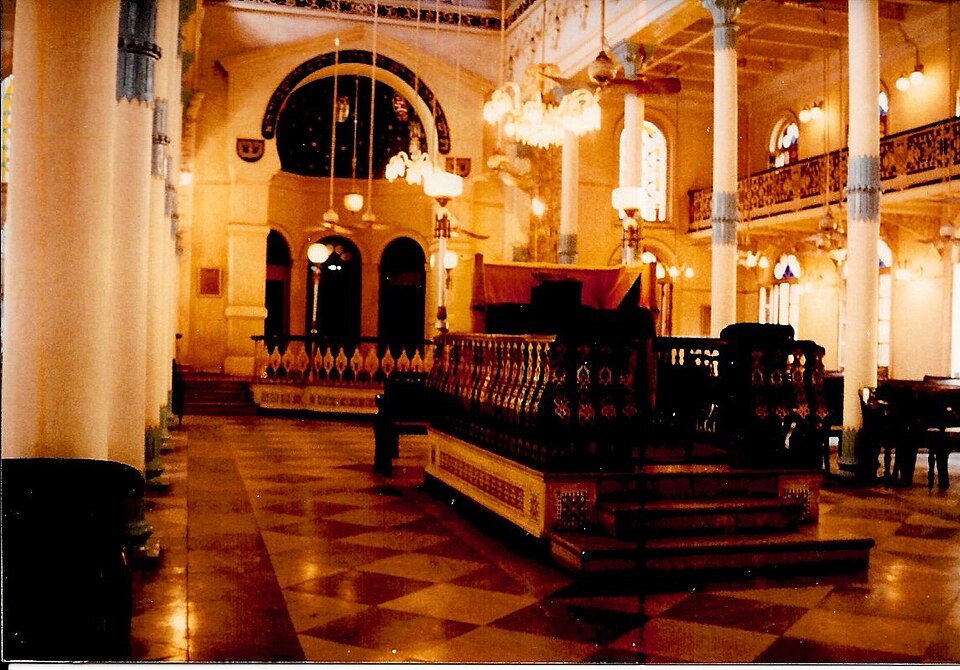
Flowers in the Blood is set within the same Baghdadi Jewish merchant community of Calcutta documented in more conventional historical terms by Flower Elias and Judith Cooper’s community-authored history and, from a more intimate family-memoir angle, by Jael Silliman’s Jewish Portraits, Indian Frames. That community traced its Calcutta origins to 1798, when the Aleppo-born merchant Shalom Obadiah Cohen arrived in the city, and grew over the following century and a half into a wealthy trading diaspora built by families such as Sassoon, Ezra, Elias, Gubbay, Belilios, and Judah, whose fortunes derived from trade in cotton, jute, spices, and opium across a network stretching from Baghdad to Shanghai. At its wartime peak during the Second World War, the community numbered over 6,000, before rapid post-1947 emigration reduced it to a small remnant of descendants scattered mainly across Australia, Canada, Britain, Israel, and the United States.
Setting a multi-generational historical novel within this specific milieu allowed Courter to dramatize, through invented but historically grounded characters, exactly the kind of domestic, marital, and generational tensions that more conventional historical and ethnographic sources – trade records, synagogue registers, communal correspondence – document only in aggregate or institutional terms. A novel can render the lived texture of arranged marriages, generational conflict over religious observance, and the tension between a wealthy merchant community’s public respectability and its private struggles in a way that complements, without replacing, the documentary and oral-history approaches taken by more conventional historical accounts of the same community.
Part of a Broader Body of Indian Jewish Fiction
Courter’s novel takes its place alongside a small but distinctive shelf of published fiction addressing India’s Jewish communities from different angles and different authorial vantage points. Sophie Judah’s Dropped from Heaven (2007) turned to the Bene Israel of small-town Maharashtra through linked short stories; Esther David’s novels and memoir drew on her own Bene Israel and Gujarati Jewish background; Meera Mahadevan’s Shula offered an earlier generational perspective on Indian Jewish life. Courter’s contribution is distinctive within this group in one important respect: unlike Judah, David, or Mahadevan, she is not herself a member of any Indian Jewish community, approaching the Calcutta Baghdadi Jewish world instead as a historical novelist working from documentary research rather than personal or family memory – a position closer to that of an outside historian than an insider memoirist, even though her chosen medium is fiction rather than academic history.
Fiction’s Distinctive Contribution to This History
This outsider’s-research approach gives Flowers in the Blood a role somewhat different from the insider fiction and memoir also covered in this collection. Where Silliman’s family history draws its authority from direct descent and personal testimony, and Judah’s stories draw on her own Bene Israel background, Courter’s novel draws its authority from the same kind of documentary research a historian would undertake – archival records, published histories, and the broader secondary literature on Calcutta’s Baghdadi Jewish community – filtered through the narrative techniques of commercial historical fiction aimed at a general international readership rather than a specialist or community audience.
That broader readership matters for how a novel like Flowers in the Blood functions within the wider literature on Indian Jewish history: published by a major American commercial house and reaching an international readership well beyond specialists in Jewish or South Asian studies, the novel likely introduced far more general readers to the existence of Calcutta’s Baghdadi Jewish community than any of the more academic or community-specific histories covered elsewhere in this collection managed to reach on their own. Historical fiction of this kind, whatever its limitations as a documentary source, often performs exactly this function of expanding public awareness of an obscure historical community well beyond the readership that specialist scholarship alone could ever achieve.
Historical Fiction as a Gateway, Not a Substitute
Because Flowers in the Blood is a work of invented narrative rather than documented history, readers encountering Calcutta’s Baghdadi Jewish community for the first time through Courter’s novel should approach its specific plot events and characters as fictional constructions built around a genuine historical setting, rather than as documented biographical fact. This distinction matters more for historical fiction set within a real, still-living community’s history than it might for fiction set in a more distant or thoroughly documented historical period, since readers unfamiliar with Calcutta’s actual Baghdadi Jewish history have less independent basis for distinguishing the novel’s invented elements from its historically grounded background details.
Read responsibly, though, a well-researched historical novel like Courter’s can function as an effective gateway into further reading rather than a substitute for it – introducing readers to the existence and general contours of a real historical community’s experience, and ideally prompting some of those readers to seek out the more rigorously documented histories, such as Elias and Cooper’s community-authored account or Silliman’s family memoir, that can confirm which elements of the novel’s setting reflect genuine historical circumstance and which represent the novelist’s own invention in service of dramatic storytelling.
A Career Marked by Meticulous Setting Research
Courter’s broader bibliography reinforces this pattern of pairing invented narrative with carefully researched historical settings. Her subsequent novels, including Healing Paradise (2013) and The Girl in the Box (2019), along with her earlier work on European midwifery in The Midwife and its sequel The Midwife’s Advice, each pair fictional protagonists and plots with settings researched in a level of documentary detail unusual for commercial historical fiction. This consistent authorial method across a decades-long career suggests that Flowers in the Blood’s engagement with Calcutta’s Baghdadi Jewish history was not an isolated exercise but part of a broader, sustained creative practice built around bringing under-documented historical communities and settings to a wide popular readership through the medium of carefully researched fiction.
For readers of this collection who have already encountered Calcutta’s Baghdadi Jewish history through Elias and Cooper’s institutional account or Silliman’s family memoir, Courter’s novel offers a third and quite different vantage point on the same underlying community: not the insider’s documentary record, and not the insider’s personal family testimony, but an outside novelist’s carefully researched dramatization, aimed at introducing this history to readers who might never otherwise encounter it at all.
Taken together, the three approaches – institutional history, family memoir, and researched fiction – illustrate how a single historical community can be documented and transmitted through genuinely different methods, each with its own strengths and limitations, and each reaching a different slice of the potential readership interested in Calcutta’s now largely dispersed Baghdadi Jewish community.
None of these three approaches alone gives a complete picture, but together they demonstrate how a small, geographically dispersed diaspora community’s history can survive and reach new audiences well beyond its own shrinking membership, through institutional scholarship, personal memory, and imaginative literature all working, in their different ways, toward the same underlying goal of keeping Calcutta’s Baghdadi Jewish story from disappearing from public memory entirely.
For that reason, Flowers in the Blood belongs on the same shelf as the more conventionally documentary works covered elsewhere in this collection, not as their equal in historical authority, but as a complementary and considerably more widely read entry point into a history that deserves exactly this kind of multiple, overlapping documentation across different literary forms.