
Published by Lexington Books in January 2007, anthropologist Ruth Fredman Cernea’s Almost Englishmen: Baghdadi Jews in British Burma traces a lesser-known extension of the Baghdadi Jewish diaspora that originated in Bombay and Calcutta and continued eastward into British-ruled Burma, now Myanmar. At 202 pages, the book examines how a community of merchants who had already reinvented themselves once, moving from Baghdad and Aleppo to colonial India, undertook a second act of migration and cultural adaptation as they established themselves in Rangoon and Mandalay during the height of British imperial rule in Southeast Asia.
A Community Built on Trade Routes, Not Just Trade
The Jewish presence in Burma dates back further than most people realize, with local tradition pointing to a Jewish commander named Solomon Gabirol serving in the army of King Alaungpaya in the eighteenth century. The community as most historians understand it, however, took shape in the mid-nineteenth century, when Baghdadi Jewish merchants from Iraq, alongside Cochin Jews and Bene Israel from India, began establishing sizable, organized communities in Rangoon and Mandalay under British colonial administration. At its height around 1940, the Jewish community of Burma numbered approximately 2,500 people, a population large enough to sustain synagogues, schools, and a full range of communal institutions.
Cernea’s title, Almost Englishmen, captures a central theme of her research: the peculiar cultural position occupied by Baghdadi Jewish merchants who, having already adapted to British colonial norms in Bombay and Calcutta, found themselves navigating an even more explicitly Anglicized colonial society in Burma, where the community’s economic success and cultural assimilation brought them into close, sometimes ambiguous, proximity to the British colonial elite — close enough to absorb many of its manners and aspirations, yet never fully accepted as equals within it.
The Musmeah Yeshua Synagogue and a Vanishing Community
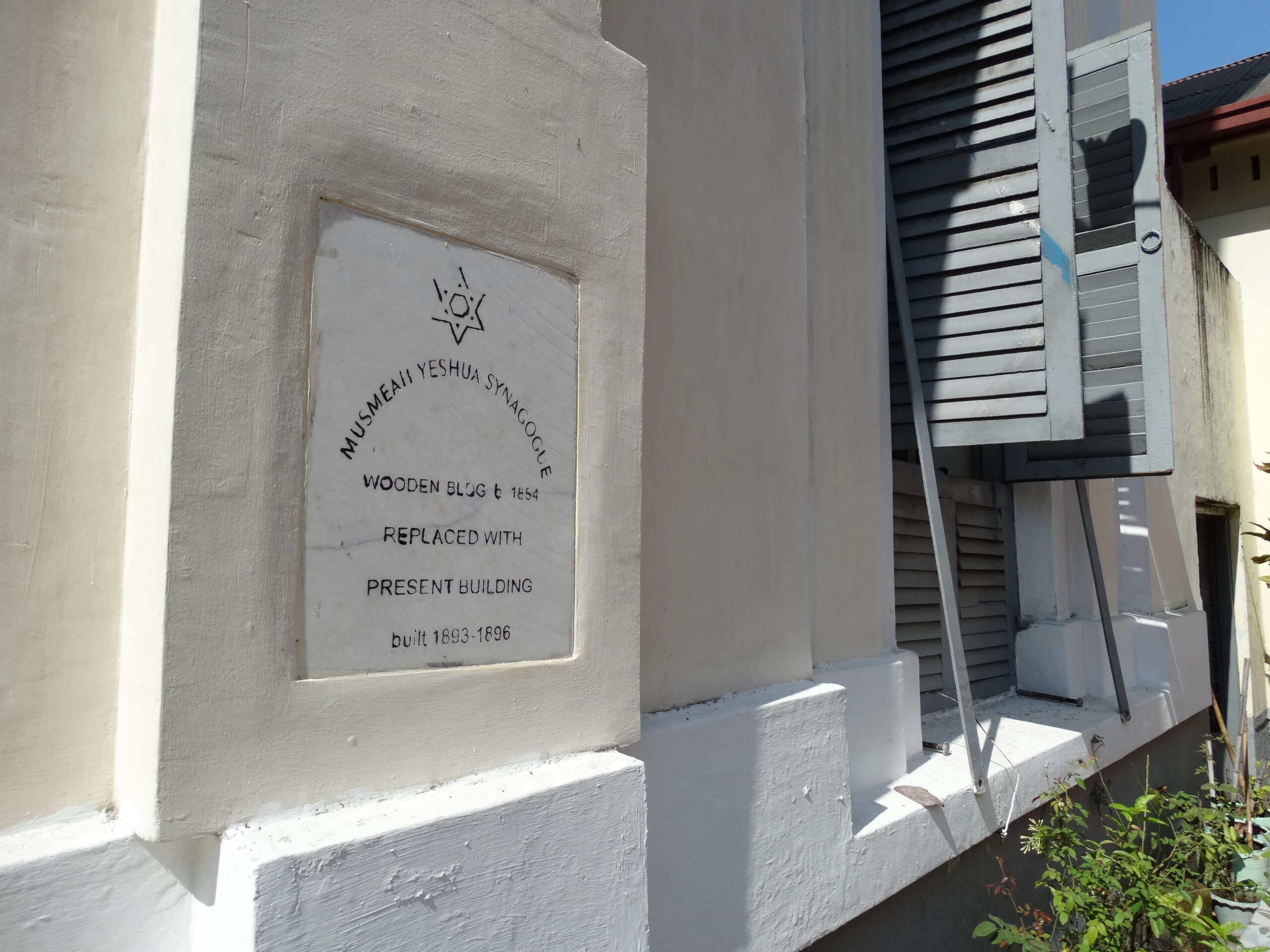
Just as Bombay’s Baghdadi Jewish community built the Knesset Eliyahoo and Magen David synagogues, and Calcutta’s community constructed the Maghen David and Beth El synagogues, Rangoon’s Jewish community built its own architectural landmark: the Musmeah Yeshua Synagogue, completed in the late nineteenth century and still standing today in downtown Yangon. The synagogue’s survival is itself a remarkable historical footnote, having endured Japanese occupation during the Second World War, the mass exodus of the Jewish community following Burmese independence and subsequent nationalist and military governments, and decades of near-total absence of a resident Jewish population to maintain it.
Cernea’s research documents how the Baghdadi Jewish community’s departure from Burma unfolded in overlapping waves: first, pressure and disruption caused by the Japanese occupation during the Second World War, and later, the political and economic uncertainty that followed Burmese independence and the country’s turn toward isolationist nationalist policies. Unlike the Bombay and Calcutta Baghdadi Jewish communities, which persisted in reduced form for decades after Indian independence, Burma’s Jewish community shrank far more rapidly and drastically, leaving behind one of the most dramatic examples of Baghdadi Jewish demographic collapse anywhere in the diaspora network that once stretched from Iraq through India to Southeast Asia and China.
An Anthropologist’s Lens on Colonial Identity
As an anthropologist rather than a historian, Cernea brought a particular set of analytical tools to her study of Rangoon’s Baghdadi Jewish community, focusing less on chronological narrative and more on questions of identity formation, cultural performance, and the complex, often uncomfortable relationship between a merchant minority community and the British colonial power structure it depended upon for its commercial success and physical security. The “almost Englishmen” of her title were a community caught between worlds: not fully Iraqi or Middle Eastern any longer, not fully British despite considerable cultural assimilation, and only tenuously connected to the broader currents of Burmese national life that would eventually reshape the country after independence.
This analytical framework connects Cernea’s work to a broader body of scholarship examining how minority trading communities across the British Empire — from Parsis in Bombay to Armenians in Calcutta to Baghdadi Jews across multiple port cities — navigated similar tensions between economic integration into colonial commercial networks and social exclusion from the colonial elite’s inner circles. Reading Burma’s Baghdadi Jewish community through this comparative lens allows Cernea’s book to speak to broader questions in colonial and diaspora studies, well beyond the specific history of one small, now largely dispersed Jewish community.
Connecting Burma to the Wider Indian Jewish Story
For readers approaching Indian Jewish history, Cernea’s book on Burma offers an important reminder that the Baghdadi Jewish diaspora network was never confined to India’s borders. Families in Rangoon frequently maintained business and marriage ties with relatives in Bombay and Calcutta, and the community’s religious and cultural practices closely mirrored those of its Indian counterparts, from synagogue architecture to communal governance structures to patterns of philanthropy modeled on the great merchant families of Bombay. Understanding the fate of Rangoon’s Jewish community, and the reasons its collapse proceeded more swiftly and completely than that of its sister communities in India, adds important context to the broader story of how the entire Baghdadi Jewish trading network across Asia unraveled over the course of the twentieth century.
Fieldwork Among a Dwindling Population
Much of the material underpinning Cernea’s book draws on fieldwork and interviews conducted with members of the Baghdadi Jewish community both in Burma itself and among the diaspora of former Rangoon Jewish families who relocated to India, Israel, the United Kingdom, the United States, and Australia. This kind of oral history research, conducted while surviving members of the pre-independence Rangoon Jewish community were still alive to be interviewed, mirrors similar urgent documentation efforts undertaken by researchers studying India’s own Bene Israel, Cochin, and Baghdadi Jewish communities during the same general period. As with those parallel projects, the value of Cernea’s fieldwork lies substantially in its timing: conducted while firsthand memory of a fully functioning, pre-collapse Jewish community in Rangoon was still directly accessible, rather than reconstructed entirely from archival fragments after the fact.
The Musmeah Yeshua Synagogue today survives largely through the dedicated efforts of a small number of caretakers, a situation that echoes the preservation challenges facing historic synagogues across the former Baghdadi Jewish diaspora, including those in Kolkata. A handful of Jewish visitors, descendants of the original community now scattered around the world, occasionally return to Yangon to see the synagogue their families once built and worshipped in, a pattern of heritage tourism increasingly common across the former Baghdadi Jewish trading world as descendants seek connection to ancestral communities that no longer exist as living, continuous entities in their original locations.
A Regional Chapter Often Overlooked
Within the broader literature on Baghdadi Jewish history, Burma often receives far less attention than Bombay, Calcutta, or the later Shanghai and Hong Kong outposts of the same trading network. Cernea’s book fills an important gap by giving this regional chapter of Baghdadi Jewish history the sustained scholarly attention it has generally lacked, using anthropological methods to draw out the specific texture of communal identity and colonial-era social positioning in a location that, while less commercially prominent than Bombay or Shanghai, nonetheless played a meaningful role in the wider network of Baghdadi Jewish migration, trade, and communal life across Asia.
For readers and researchers interested in the fullest possible picture of the Baghdadi Jewish trading diaspora that once linked Baghdad, Bombay, Calcutta, Rangoon, Singapore, Hong Kong, and Shanghai into a single interconnected commercial and religious network, Cernea’s study of the Burma chapter is an essential complement to the more extensively documented histories of the Indian communities. It demonstrates that the story of Baghdadi Jewish migration cannot be fully told by focusing on India alone, and that understanding the network’s eventual twentieth-century unraveling requires attention to its more peripheral, and in Burma’s case more abruptly terminated, outposts as well.