
India’s Jewish Heritage: Ritual, Art and Life Cycle is an edited scholarly volume published by Marg Publications in 2006, put together under the general editorship of Shalva Weil, a British-born, Israel-based social anthropologist who has spent much of her career studying Indian Jewish communities. Rather than a single-author narrative history, the book is a collection of essays by specialists in Jewish art, ritual, and material culture, examining how India’s three historic Jewish communities, the Cochin Jews, the Bene Israel, and the Baghdadi Jews, expressed their religious life through synagogue architecture, ceremonial objects, textiles, manuscripts, and the rites that marked birth, marriage, and death.
An Anthology Built Around Objects and Rites
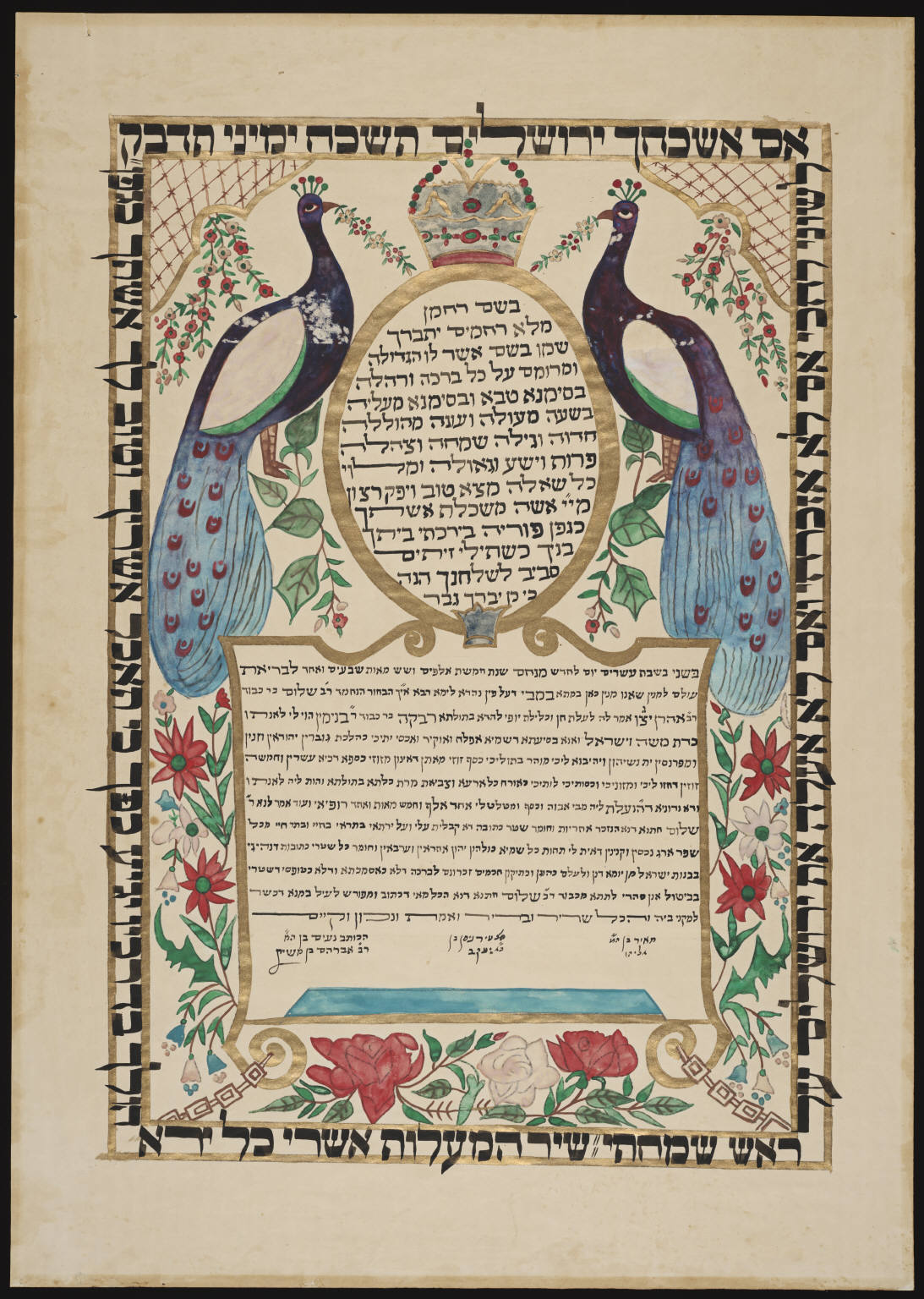
The book’s organizing idea is that Jewish identity in India survived and adapted less through formal theology than through the concrete, repeated practices of ritual life and the physical objects that supported them: the Torah scrolls and their ornamental cases, the illuminated marriage contracts known as ketubot, the silver ceremonial items used at circumcision and at the Sabbath table, and the particular blend of local Indian craftsmanship with imported Jewish religious forms that these objects display. An illustrated ketubah produced in Bombay in 1911, for instance, shows the way Indian Jewish artisans combined standard Hebrew legal formulas with decorative styles drawn from the surrounding visual culture of colonial-era Bombay, producing objects that were fully Jewish in function and fully Indian in artistic idiom at the same time.
Essays in the volume cover the architectural history of synagogues such as the Paradesi Synagogue in Cochin and the Bene Israel synagogues of Bombay, tracing how buildings originally modeled on regional templates were adapted over generations to serve Jewish liturgical needs. Other contributions examine the life-cycle rites, birth ceremonies, bar mitzvah customs, wedding rituals, and mourning practices, that gave shape to community identity, showing how Indian Jewish communities preserved core Jewish legal requirements while absorbing local customs around food, dress, and social organization from their Hindu, Muslim, and Christian neighbors.
Shalva Weil’s Long Engagement with Indian Jewry
Weil’s own scholarly path runs directly through this material. Born in London, she studied sociology at the London School of Economics before completing a doctorate in social anthropology at Sussex University under A. L. Epstein, with a dissertation titled “The Persistence of Ethnicity and Ethnic Identity among the Bene Israel Indian Jews in Israel,” based on three years of fieldwork among Bene Israel families in the Israeli town of Lod. That early immersion in Bene Israel communal life, straddling both India and Israel, gave Weil a rare vantage point on how ritual practice and material culture travel with a migrating community and change, or persist, in a new setting.
Weil went on to a long academic career at the Hebrew University of Jerusalem, eventually becoming a Senior Researcher at the Seymour Fox School of Education, alongside a Life Membership at Clare Hall, University of Cambridge, and, in 2017, a distinguished visiting professorship at Jawaharlal Nehru University in New Delhi. Over the course of her career she has published more than 250 academic papers and become recognized internationally as an expert on Indian Jews, Ethiopian Jews, and the Ten Lost Tribes, among other subjects. In 2023 she was elected a Fellow of the Royal Historical Society, and in 2025 she received the Yakir Yerushalayim prize in recognition of more than five decades of contribution to Jewish scholarship and education centered on Jerusalem.
Why an Object-Centered Approach Matters
Much of the existing literature on India’s Jewish communities approaches the subject through migration history, demography, or personal memoir. India’s Jewish Heritage: Ritual, Art and Life Cycle takes a different route, treating physical objects and enacted rituals as primary evidence in their own right, on the premise that a wedding contract, a synagogue’s floor plan, or the embroidery on a prayer shawl can reveal as much about a community’s identity and adaptation as a demographic table or an oral history interview. This approach aligns the book with a broader trend in the study of diaspora Jewish communities worldwide, in which material culture and ritual practice are treated as active sites where identity is negotiated, rather than as passive illustrations of a history told elsewhere.
For India’s three Jewish communities specifically, all of them small, all of them substantially emigrated to Israel by the late twentieth century, and all of them at risk of having their distinctive material culture scattered or lost, a volume dedicated to documenting synagogue architecture, ceremonial objects, and life-cycle ritual carries an additional urgency. Many of the physical items discussed in the book, ketubot, Torah ornaments, synagogue textiles, exist today only in private collections, museum holdings, or the pages of scholarship like Weil’s edited volume, making the book a work of preservation as much as of interpretation.
Placing the Book in the Marg Publications Tradition
Marg Publications, the Mumbai-based publisher of art and cultural history that produced the volume, has a long history of documenting India’s diverse religious and artistic traditions through richly illustrated, scholarly anthologies, and India’s Jewish Heritage sits within that broader publishing project of recording India’s minority religious communities through their material and visual culture. For readers seeking to understand the Cochin, Bene Israel, and Baghdadi Jewish communities not only through their history of migration and demographic change but through the tangible objects and lived rituals that carried Jewish practice through centuries in India, Weil’s edited collection remains one of the most focused and richly documented resources available.
Three Communities, Three Visual Traditions
Part of what makes an object-and-ritual-centered study of India’s Jews so rewarding is the sheer visual diversity across the three communities, despite their shared religion. The Cochin Jews, whose presence in Kerala stretches back roughly two millennia and who absorbed centuries of exposure to South Indian temple architecture, Portuguese and Dutch colonial styles, and Malayali textile and woodworking traditions, produced synagogue interiors and ceremonial objects with a distinctly South Indian character, visible for instance in the hand-painted Chinese willow-pattern floor tiles and brass ceremonial lamps of Cochin’s Paradesi Synagogue. The Bene Israel, concentrated first along the Konkan coast and later in Bombay, developed their own visual and ritual conventions shaped by Marathi regional culture, while the Baghdadi Jews, arriving later from Iraq and other parts of the Middle East by way of established Sephardic trading networks, brought a more explicitly Middle Eastern aesthetic to the synagogues they built in Calcutta and Bombay. A volume that gathers essays on all three communities side by side allows readers to see this variation directly, rather than encountering each community’s material culture in isolation across separate specialist publications.
Because the book was produced for Marg Publications, known for high production values and extensive photographic documentation, India’s Jewish Heritage: Ritual, Art and Life Cycle also functions as a visual record in its own right, preserving photographs of objects, interiors, and ceremonies that may not survive in their original form as India’s Jewish population continues to shrink through ongoing emigration to Israel. In that sense the book occupies a position somewhere between an academic anthology and an archival record, valuable both to specialists in Jewish studies and South Asian art history and to descendants of these communities seeking a visual connection to a heritage increasingly maintained outside India itself.
Weil’s broader scholarly output, spanning over 250 papers across topics from Bene Israel identity in Israel to Ethiopian Jewish immigration and the sociology of the Ten Lost Tribes idea, reflects a career-long interest in how Jewish communities that developed outside the mainstream European and Middle Eastern centers of Jewish life construct and maintain identity under conditions of geographic isolation and, eventually, mass migration. India’s Jewish Heritage: Ritual, Art and Life Cycle can be read as one expression of that larger interest, applied specifically to the question of how ritual objects and ceremonial practice functioned as vehicles of continuity for India’s Jews across generations of relative isolation from the wider Jewish world, and how that material inheritance is now being documented and preserved even as the communities that produced it grow smaller in India itself.