
Indian heritage and its Jewish influences come together most clearly in Samuel Fyzee-Rahamin, a painter born into a Bene Israel Jewish family in Poona who became, by most accounts, one of the founders of modern Indian painting. His own writing, including a 1947 study titled Indian Painting and Sculpture and an earlier, lesser-known history of his own community, Beni-Israel in India: A History, makes him a rare case of an Indian Jewish artist who wrote directly about both Indian art history and his own community’s place within it.
From Poona to the Royal Academy
Born in 1880 as S. Rahamin Samuel Talkar, Fyzee-Rahamin began his training at the Sir J. J. School of Art in Bombay before winning a scholarship to London’s Royal Academy of Arts, becoming one of the first Indians ever admitted there. He studied under the prominent portrait painters John Singer Sargent and Solomon J. Solomon, absorbing a rigorous Western academic technique that he would then deliberately set aside in favor of a distinctly Indian visual style drawn from Rajasthani painting and Mughal miniature traditions. This deliberate rejection of his own Western academic training in favor of indigenous Indian artistic idioms became the defining gesture of his career and the reason later historians credit him as a founding figure of modern Indian painting. This trajectory, from a Bene Israel family working within Bombay’s ordinary Jewish community structures to the highest levels of European academic art training, mirrors a broader pattern among ambitious Bene Israel families in the late nineteenth and early twentieth centuries, who increasingly sought entry into colonial professional and educational institutions even as most of the community continued to observe traditional religious practice at home. Fyzee-Rahamin’s specific path into elite fine arts training was unusual even within this broader pattern, since very few Bene Israel families of the period pursued careers in painting rather than the more common professional routes into medicine, law, or government service that colonial-era Bene Israel families more typically favored.
Court Painter to Baroda
On returning to India in 1908, Fyzee-Rahamin was appointed court painter to Baroda State, a position he held for a decade while also serving as art advisor to Maharaja Sayajirao Gaekwad III. His portraits of the Baroda royal family, along with paintings of local landmarks including the Swaminarayan Mandir and Sursagar, were exhibited at the 1911 Bombay Exhibition and remain housed today in the Baroda Museum and the Maharaja Fateh Singh Museum. This decade of court patronage gave a Bene Israel Jewish artist direct, sustained access to one of India’s most prestigious princely courts at a formative moment in the development of modern Indian art. The specific choice of subjects for his royal portraits and landmark paintings, focused on Hindu religious architecture and Gujarati courtly life rather than any Jewish or Bombay-specific imagery, reflects the same pattern that would define his entire career: rather than positioning himself as a specialist in depicting his own community, Fyzee-Rahamin worked from the outset as a generalist interpreter of Indian visual heritage broadly defined, willing to take up whatever subject matter a particular commission required, whether Hindu, Islamic, or secular courtly portraiture.
Marriage, Conversion, and a Creative Partnership
In 1912, Fyzee-Rahamin converted to Islam to marry Atiya Begum, a pioneering Muslim intellectual, classical singer, and writer, and the couple adopted each other’s surnames, with Samuel Rahamin Talkar becoming Samuel Fyzee-Rahamin. The couple built an unusually integrated creative partnership, exhibiting together internationally, including a joint show at the Galerie Georges Petit in Paris in 1914, and collaborating directly on Atiya Begum’s influential book on Indian classical music, for which Samuel provided the illustrations. Their partnership, crossing lines of religion, gender expectation, and artistic discipline simultaneously, itself stands as a striking example of the boundary-crossing lives many Indian Jewish artists and intellectuals led within India’s cosmopolitan early twentieth-century cultural elite. Atiya Begum’s own background as a member of a prominent Bombay Muslim family with strong connections to reformist and literary circles meant that their marriage joined two minority religious communities within colonial Bombay’s elite intellectual life, rather than representing a conversion into the city’s Hindu majority. Their combined household became a genuine cultural salon, hosting visiting artists, musicians, and writers from across India and Europe, and their joint international exhibitions consistently paired Samuel’s visual art with Atiya’s musical performances and writing on Indian classical music traditions, producing a genuinely collaborative body of work that neither partner could have produced independently.
The Imperial Secretariat Frescoes
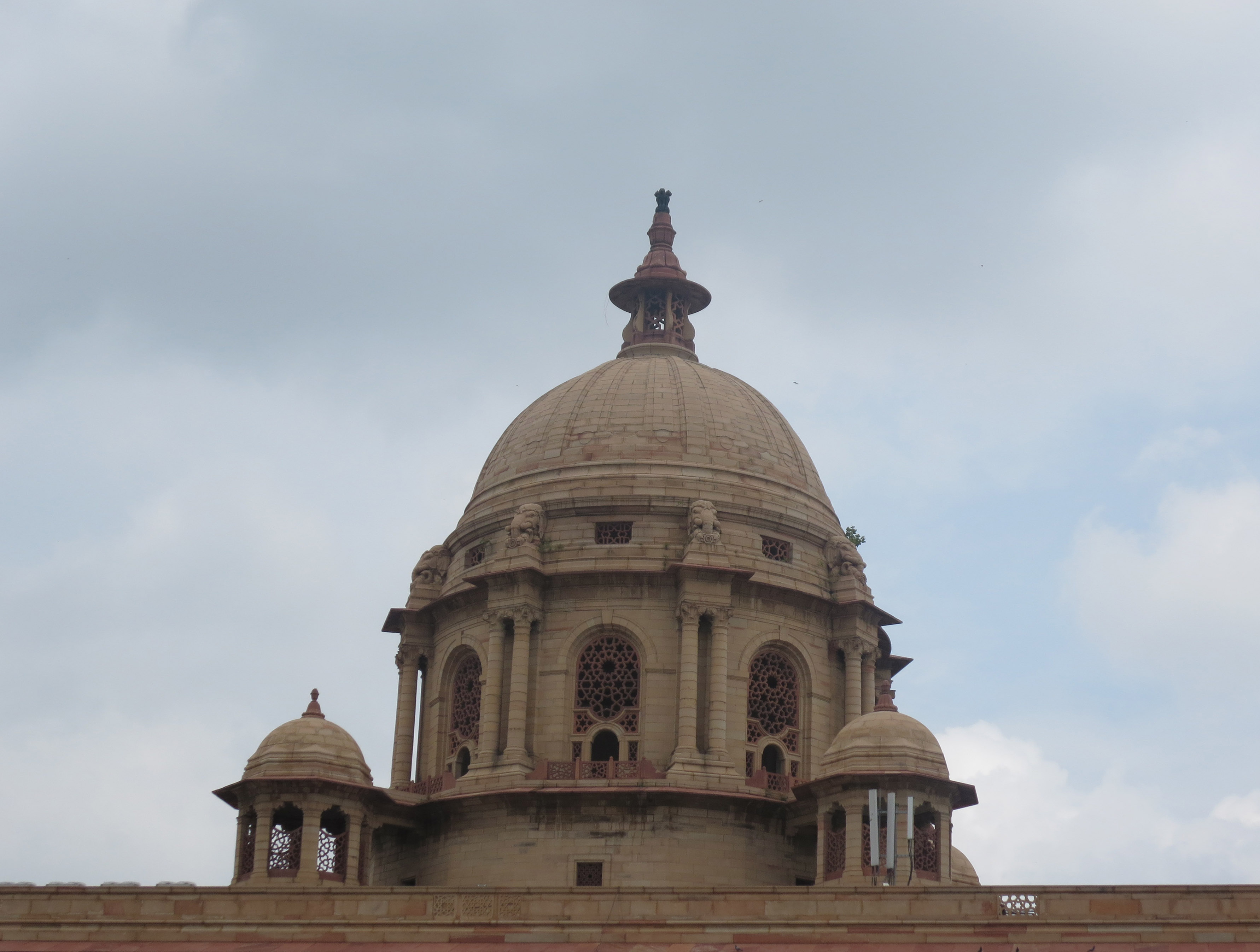
Fyzee-Rahamin’s most significant public commission came between 1926 and 1929, when the Government of India selected him, the only artist not affiliated with the official Bombay school group led by W. E. Gladstone Solomon, to paint frescoes inside the newly built Imperial Secretariat in New Delhi. Working in a tempera technique using natural stone pigments chosen for permanence, Fyzee-Rahamin drew on Rajasthani painting traditions and the flattened forms of the Ajanta cave murals to decorate two domed rooms. One, now known as the Fresco Room, combines Islamic-influenced imagery, a radiant golden sun and the takbir inscription, with quadrants illustrating justice and craftsmanship and a quotation from the Persian poet Saadi. The other depicts core Hindu deities, Vishnu, Shiva, Brahma, and Dattatreya, arranged around an Om inscription. That a single Bene Israel Jewish artist was entrusted with decorating the seat of British Indian government using both Islamic and Hindu religious imagery, rather than any specifically Jewish iconography, reflects how thoroughly Fyzee-Rahamin had positioned himself as an interpreter of India’s broader religious and artistic heritage rather than as a representative of his own smaller community alone. The selection process itself carries significance: choosing an artist entirely outside the official Bombay school delegation to decorate rooms devoted to Islamic and Hindu religious themes at the literal seat of British Indian government suggests that colonial administrators viewed Fyzee-Rahamin’s specific artistic technique and cross-traditional fluency as valuable in its own right, independent of any institutional affiliation or specific religious community membership, a level of individual professional recognition uncommon for an artist from so small a religious minority working within a large, hierarchical colonial bureaucracy.
Writing About His Own Community
Alongside his painting career, Fyzee-Rahamin wrote several books, including the plays Invented Gods and Daughter of Ind, a 1944 poetry collection titled Man and Other Poems, and two nonfiction works: Indian Painting and Sculpture (1947) and the earlier Beni-Israel in India: A History. The second of these represents a rare instance of an internationally exhibited Indian artist turning his attention directly to documenting his own Bene Israel community’s history, connecting his personal artistic legacy directly back to the specific Jewish community that produced him, even as the bulk of his professional output engaged with Hindu, Islamic, and broader Indian artistic traditions rather than explicitly Jewish subject matter. Little independent verification of the specific contents of Beni-Israel in India: A History survives in easily accessible modern library catalogues, a common fate for community-specific histories published in relatively small print runs in mid-twentieth-century India, but its existence alone, a serious nonfiction historical study written by one of India’s most internationally exhibited painters about his own small religious community, remains a notable and unusual data point in the broader history of Bene Israel self-documentation.
Later Life and Legacy
Following the 1947 Partition of India, Fyzee-Rahamin and Atiya Begum emigrated to the newly created Pakistan, where he died in relative poverty in Karachi in 1964, a difficult final chapter for an artist who decades earlier had been celebrated at exhibitions in Paris, London, and New York and had helped reorganize the Asian art collections of both the Victoria and Albert Museum and New York’s Metropolitan Museum. His paintings nonetheless remain in major Indian museum collections today, and his Imperial Secretariat frescoes still exist within what is now India’s central government complex in New Delhi, a physical, permanent record of Jewish artistic contribution to one of India’s most significant government buildings.
The contrast between his celebrated international career and his impoverished final years in Karachi also mirrors the broader displacement Partition inflicted on many minority artists and intellectuals who had built careers within a specifically pre-Partition, pluralistic Bombay cultural world that ceased to exist in the same form after 1947.
Why His Story Matters
Fyzee-Rahamin’s career complicates any simple account of how Jewish artists related to Indian heritage. He was not confined to producing exclusively Jewish-themed work, nor did he abandon his origins entirely; instead, he moved fluidly between Hindu, Islamic, and Jewish subject matter across different commissions and personal projects, ultimately writing histories of both Indian art broadly and his own Bene Israel community specifically. That dual engagement, contributing to India’s mainstream national artistic heritage while also documenting his own community’s particular history, offers one of the clearest individual case studies of what “Jewish influence on Indian heritage” actually looked like in practice during the first half of the twentieth century.
Further Reading
For more on the community that produced this artist, see our coverage of the Bene Israel of Maharashtra, as well as the Wikipedia article on Samuel Fyzee-Rahamin.