
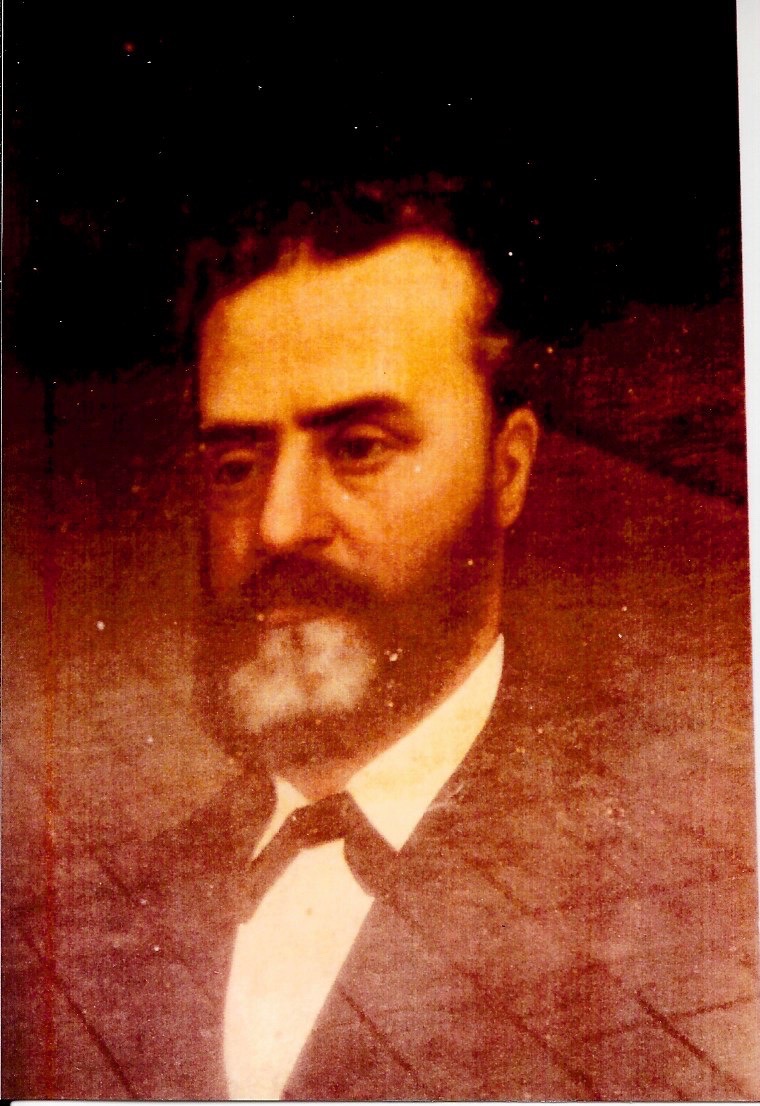
Published in 1986 by Brookside Press, Esmond David Ezra’s Turning Back the Pages: A Chronicle of Calcutta Jewry stands as one of the most substantial community-authored histories of the Baghdadi Jewish settlement in Calcutta, now Kolkata. Written by a member of one of the city’s most prominent Jewish merchant families, the book combines documented history with the kind of family-level detail and institutional memory that only an insider with access to private papers, oral testimony, and personal recollection could assemble.
An Author From Within the Community’s Leading Family
The Ezra name carried particular weight within Calcutta’s Jewish community. Elias David Joseph Ezra, born in 1830, built the Maghen David Synagogue in 1884 in honor of his father, the merchant David Joseph Ezra, and went on to serve as High Sheriff of Calcutta, one of the most prominent civic positions available to a member of the city’s immigrant merchant class during the British colonial period. Elias married Mozelle Sassoon, daughter of Sir David Sassoon of Bombay, tying the Calcutta Ezra family directly to the Sassoon dynasty that dominated Baghdadi Jewish commercial life across British India and beyond. Their sons, including Sir David Ezra, continued the family’s prominence in Calcutta’s civic, commercial, and communal life well into the twentieth century. It was against this backdrop of multi-generational family leadership within Calcutta’s Jewish community that Esmond David Ezra undertook the writing of a comprehensive chronicle spanning the community’s history from its founding in the late eighteenth century through its twentieth-century decline.
A Community Built by Trade, Sustained by Faith
Calcutta’s Baghdadi Jewish community traced its origins to Shalom Obadiah Cohen, an Aleppo-born trader who arrived in the city in 1798 after first establishing himself in Surat. Over the following century, families arriving from Baghdad and Aleppo built substantial fortunes in cotton, jute, spices, and the opium trade that linked British India to China, using that wealth to construct the synagogues, schools, and charitable institutions that gave the community its lasting physical and spiritual infrastructure. The Maghen David Synagogue, completed in 1884 through Elias David Ezra’s patronage, along with the Neveh Shalome and Beth El synagogues, remain the most visible legacy of that era, their towers and archways still standing in central Kolkata today even as the community that built them has almost entirely emigrated.
A chronicle like Ezra’s had to grapple honestly with the uneven distribution of that wealth: alongside the merchant elite whose names still adorn synagogue foundation stones and charitable trust deeds, the majority of Calcutta’s Jewish population lived far more modestly, often dependent on communal charity distributed through the synagogues themselves. Capturing both the grandeur of the merchant families and the everyday reality of ordinary community members is part of what gives a substantial, locally authored history like this one its documentary value, in contrast to accounts that focus solely on the prominent families whose archives happen to survive.
Writing History as the Community Dispersed
By the time Ezra’s book appeared in 1986, the demographic transformation of Calcutta’s Jewish community was essentially complete. The establishment of Israel in 1948, combined with the economic and political uncertainties following Indian independence and the nationalization pressures of subsequent decades, had driven the overwhelming majority of the community’s members to relocate to Israel, the United Kingdom, Australia, and North America. What had once been a community numbering several thousand had dwindled, by the 1980s, to a small remnant population insufficient to sustain the kind of active communal and religious life the synagogues had been built to serve.
This context of near-total dispersal gives Ezra’s chronicle a particular urgency and poignancy. Writing more than three decades after the community’s peak, with many of the people who could offer firsthand testimony about pre-independence Calcutta Jewish life scattered across continents or already deceased, Ezra was effectively racing against the erosion of living memory. The book’s title, invoking the act of turning back through the pages of history, reflects this explicitly retrospective, memory-preserving purpose.
A Family Chronicle With Wider Historical Value
What distinguishes Turning Back the Pages from more narrowly academic histories of Calcutta’s Jewish community is its combination of documented historical research with the kind of family-specific detail — personal anecdotes, correspondence, business records — that an author embedded in one of the community’s leading families was uniquely positioned to access. Where an outside scholar might reconstruct the broad contours of Calcutta Jewish history from archival sources and secondary literature, Ezra could draw on direct family knowledge of figures like Elias David Ezra and his descendants, adding texture and specificity that purely archival research often cannot recover.
For researchers and genealogists tracing Baghdadi Jewish family lines connected to Calcutta, and for general readers interested in the human story behind the city’s now largely empty but still-standing synagogues, Ezra’s chronicle remains one of the essential references. It sits alongside other community-authored histories, including I. S. Abraham’s earlier 1969 account, as part of a small but historically vital body of literature produced by Calcutta’s Jewish community members themselves, determined to ensure that their community’s history would not simply vanish along with its last remaining members.
The Sassoon Connection and a Trans-Regional Jewish Network
Elias David Ezra’s marriage to Mozelle Sassoon illustrates a broader pattern that a comprehensive chronicle like Ezra’s had to account for: Calcutta’s Baghdadi Jewish community was never an isolated outpost, but one node within a tightly interconnected trans-regional network of Baghdadi Jewish trading families stretching from Baghdad and Aleppo through Bombay, Calcutta, Rangoon, Singapore, Hong Kong, and Shanghai. Marriages between prominent families in different cities, such as the Ezra-Sassoon alliance, served to bind together what was in effect a single extended commercial and religious community spread across multiple port cities of the British imperial trading world. A family chronicle centered on Calcutta could not tell its story in isolation from this wider network, since so much of the community’s commercial success, religious leadership, and even marriage patterns depended on maintaining active ties with Baghdadi Jewish communities in Bombay and further afield.
This trans-regional dimension also helps explain why, when emigration accelerated after 1948, Calcutta’s Jewish families often had existing family and business connections in Bombay, London, or Hong Kong that eased their relocation, in contrast to communities without such established networks. Ezra’s chronicle, in documenting the Calcutta community’s history in detail, necessarily also illuminates this wider pattern of Baghdadi Jewish diaspora connectivity across Asia, offering readers a window into a form of Jewish communal life defined as much by mobility and trans-regional family ties as by attachment to any single city.
Civic Life Beyond the Synagogue
Members of the Ezra family and other prominent Baghdadi Jewish families in Calcutta did not confine their influence to communal religious life. Elias David Ezra’s appointment as High Sheriff of Calcutta reflects the degree to which some members of the community achieved recognition and standing within the wider colonial civic establishment, participating in municipal governance, philanthropy, and public life well beyond the boundaries of the Jewish community itself. A chronicle spanning this family’s history over multiple generations offers insight not only into specifically Jewish communal development but into the broader social position occupied by a small, prosperous immigrant minority navigating British colonial Calcutta’s civic and commercial hierarchies — a position that shifted again, in different ways, after Indian independence in 1947.
Copies of Turning Back the Pages are today held mainly in specialist Judaica collections and libraries with strong South Asian Jewish history holdings, reflecting its status as a community-published rather than mass-market title. Its lasting value lies in precisely this specificity: a detailed, family-informed account of one city’s Jewish community, written at the moment when that community had all but ceased to exist as a living, continuous presence in Calcutta, ensuring that the detailed texture of its history was captured before the last direct witnesses were gone.