
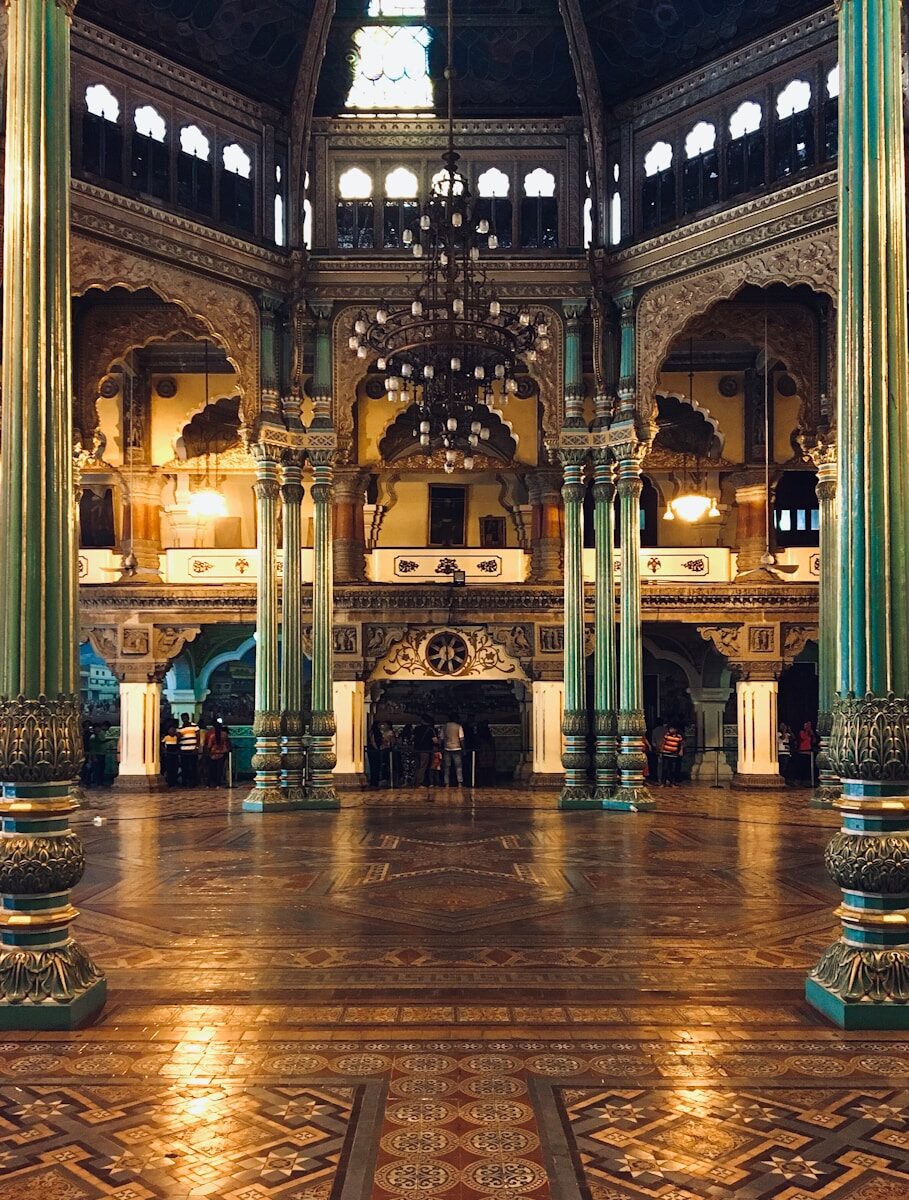
Photo: Ornate historic synagogue interior in India, via Unsplash
Related Reading
- The Four Communities of Indian Jews: An Overview
- The Bene Israel of Maharashtra
- The Jews of Cochin
- The Baghdadi Jews of Mumbai and Kolkata
- Books on the Jews of India
In Delhi, India’s vast and ancient capital, Jewish community life has always been a quiet and marginal affair. Unlike Mumbai, with its tens of thousands of Bene Israel families, or Kolkata, with its once-thriving Baghdadi Jewish quarter, Delhi never had a large or prominent Jewish community. Today, by some accounts, fewer than ten Jewish families remain in the city, the guardians of a heritage that stretches back centuries but which the great waves of emigration to Israel have reduced to a barely visible remnant.
Delhi’s Jewish History
The Jewish presence in Delhi is connected primarily to the movement of individuals and families associated with trade, government service, and the British colonial administration rather than to any established and rooted community comparable to those of Mumbai or Kochi. Jewish merchants, administrators, and professionals passed through Delhi over the centuries, and some settled there temporarily or permanently, but they never formed a community with the density, the institutions, or the cultural life of the major Indian Jewish centers.
The small number of Jews who settled in Delhi in the colonial era were typically associated with commercial activities or with service in the colonial administration. Some were Baghdadi Jews from the commercial communities of Calcutta and Bombay who came to Delhi for business reasons. Others were European Jews who arrived as professionals or entrepreneurs during the period of British rule. Together these individuals and families constituted a scattered presence rather than a true community.
The Judah Hyam Hall
The most important Jewish institution in Delhi is the Judah Hyam Hall, a synagogue and community center that was established in the twentieth century to serve the small Jewish population of the capital. The building, located in the diplomatic enclave of Chankyapuri, has served as a gathering place for Delhi’s Jewish residents, for Jewish diplomats and embassy staff from Israel and other countries, and for Jewish travelers passing through the city.
The hall is named after the man who founded it, Judah Hyam, a prominent member of Delhi’s Jewish community in the mid-twentieth century whose dedication to maintaining Jewish communal life in the capital was essential to its survival. Today the hall continues to hold services for Jewish holidays and functions as a center for the tiny community that remains.
The Last Jewish Families
The remaining Jewish families in Delhi are custodians of a heritage that most of their community has left behind. They maintain connections with Jewish communities around the world through travel, communication, and participation in Jewish organizational life, and they keep Jewish practice alive in their homes and, when numbers permit, at the Judah Hyam Hall. Their decision to remain in Delhi while most of their contemporaries emigrated to Israel or elsewhere reflects a deep attachment to India and to the specific life they have built in the capital.
For these families, being Jewish in Delhi is a practice that requires active effort and creative adaptation. There are no Jewish schools for children, no kosher restaurants for daily life, no Jewish neighborhoods offering the ambient community support that Jews in larger Jewish centers take for granted. Every aspect of Jewish life requires deliberate choice and personal commitment.
A Heritage Worth Preserving
The tiny Jewish community of Delhi represents something important about the Indian Jewish story more broadly: the extraordinary diversity of Jewish presence in India, which included not just the large and well-documented communities of Mumbai and Kochi but smaller settlements across the subcontinent where individual families and small groups maintained Jewish life in challenging conditions. Delhi’s Jewish heritage, however modest in scale, is part of the larger tapestry of Indian Jewish history and deserves to be documented and remembered.
As India and Israel deepen their bilateral relationship and as Israeli diplomatic presence in Delhi grows, the small Jewish community of the capital may find new energy and new connections that help it survive and perhaps even grow. In the meantime, the last Jewish families of Delhi guard their ancient heritage with a dedication that speaks to the resilience of Jewish identity in the most challenging circumstances.