
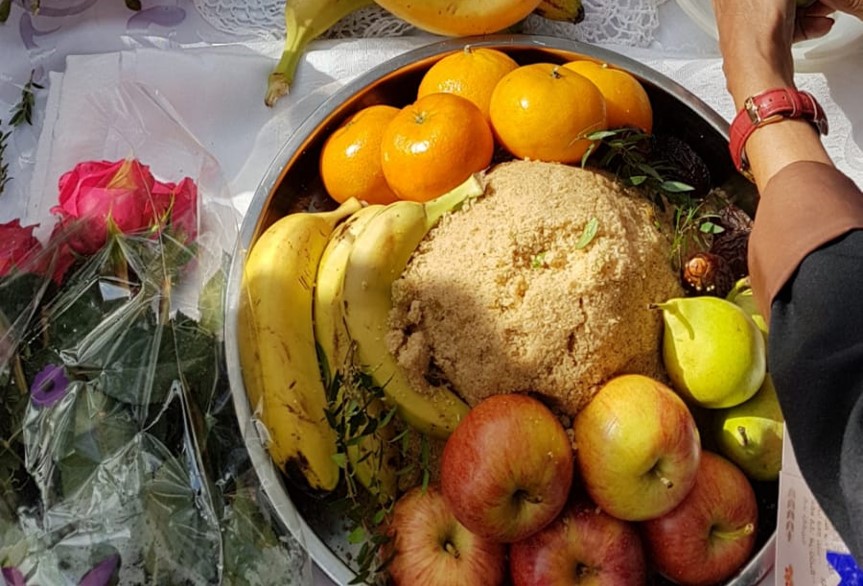
Every Indian Jewish community has kept its history in more places than the synagogue and the family tree. It survives in the kitchen too, in the specific way a household toasts spices, avoids pork and shellfish, or sets aside a plate of coconut rice for a Sabbath guest. Bene Appétit: The Cuisine of Indian Jews, published by HarperCollins India in 2021, is the first book to gather these food traditions from across the subcontinent’s Jewish communities into a single volume, written by the novelist, art critic, and Bene Israel Jew Esther David.
A Novelist Turned Culinary Historian
Esther David is best known in Indian literary circles as a novelist and Sahitya Akademi Award winner, with earlier books that drew heavily on her own Bene Israel upbringing in Ahmedabad. With Bene Appétit, she turned that same autobiographical instinct toward food, treating recipes as a way of recording a community’s memory before it disappears. The book grew out of years of visiting relatives and community elders across India, collecting dishes that in many households exist only as spoken instructions passed from mother to daughter.
Five Communities, One Table
Rather than treating “Indian Jewish food” as a single cuisine, David organizes the book by community, devoting separate chapters to the Bene Israel of Maharashtra, the Cochin Jews of Kerala, the Baghdadi Jews of Kolkata, the Bene Ephraim of Andhra Pradesh, and the Bnei Menashe of Manipur and Mizoram. Each group settled in a different part of India, at different points in history, and adapted its dietary laws to whatever regional ingredients were on hand. The Bene Israel built their cooking around coconut, rice, and Konkan coastal spices; the Cochin Jews leaned on Kerala’s tamarind, curry leaves, and seafood traditions reworked to stay kosher; and the Baghdadi Jews of Kolkata carried Iraqi dishes like aloo makala and cutlets into a Bengali setting. The Bnei Menashe of India’s northeast, a much more recently recognized Jewish community, bring yet another regional palette shaped by the hill cuisines of Manipur and Mizoram.
Malida and the Rituals Behind the Recipes
Among the dishes David documents, few carry as much symbolic weight for the Bene Israel as malida, a ceremonial offering of flattened rice, sugar, coconut, and seasonal fruit prepared for Eliyahu HaNavi (the prophet Elijah) at births, weddings, and thanksgiving occasions. The dish is not eaten as an everyday meal; it is assembled, blessed, and shared communally, making it as much a ritual object as a recipe. Bene Appétit treats dishes like malida as evidence of how Bene Israel families kept a distinctly Jewish practice alive for generations while living almost entirely apart from other Jewish communities.
Cooking as a Record of a Shrinking Community
India’s Jewish population has fallen from roughly 50,000 in the 1940s to a few thousand today, as successive waves of emigration, mostly to Israel, thinned out communities that once supported dozens of synagogues. David has spoken in interviews about how many of the dishes in the book are already rarely cooked, kept alive mainly by older relatives, which gave the project an urgency beyond simple food writing. Part cookbook and part travelogue, the book pairs each recipe with family stories, historical notes, and David’s own illustrations, so that a reader can follow both how a dish is made and why it mattered to the people who made it.
Reception
Reviewers, including the Jewish Book Council and the Times of India, have praised the book for documenting recipes and customs that had never been written down in one place before, while noting that its community-by-community structure means some historical background repeats across chapters. That repetition is also, in a sense, the book’s point: it shows five distinct Jewish communities in India arriving at parallel solutions, adapting the same core dietary framework to five very different regional cuisines.
Why This Book Matters
For readers exploring the wider history of Jewish life in India, Bene Appétit works as a companion to community histories rather than a replacement for them. It shows in concrete, edible detail what is often described only in the abstract elsewhere: how Jewish law and local Indian food culture were reconciled in practice, dish by dish, over centuries. Readers interested in the communities behind the recipes can find more on the Bene Israel, the Cochin Jewish community, and the Baghdadi Jews of Kolkata elsewhere on this site.
Book details: Bene Appétit: The Cuisine of Indian Jews by Esther David, HarperCollins India, 2021, approx. 200 pages. Further reading: Jewish Book Council review and the Open Library catalog entry.
Adapting Dietary Law to Local Ingredients
One of the quieter arguments running through Bene Appétit is that keeping kosher in India was never a matter of importing a fixed cuisine wholesale. Without easy access to the ingredients used in Ashkenazi or even Sephardi kitchens elsewhere, each community had to work out its own answer to Jewish dietary law using what regional markets actually offered. The Baghdadi Jews of Kolkata, for instance, kept dishes like aloo makala (crisp fried potatoes) and meat cutlets close to their Iraqi originals, since Kolkata’s spice trade made many of the same ingredients available; the community also leaned on Shabbat-friendly slow-cooked dishes similar to the Iraqi hamin. Further south and further back in time, Cochin Jewish cooks folded tamarind, curry leaves, and coconut milk into recipes built around the same laws of separating meat and dairy, producing dishes that tasted distinctly Keralan while still following kosher rules. David treats these adaptations less as compromises than as evidence of how portable Jewish law is when a community is determined to keep it.
Bene Ephraim and Bnei Menashe: The Newer Chapters
The book’s inclusion of the Bene Ephraim of Andhra Pradesh and the Bnei Menashe of Manipur and Mizoram is notable because both communities are far more recent additions to the story of Jewish India than the Bene Israel, Cochin, or Baghdadi Jews. The Bene Ephraim began publicly identifying as a Jewish community only in the twentieth century, while the Bnei Menashe, who trace their practice to a belief in descent from one of the biblical tribes, did not gain formal rabbinical recognition allowing large-scale immigration to Israel until 2005. Their culinary chapters in Bene Appétit look noticeably different from the older communities’ sections, drawing on the fermented and stir-fried dishes typical of the northeastern hill states and Andhra’s Telugu-speaking countryside rather than on Konkan, Malayali, or Iraqi cooking traditions. Including them was, in effect, an editorial decision to define “Indian Jewish cuisine” as broadly as the current, still-evolving map of Indian Jewish identity itself.
Part Travelogue, Part Family Archive
David has described the research process as much closer to reporting than to recipe testing: visiting elderly relatives and community members in Mumbai, Kochi, Kolkata, and beyond, and writing down dishes that in many cases had never been measured out in cups and teaspoons before. The finished book keeps that travelogue quality, moving chapter by chapter through the cities and towns where each community settled, with David’s own line drawings standing in for the glossy food photography typical of most contemporary cookbooks. That choice fits the book’s stated purpose: it is less interested in being a polished kitchen reference than in being a record, compiled while the people who still remember these dishes by heart are alive to describe them.
A Wider Pattern of Food as Preservation
Bene Appétit arrived at a moment when food writing had already become a common way of documenting endangered minority cultures worldwide, from diaspora Sephardi cookbooks to community cookbooks compiled by shrinking immigrant congregations elsewhere. What sets the Indian case apart is the sheer number of distinct communities involved: five separate Jewish groups, each with its own migration story, language history, and regional cuisine, all technically covered by the same set of dietary laws. Few other countries could produce a single cookbook spanning coastal Kerala, industrial Kolkata, western Maharashtra, and the hill districts of the northeast under one religious umbrella. That range is part of why reviewers have treated the book as much as a work of cultural documentation as a practical kitchen guide.
For a site devoted to the history of Jewish communities across India, Bene Appétit is a useful reminder that community history is not only preserved in synagogue records, immigration papers, and oral histories, but also in something as ordinary as a family recipe for coconut rice or fried potatoes, quietly carried forward long after the more visible markers of a community, such as a functioning synagogue, have disappeared from a given town.