
The Bene Israel sourcebook India’s Bene Israel: A Comprehensive Inquiry and Sourcebook, published in 1988 by the American researcher Shirley Berry Isenberg, is one of the most thorough documentary records ever assembled on this community, the largest and oldest continuously-documented Jewish community native to India. Co-published by Popular Prakashan in Bombay and the Judah L. Magnes Museum in Berkeley, California, the 443-page volume gathers genealogies, interviews, synagogue records, and photographs into a single reference work, at a time when the community it describes was already shrinking rapidly through emigration to Israel.
The Shipwreck at Navagaon: A Community’s Origin Story
Bene Israel tradition traces the community’s arrival in India to a shipwreck off the Konkan coast, near the village of Navagaon about twenty miles south of present-day Mumbai. Fourteen survivors, seven men and seven women, are said to have swum ashore after fleeing persecution in Judea under Antiochus Epiphanes centuries earlier. Some historians have connected this founding story to the broader, unverifiable tradition of the Ten Lost Tribes of Israel, while others read it as a folk memory of a much later, more gradual migration. Isenberg’s sourcebook takes this oral tradition seriously as a starting point, treating it not as settled fact but as the community’s own account of itself, to be weighed alongside the genealogical and documentary evidence she collected village by village.
David Rahabi and the Kaji System
For centuries after their arrival, Bene Israel families lived in Konkan villages largely cut off from the wider Jewish world, retaining only fragments of practice such as Sabbath rest, circumcision, and dietary restrictions. According to community tradition, a Cochin Jewish trader named David Rahabi rediscovered the Bene Israel in their villages, recognized their vestigial Jewish customs, and began teaching them normative rabbinic Judaism. Bene Israel accounts place Rahabi’s arrival anywhere from the eleventh to the eighteenth century, and historians have proposed several real individuals named Rahabi as candidates for the figure behind the legend. Out of this re-education grew the office of Kaji, a hereditary religious leadership position roughly comparable to the Cohanim, whose holders served as prayer leaders and settled disputes within the community. Isenberg’s book traces individual Kaji lineages and village religious structures in detail that is difficult to find anywhere else in print.
From Oil Pressers to Colonial Officers
For generations, the Bene Israel worked as oil pressers who, unusually for their trade, refused to work on the Sabbath. This habit earned them the name “Shanivar Teli,” or Saturday oil-pressers, a label that stuck long after most of the community had left the trade behind. Beginning in the second half of the eighteenth century, Bene Israel families began moving from their villages to Bombay, where the first synagogue opened in 1796, and later to Pune, Ahmedabad, and Karachi. Under British rule, Bene Israel men enlisted in the colonial army and civil service in disproportionately high numbers, and the community’s population grew from an estimated 6,000 in the 1830s to around 10,000 by 1900 and roughly 20,000 by 1948, its historic peak in India. In the early twentieth century, Bene Israel men and women also became a visible presence in the young Indian film industry, as actors, producers, and directors, a history Isenberg documents alongside the community’s religious and military life.
Two Publishers, Two Audiences
The book’s dual publication says almost as much about its purpose as its contents. Popular Prakashan, a mainstream Bombay press, brought the book to Indian readers, including Bene Israel families who could recognize their own village and family names in its pages. The Judah L. Magnes Museum, a Jewish history and art institution in Berkeley, California, brought it to an American and diaspora audience increasingly disconnected from India as emigration accelerated. Few books about an Indian Jewish community were positioned to speak this directly to both the community being documented and the diaspora it was becoming, and that dual framing runs through the whole project.
A Sourcebook Built From the Community Itself
What distinguishes Isenberg’s book from a conventional history is its declared purpose as a sourcebook rather than a single narrative. Rather than only telling the Bene Israel story from the outside, it was compiled through direct engagement with the community: family genealogies, first-person recollections, and photographs contributed by Bene Israel families themselves, alongside more conventional historical and demographic material. That approach makes the book as much an archive as an argument, useful to genealogists tracing a specific Konkan village surname as it is to historians studying Jewish life under British colonial rule.
A Community Divided Over Its Own Identity
The book does not shy away from the tensions within Bene Israel history. In the nineteenth century, the more recently arrived and anglicized Baghdadi Jewish community in Bombay questioned whether the Bene Israel, with their Marathi language and Indian dress, were fully Jewish at all. The Bene Israel educator Haeem Samuel Kehimkar spent years defending his community’s Jewishness in writing, though in doing so he also drew a sharp and troubling internal line between so-called “gora” (white) and “kala” (black) Bene Israel, claiming the former to be of purer descent. Isenberg’s inquiry into these divisions, drawn from oral history as much as archival record, gives readers a more honest picture of a community that was never as internally unified as outsiders often assumed.
Why the Sourcebook Still Matters
By the time Isenberg’s book appeared in 1988, the community it documented had already shrunk dramatically. Emigration to Israel after 1948, and later to the United States, Canada, and the United Kingdom, reduced the Bene Israel population in India from its 1948 peak of roughly 20,000 to a small fraction of that number within a few decades; Mumbai’s Jewish population today, overwhelmingly Bene Israel, numbers only in the thousands. That timing makes the book less a history written from a comfortable distance and more a rescue operation, capturing genealogies, photographs, and firsthand memory while the people who held them were still there to share them.
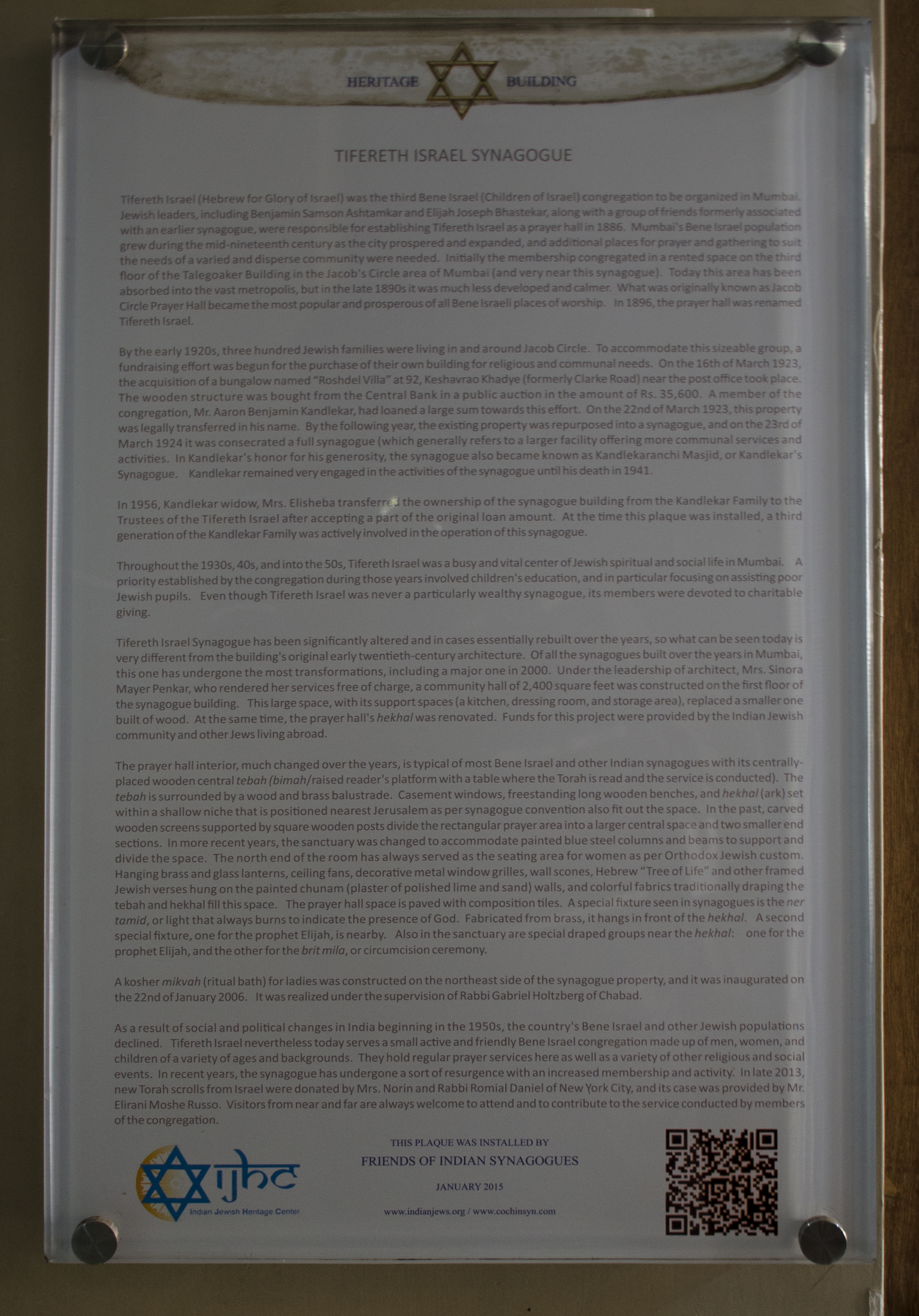
For descendants researching Konkan village surnames or family synagogue records today, Isenberg’s sourcebook remains one of the few places where that material was systematically gathered in one volume. Readers curious about how those surnames map onto specific villages can also see our own survey of Bene Israel surnames and their Konkan origins, and those interested in the synagogues the community built as it urbanized can walk through Mumbai’s six downtown synagogues, several of which appear in Isenberg’s own survey of Bene Israel congregations.
Copies of the original 1988 edition are scarce today, but the book is catalogued and searchable through Open Library, which lists both the Popular Prakashan and Judah L. Magnes Museum printings along with library holdings for readers who want to track down a copy of their own.
What the Photographs Preserve
Beyond the genealogies and interview transcripts, Isenberg’s sourcebook is also a photographic record, reproducing family portraits, synagogue interiors, wedding parties, and community gatherings supplied directly by Bene Israel households. Many of these images exist nowhere else in published form. For a community whose numbers in India had already fallen far below their 1948 peak by the time the book went to press, a photograph contributed by a single family could represent the only surviving visual record of a synagogue, a wedding, or a generation that had since scattered to Israel, Britain, or North America. Read today, the book functions as much as a family album assembled from dozens of households as it does a conventional academic history.
Locating a Copy Today
Because it was printed in two relatively small runs, one in Bombay and one in Berkeley, original copies of India’s Bene Israel rarely appear in general bookshops and are now most often found through research libraries, Jewish museum collections, or secondhand booksellers specializing in South Asian or Jewish studies. University libraries with strong South Asia or Jewish studies collections are the most reliable starting point for readers who want to consult it directly, and its continued presence in library catalogues more than three decades after publication is itself a sign of how few comparable sourcebooks on the Bene Israel exist.
A Different Story From India’s Other Jewish Communities
India was home to three historically distinct Jewish communities, the Bene Israel of the Konkan coast and Bombay, the Cochin Jews of Kerala, and the later-arriving Baghdadi Jews of Bombay and Calcutta, and Isenberg’s sourcebook is careful to stay within its own subject rather than blending the three into a single generic account. The Bene Israel spoke Marathi as their first language, observed customs that had drifted furthest from rabbinic norms before Rahabi’s intervention, and, unlike the Cochin Jews, had no single ancient port city as a communal center, instead spreading across dozens of Konkan villages before urbanizing in the nineteenth century. That specificity is part of what makes the book valuable: it resists the temptation to write a single flattened narrative of “Indian Jews” and instead documents one community, with its own villages, surnames, and internal disputes, in detail.