
Related Reading
- The Four Communities of Indian Jews: An Overview
- The Bene Israel of Maharashtra
- The Jews of Cochin
- The Baghdadi Jews of Mumbai and Kolkata
- Books on the Jews of India
The history of women in Indian cinema is inseparable from the history of the Bene Israel Jewish community of Maharashtra. In the early decades of the Indian film industry, when it was still considered disreputable for women of respectable Hindu families to work on stage or screen, the more cosmopolitan and educationally progressive Bene Israel community provided Bollywood with some of its first, most talented, and most celebrated leading ladies. Their contribution to Indian cinema helped define the aesthetic and cultural standards of a medium that would eventually become the largest film industry in the world.
The Social Context
Understanding why Jewish women became pioneers in Indian cinema requires understanding the social landscape of early twentieth-century India. The film industry, which developed in Bombay from the 1910s onward, was initially considered a disreputable profession associated with prostitution and moral corruption. This perception was common across South Asian cultures and was particularly strong among the high-caste Hindu families who might otherwise have provided the industry with its performers.
The Bene Israel community, with its distinct cultural identity and its relative openness to Western education and professional modernity, did not share these reservations to the same degree. Jewish families in Bombay had been educated in English-language schools, had experience in commercial and professional roles that brought them into contact with modern Western culture, and had a tradition of evaluating professional opportunities on their merits rather than on the basis of traditional caste-based restrictions. For Bene Israel women with talent and ambition, the film industry offered opportunities that were genuinely new.
Pramila: India’s First Jewish Film Star
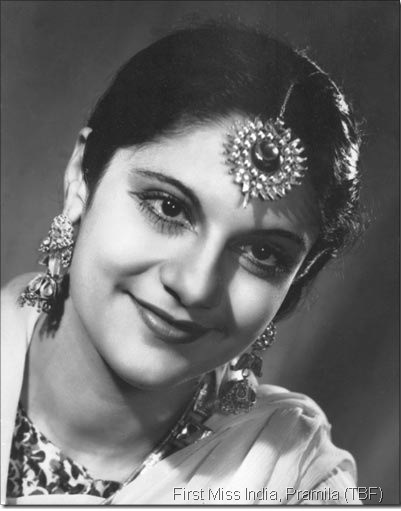
The most celebrated of the early Jewish film actresses was Pramila, born Esther Victoria Abraham in Calcutta in 1916. Pramila’s beauty, talent, and determination made her one of the biggest stars of 1930s and 1940s Hindi cinema, and she became a symbol of the glamorous modern woman that the industry was creating. She was the first Miss India to be crowned, in 1947, and later founded her own film production company, becoming one of the earliest women producers in Indian cinema history.
Pramila’s Jewish identity was not a secret, and she maintained her connection to the Bene Israel community throughout her career. Her success demonstrated that a Jewish woman could achieve the highest levels of recognition in Indian public life, and her presence in Indian cinema helped normalize the idea of Jewish participation in the country’s cultural mainstream.
Nadira: The Vamp Who Transformed Bollywood
If Pramila was the wholesome first star, Nadira, born Florence Ezekiel in Baghdad in 1932, was her glamorous, transgressive counterpart. Nadira became famous for playing sophisticated, often villainous women in 1950s Hindi films, bringing a European-inflected sense of style and danger to the Indian screen. Her most famous role was in Raj Kapoor’s Shree 420 in 1955, where she played the seductive antagonist opposite the film’s morally upstanding hero.
Nadira’s ability to portray complexity and moral ambiguity in her characters represented a significant expansion of what Indian cinema could depict and reflect. The “vamp” characters she specialized in, while often narratively punished by films’ conventional moral conclusions, were among the most interesting and nuanced figures in mid-century Hindi cinema. Her contribution to the development of Indian screen acting was substantial and has been recognized by film historians as genuinely significant.
A Lasting Legacy
The Jewish women who helped found the Indian film industry left a legacy that goes beyond their individual careers. They demonstrated that women from minority communities could achieve prominence in India’s cultural mainstream. They helped establish professional standards and aesthetic conventions for Hindi film acting that influenced generations of performers. And they created a connection between the Bene Israel community and India’s most popular art form that has continued to the present day.
Today, as the Bene Israel community has largely emigrated from India, the memory of these pioneering actresses is being reclaimed by scholars, filmmakers, and community historians who recognize their significance both as cultural figures and as representatives of a specific form of Jewish Indian modernity that no longer exists in its original form.