
Jews and the Indian National Art Project, published by Niyogi Books in 2015 and edited by Kenneth X. Robbins and Rabbi Marvin Tokayer, documents a subject easy to overlook entirely: the specific contributions Jewish patrons, collectors, and craftspeople made to the visual and material culture of India, both within their own synagogues and communities and within the broader Indian art world beyond them.
The Editors Behind the Project
Kenneth X. Robbins is an American psychiatrist and collector of South Asian art whose personal collection, much of it donated to the Smithsonian Institution in 1990, spans centuries of Indian visual and material culture. Robbins has built a career around documenting the overlooked contributions of minority and expatriate communities to Indian courtly and artistic life, co-editing African Elites in India: Habshi Amarat in 2006, a study of the African-descended nobility who rose to prominent positions in several Indian princely states, and curating exhibitions on India’s Maharajas and princely states drawn from his own collection. His co-editor, Marvin Tokayer, is an American rabbi who served for eight years as the only rabbi in Japan and has spent much of his later career documenting Jewish communities across Asia, including co-editing Western Jews in India: From the Fifteenth Century to the Present with Robbins in 2013, the volume that immediately preceded and set the groundwork for Jews and the Indian National Art Project. Robbins’ broader collecting practice has consistently focused on documenting how outsider or minority communities, whether African-descended nobility, Jewish merchant families, or other diaspora groups, found ways to participate in, patronize, and sometimes reshape the artistic conventions of the Indian courts and cities where they settled, rather than remaining passive recipients of a fixed local tradition. This consistent thread across his published work situates Jews and the Indian National Art Project as one entry in a much longer personal research project concerned with minority artistic agency within Indian history generally, rather than as an isolated study produced in response to Jewish communal interest alone.
What the Book Documents
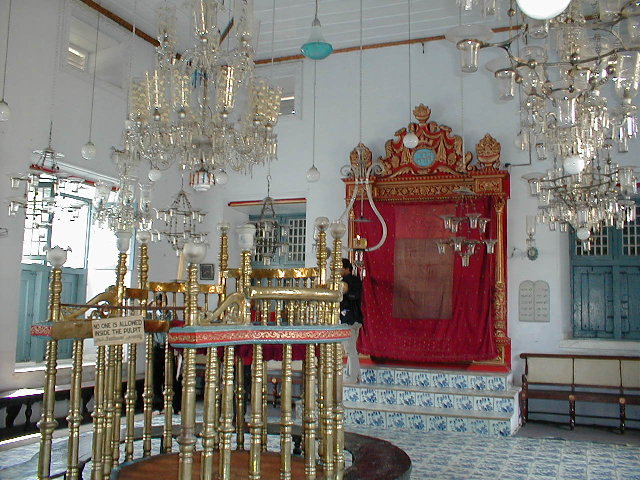
Catalogued under subjects including Jewish art, Indic art, and art patronage, the book traces the ways India’s Jewish communities, and individual Jewish patrons connected to India more broadly, shaped and were shaped by Indian visual culture. This includes the distinctive material culture produced within India’s own synagogues: hand-painted ceramic floor tiles imported from China for buildings like the Paradesi Synagogue in Kochi, elaborately decorated Torah arks and finials crafted by both Jewish and non-Jewish silversmiths working in shared regional workshop traditions, and illuminated ketubot and Haggadot that blended Hebrew text with distinctly Indian decorative motifs. It also extends outward to the wider patronage networks built by wealthy Baghdadi Jewish merchant families such as the Sassoons, whose civic philanthropy in Bombay funded libraries, docks, and other institutions that shaped the city’s built environment well beyond any single synagogue or Jewish neighborhood. These objects were rarely produced by Jewish craftspeople working in isolation from wider Indian artistic traditions; Cochin’s silver Torah crowns, for instance, were frequently made by the same workshops of Hindu and Muslim silversmiths who produced ceremonial objects for the region’s temples and mosques, meaning that a single regional craft tradition produced ritual objects across multiple religious communities simultaneously, adapted to each community’s specific liturgical requirements but sharing common techniques, materials, and often the same individual artisans. Documenting this kind of cross-community craft production, rather than treating Jewish ritual art as though it emerged from a hermetically sealed tradition, is precisely the kind of material history the book’s editors set out to recover.
Why Frame This as a “National Art Project”
The book’s title deliberately positions Jewish contributions to Indian art as part of India’s broader national art history rather than as a separate, self-contained Jewish story, echoing the same argument Robbins made in his earlier work on African-descended elites in Indian princely courts: that India’s visual and material culture was never produced by a single dominant community alone, but was continuously shaped by the contributions of numerous minority communities working within, and often between, India’s dominant artistic traditions. Positioning Jewish patrons and craftspeople as participants in a genuinely national art project, rather than curators of a niche communal collection, reflects a broader historiographical move within South Asian studies to recover minority contributions to mainstream national narratives rather than treating them as a separate footnote. This reframing carries real stakes for how museums and archives choose to catalogue and display these objects going forward. A Torah ark or ketubah stored and interpreted purely as a religious artifact within a narrowly defined Jewish studies context risks being separated entirely from the regional craft traditions, and the non-Jewish artisans, that actually produced it, while a national art history framework insists on tracing those same objects back into the broader networks of patronage, material sourcing, and craft technique that produced comparable objects for India’s other religious communities at the same historical moment.
A Companion to Western Jews in India
Because Jews and the Indian National Art Project followed directly on from Robbins and Tokayer’s 2013 volume Western Jews in India, the two books function as a linked pair, one documenting the broader historical and social presence of Jewish communities and individuals connected to India from the fifteenth century onward, the other focusing specifically on the visual and material record that presence left behind. Read together, they represent one of the most sustained efforts by any scholars to document India’s Jewish communities specifically through the lens of art history and material culture rather than through the more common frameworks of religious history, migration studies, or communal demography that dominate most other scholarship on the subject. Tokayer’s involvement brought a specifically communal, religiously literate perspective to a project that could otherwise have remained purely art-historical in focus, ensuring that the book’s treatment of ritual objects, Torah arks, Haggadot, ketubot, remained grounded in an accurate understanding of how these objects actually functioned within synagogue and home religious practice, rather than treating them purely as decorative artifacts disconnected from the liturgical purposes that shaped their design in the first place.
Why This Scholarship Matters
As India’s synagogues empty and its Jewish communities continue to shrink through emigration, the physical objects these communities created, and the objects wealthy patrons within these communities commissioned from artists working in wider Indian traditions, represent some of the only tangible evidence that will eventually remain of communities that otherwise leave a comparatively thin documentary record. A book that treats these objects as a coherent body of art history, worthy of the same kind of careful cataloguing and interpretation as any other regional Indian artistic tradition, helps ensure that this material record receives serious scholarly attention before the living memory needed to fully interpret it disappears along with the last generations of practitioners who used these objects in their original religious and communal contexts. Niyogi Books, the volume’s publisher, has built a broader catalogue focused on Indian art, heritage, and photography, situating this particular title within a publishing house whose primary audience is readers interested in Indian visual culture generally rather than a specifically Jewish studies readership, a distribution choice that reinforces the editors’ stated intention of presenting Jewish artistic contributions as integral to Indian art history rather than as a specialized subfield addressed only to Jewish studies scholars or the Indian Jewish community itself.
The book’s subject classification, spanning Jewish art, Indic art, and art patronage simultaneously rather than being filed under a single narrower category, itself reflects this deliberately cross-disciplinary framing, positioning the volume to be discovered by researchers approaching from South Asian art history, Jewish studies, or the broader history of religious minorities’ material culture, three audiences that do not always overlap in library catalogues or academic conference programming but that the book’s editors clearly hoped to bring into direct conversation with one another through a single shared volume.
Robbins’ decision to donate the bulk of his personal collection to the Smithsonian Institution in 1990, decades before this book’s publication, also suggests a consistent belief that material documenting minority contributions to Indian history belongs in major public institutions capable of preserving and displaying it long-term, rather than remaining exclusively in private hands or narrowly specialized community archives, a philosophy that appears to have directly shaped the editorial approach taken in Jews and the Indian National Art Project as well.
Taken as a whole, the book stands as a reminder that documenting a small, shrinking religious community does not have to mean confining that documentation to a narrow communal shelf; treated seriously as art history, the same material can find a home within the much larger, ongoing story of Indian visual culture as a whole.
That reframing is the book’s most lasting contribution.
Few other single volumes attempt anything comparable for this particular community.
Further Reading
For more on the synagogues and material culture discussed in this volume, see our coverage of the Jews of Cochin and the Baghdadi Jews of Mumbai and Kolkata, as well as the Wikipedia article on Marvin Tokayer.