
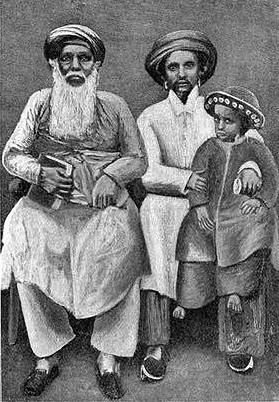
Photo: Bene Israel Teachers, 1855. SMU Central University Libraries / Wikimedia Commons
The Bene Israel are believed to be one of the oldest Jewish communities in the world, and their presence in India is among the most remarkable chapters in the history of the Jewish diaspora. Settled along the Konkan coast of Maharashtra for what community tradition holds to be more than two thousand years, the Bene Israel maintained their Jewish identity through centuries of isolation from the broader Jewish world, preserving their faith through oral tradition and the observance of practices that, while diverging from normative Judaism in some ways, remained distinctly and unmistakably Jewish.
Origins Lost to History
The precise origins of the Bene Israel remain one of the great historical mysteries of the Jewish world. Community tradition holds that they arrived in India after fleeing persecution in the ancient Land of Israel, possibly in the second century BCE during the period of Antiochus IV Epiphanes, or alternatively after the destruction of the Second Temple in 70 CE. According to legend, they shipwrecked off the Konkan coast and settled in the village of Navgaon, near present-day Alibag, with only seven couples surviving. Historical documentation of these origins is impossible to verify, but the community’s archaeological and documentary record in India goes back at least a thousand years.
What is clear is that by the time the Portuguese arrived on the Malabar Coast in the late 15th and early 16th centuries, the Bene Israel were already a well-established community with a distinct identity. Portuguese records mention them, and subsequent accounts by travelers, colonial administrators, and missionaries in the 17th and 18th centuries confirm a community living primarily along the Konkan coast, working as oil pressers, speaking Marathi as their everyday language, and observing a form of Jewish practice that included the Sabbath, dietary restrictions, circumcision, and the celebration of certain festivals.
What They Preserved
During the centuries when the Bene Israel had little or no contact with the broader Jewish world, they maintained a core of Jewish observance that is remarkable given their isolation. They observed the Sabbath, which they called Shanwar (Saturday), and were known to their non-Jewish neighbors as the “Saturday oil pressers” because they refused to work on that day. They practiced circumcision, recited the Shema (the central Jewish prayer), kept the dietary prohibition on pork, and celebrated the festivals of Rosh Hashanah, Yom Kippur, Passover, and Shavuot, though the names and some practices of these festivals adapted over time to the Marathi environment.
They also developed uniquely Indian Jewish practices, most notably the Malida ceremony, a thanksgiving ritual performed with sweetened rice and various foods as offerings, which has no direct parallel in other Jewish traditions and appears to reflect an adaptation of local Hindu and Muslim thanksgiving practices to a Jewish framework. The Malida is still performed by Bene Israel families around the world today and is one of the most distinctive markers of Bene Israel identity.
Contact with the Broader Jewish World
The Bene Israel’s gradual reintegration into the broader Jewish world began in the 18th century, when Cochin Jews and later Baghdadi Jews established contact with them, introducing them to mainstream Jewish prayer books, Hebrew education, and aspects of Jewish practice they had either forgotten or never known. British missionaries also played a role by establishing English-language Jewish schools among the Bene Israel in the 19th century, which, while designed for conversion purposes, actually had the effect of strengthening Bene Israel Jewish identity and literacy.
Today, the largest Bene Israel community in the world is in Israel, where approximately 50,000 to 70,000 people of Bene Israel descent live, primarily in cities like Ramla, Lod, Beersheba, and certain neighborhoods of Tel Aviv. Smaller communities remain in Mumbai and Pune, and diaspora communities can be found in the United Kingdom, the United States, Canada, and Australia.
Learn more: Bene Israel – Wikipedia