
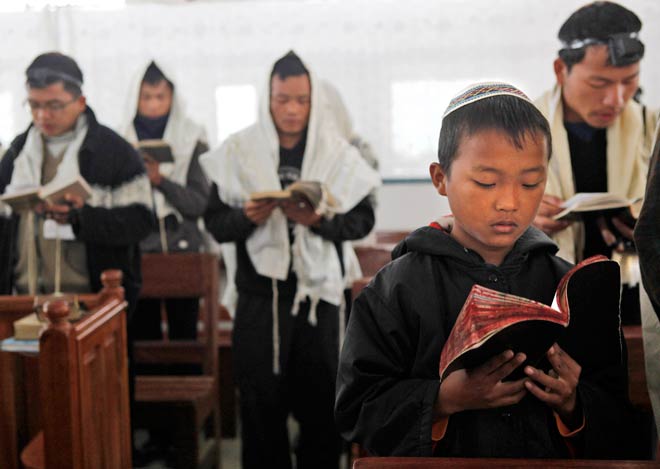
Photo: Bnei Menashe community members. Shavei Israel / Wikimedia Commons
The Bnei Menashe — the “Sons of Menashe” — are a community in northeastern India, primarily in the states of Manipur and Mizoram, who claim descent from the biblical tribe of Menashe, one of the Ten Lost Tribes of Israel exiled by the Assyrian Empire in the eighth century BCE. Their story, as reflected in “The Lost Jews of Churachandpur, Manipur,” is one of the most extraordinary chapters in the contemporary history of the Jewish people: a community that maintained elements of Israelite practice in remote northeastern India across many centuries, and that has in recent decades been making aliyah to Israel in significant numbers.
The Bnei Menashe: Origin and Identity
The Bnei Menashe community of Manipur and Mizoram presents one of the most contested and fascinating questions in contemporary Jewish identity. The community’s own tradition holds that they are descended from the biblical tribe of Menashe, carried into captivity by the Assyrian Empire around 722 BCE, and that they maintained a form of Israelite practice across the centuries in their remote northeastern Indian homeland. They practiced circumcision, observed dietary restrictions, maintained Sabbath-like rest days, and preserved oral traditions and songs that they understood as memories of their ancient Israelite origins.
The discovery of these practices by outside observers in the mid-twentieth century generated enormous interest in the Jewish world and led to a process of formal engagement between the Bnei Menashe and Israeli and international Jewish institutions. The Israeli Chief Rabbinate has accepted the community’s claim of Jewish descent conditionally, requiring a formal conversion process before full recognition, and has permitted aliyah for those who complete this process.
Community in Manipur and Mizoram
Within Manipur and Mizoram, the Bnei Menashe community — which may number around 10,000 individuals — has built institutions for Jewish life that are remarkable given the remote and predominantly Christian environment in which they exist. Synagogues have been established in Churachandpur and other towns; Hebrew schools have been created to prepare community members for aliyah; and community organizations coordinate the practical and spiritual dimensions of Jewish life in northeastern India.
The daily life of the Bnei Menashe combines modern Indian life with Jewish religious observance. Community members speak Mizo or Thadou-Kuki as well as learning Hebrew, observe Shabbat and the Jewish holidays, maintain kosher dietary laws to the extent possible in their environment, and maintain the distinctive traditions and songs that connect them to their claimed Israelite heritage.
Preserving Indian Jewish Heritage for Future Generations
The task of preserving Indian Jewish heritage is one of the most urgent cultural projects in the contemporary Jewish world. As the communities that created this heritage continue to shrink through emigration and natural attrition, the window for capturing living memories, traditional practices, and community knowledge is narrowing rapidly. Every year, elderly community members pass away, taking with them irreplaceable firsthand knowledge of how Jewish life was actually lived in the Bene Israel villages of Maharashtra, the Jewish neighborhoods of Cochin, or the commercial districts of Calcutta and Bombay where Baghdadi Jewish families built their businesses and synagogues.
The response of scholars, community organizations, and cultural institutions to this challenge has been energetic and multifaceted. Oral history projects have recorded interviews with elderly community members in India, Israel, and the diaspora. Digital archives have made historical photographs, documents, and recordings accessible to researchers and community members around the world. Museum exhibitions have introduced Indian Jewish heritage to audiences who might otherwise never encounter it. And writers, artists, and filmmakers from within and outside the community have created new works that carry Indian Jewish stories and traditions into the contemporary cultural conversation.
The Place of Indian Jews in the Larger Jewish Story
The history of India’s Jewish communities occupies a distinctive and important place in the broader story of the Jewish diaspora. Unlike the often traumatic histories of Jewish communities in Europe and the Middle East — marked by persecution, pogroms, forced conversions, and the Holocaust — the Indian Jewish story is predominantly one of peaceful coexistence, communal autonomy, and cultural creativity within a tolerant host society. This positive experience does not diminish or contradict the difficult experiences of other Jewish communities; it demonstrates that the relationship between Jews and their host societies is shaped by specific historical circumstances rather than by any inevitable dynamic of conflict.
The Indian Jewish communities offer evidence that Jewish identity can be maintained across many centuries of geographic isolation and cultural interchange without requiring either segregation from the surrounding society or assimilation into it. The Bene Israel maintained their Jewish identity across what may be two thousand years of life in Maharashtra while becoming genuinely Indian in language, culture, and social orientation. The Cochin Jews built a thriving community under the protection of local Hindu rulers while maintaining Hebrew literacy and connections to the broader Jewish world. The Baghdadi Jews created cosmopolitan communities in Calcutta and Bombay that participated fully in both the British imperial system and the commercial networks of the Indian Ocean world while maintaining the religious traditions of the ancient Jewish communities of Iraq.