
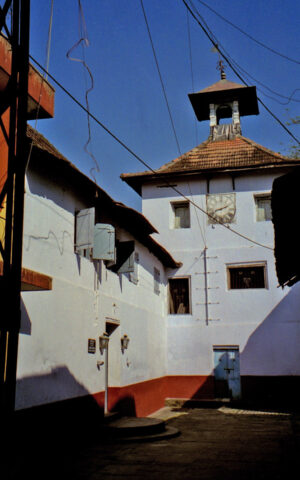
One of the most distinctive features of the Paradesi Synagogue in Kochi is its freestanding clock tower, built adjacent to the main synagogue building. What makes this clock tower extraordinary — and unique in the world — is that it displays the time in three different scripts simultaneously: Hebrew, Roman (Latin), and Malayalam. The three-faced clock is a physical embodiment of the Cochin Jewish community’s remarkable position at the intersection of three civilizations: Jewish, European, and South Indian.
The Three Scripts
The Hebrew face of the clock uses traditional Jewish numerology, marking the hours with the letters of the Hebrew alphabet (aleph for one, bet for two, and so on). The Roman face uses the standard Western Arabic numerals familiar throughout the world. The Malayalam face uses the Malayalam numeral system of the Kerala region. The three faces tell the same time in three different symbolic languages, representing the three communities and cultures with which the Cochin Jews interacted most closely throughout their history.
History of the Clock Tower
The clock tower was built in 1760, nearly two centuries after the original synagogue in 1568. Its construction reflects the prosperity and self-confidence of the Cochin Jewish community during the 18th century, when they enjoyed the protection of the Cochin rajas and had established strong commercial ties with Dutch and later British traders. The tower is visible from the surrounding streets of Jew Town, serving as both a practical timepiece and a landmark of Jewish presence in the city.
The Paradesi Synagogue: A UNESCO Heritage Site
The Paradesi Synagogue was built in 1568 by the Paradesi (foreign-origin) Jewish community of Cochin, descendants of Jews who had fled the Portuguese Inquisition in Spain, Portugal, and other European territories. The word paradesi means foreigner in several Indian languages, distinguishing this community from the Malabari (indigenous) Jews who had lived on the Kerala coast for millennia before their arrival. Despite their different origins, both communities worshipped at the Paradesi Synagogue, though historically from different sections.
The Famous Floor Tiles
The interior of the Paradesi Synagogue is famous for its floor of hand-painted Chinese porcelain tiles, each one unique, depicting willow trees, bridges, and pavilions in the traditional blue-and-white Chinese style. The tiles were a gift from a Cochin Jewish merchant who traded with China, and they were laid in the 18th century during a major renovation. No two tiles are identical, making the floor one of the most unusual and beautiful in any Jewish house of worship in the world.
Visiting Today
The Paradesi Synagogue is open to visitors and remains an active synagogue, though services require a minyan (quorum of ten Jewish adults) that can only be assembled when there are enough Jewish visitors to supplement the tiny remaining local community. The complex, including the clock tower and the adjacent Jew Town spice merchants’ lane, is one of Kochi’s most visited heritage sites. The Archaeological Survey of India and the Jewish community trust maintain the property jointly.
For more on the Cochin Jewish community, see the Cochin Jews section of this website.