
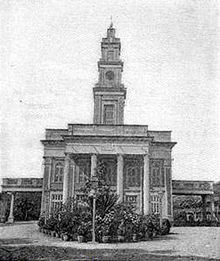
Photo: David Sassoon Library, Mumbai. Wikimedia Commons (CC BY-SA 3.0)
Few families in history have made a comparable impact on the commerce, culture, and philanthropy of the colonial world as the Sassoon family, Baghdadi Jews who built a trading empire centered in Bombay that extended across Asia, Europe, and beyond. The Sassoons are the most prominent example of what the Baghdadi Jewish community in India achieved at its height, and their legacy is still visible today in the streets of Mumbai, the history of Shanghai, and the cultural institutions they endowed across the world.
David Sassoon: The Patriarch
The dynasty’s founder, David Sassoon (1792-1864), was born in Baghdad into a prominent Jewish family and served as treasurer to the city’s pasha before fleeing political unrest in 1829. He made his way to Bombay, then the commercial capital of British India, where he established a trading house that would grow to dominate trade across the Indian Ocean world. David Sassoon and Sons became one of the largest commercial enterprises in Asia, with offices in Calcutta, Hong Kong, Shanghai, Yokohama, Guangzhou, and London. The business traded in textiles, metals, opium (the dominant commodity in the Anglo-Chinese trade of the time), and eventually industrial goods as the global economy industrialized.
David Sassoon never learned English. He conducted his business in a combination of Arabic, Hebrew (which served as a business language within the community), Persian, and Hindustani, relying on his sons and nephews to manage the English-language aspects of his enterprise. He remained deeply Orthodox in his religious observance throughout his life, maintaining kashrut, observing the Sabbath, and building synagogues and community institutions for the Baghdadi Jewish community in Bombay and Pune. His grave in Pune, marked by a striking monument, remains a site of pilgrimage for Indian Jews and historians of the Jewish world.
The Children and the Dynasty
David Sassoon’s sons and grandsons expanded and transformed the family enterprise. His son Albert (Abdullah) Sassoon (1818-1896) moved the family’s base to London and was one of the first prominent Jews in English high society, receiving a baronetcy from Queen Victoria. Another branch of the family produced Siegfried Sassoon (1886-1967), one of the greatest English poets of the First World War, whose family connection to the Bombay dynasty illustrates how far the Sassoon diaspora reached.
In Bombay, the family’s philanthropic impact was enormous. They built hospitals, schools, orphanages, and public institutions that served the entire city, not just the Jewish community. The David Sassoon Library in Churchgate, Mumbai, built in 1870, is still functioning today as a research library and is one of the oldest libraries in the city. The Sassoon Docks, the main fishing harbor of Mumbai, bear the family name. Keneseth Eliyahoo Synagogue in the Fort area of Mumbai, one of the most important Baghdadi Jewish synagogues in the world, was built by the Sassoon family.
Legacy
The Sassoon story illuminates how the Baghdadi Jewish community in India, despite being numerically small, achieved extraordinary influence through commercial success, philanthropy, and a willingness to engage with the colonial world on its own terms while maintaining their Jewish identity and community cohesion. The family’s trajectory, from Baghdad to Bombay to London, from opium traders to English baronets to celebrated poets, is one of the most extraordinary stories in the history of the Jewish diaspora.
Learn more: Sassoon family – Wikipedia