
One Heart, Two Worlds: The Story of the Jews of Kochi, published in 2019 by Stark World Publishing, is a 177-page pictorial study documenting the Cochin Jewish community of Kerala. Credited to K. S. Mathew, Yamini Nair, Bhawani Cheerath, and Ajay Menon, the book combines photography with historical narrative to trace a community whose documented presence on the Malabar coast stretches back at least a thousand years.
The 1000 CE Starting Point
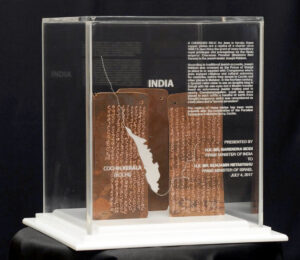
The book’s framing around the year 1000 CE points to one of the most important surviving artifacts of Indian Jewish history: the Jewish copper plates of Cochin, a royal charter issued by the Chera ruler Bhaskara Ravi Varman to Joseph Rabban, a Jewish merchant magnate of the port of Kodungallur, dated by historians to approximately 1000 CE. The charter, engraved in the Vattezhuthu script across two copper plates, granted Rabban and his descendants membership in the anjuvannam merchant guild along with a set of commercial rights and aristocratic privileges, in perpetuity. Crucially, the tone and content of the charter itself suggests the Jewish community was not newly arrived on the Malabar coast at the time the grant was made, meaning 1000 CE marks the earliest surviving documentary evidence of an established Jewish presence in Kerala rather than the community’s actual arrival date, which most historians believe was considerably earlier. The copper plates themselves are still preserved today in an iron box known as the Pandeal, kept inside the Paradesi Synagogue in Mattancherry, Cochin. The charter’s text includes a list of witnesses, chieftains from both southern and northern Kerala and the commander of the Chera kingdom’s eastern military forces, whose presence underscores how seriously the grant was treated at the highest levels of medieval Kerala’s political structure, rather than functioning as a minor local arrangement between a ruler and a single merchant family. The anjuvannam guild itself was not exclusively Jewish; it organized merchants from multiple religious backgrounds, Jewish, Christian, and Muslim traders from the Middle East, reflecting how thoroughly international trade networks along the Malabar coast already blended different religious communities within shared commercial and legal structures by the turn of the first millennium.
A Pictorial Approach to Community History
Unlike the more text-heavy academic studies of Cochin Jewish history produced by scholars such as Nathan Katz, One Heart, Two Worlds is explicitly catalogued as a pictorial work, prioritizing photography alongside its historical narrative. This approach suits its subject particularly well: Cochin’s Jewish community is defined as much by its surviving physical spaces, the Paradesi Synagogue with its Chinese porcelain floor tiles and 18th-century clock tower, the narrow lanes of Mattancherry’s Jew Town, gravestones in the community’s cemeteries, as by any textual record. A photographic study allows readers to encounter these spaces directly rather than only through description, an important consideration for a community whose remaining population in Kerala has dwindled to only a handful of individuals. The synagogue’s floor, covered in hand-painted eighteenth-century Chinese porcelain tiles with no two alike, and its clock tower bearing three faces inscribed in Hebrew, Roman, and Malayalam numerals respectively, have become some of the most photographed details of any Indian synagogue precisely because they visually embody the same cross-cultural blending the book’s title describes: a building that is unmistakably a functioning Jewish house of worship while simultaneously reflecting Chinese trade goods, European clockwork, and local Malayalam script within a single small structure.
Four Contributors, One Community
The book’s four credited contributors suggest a genuinely collaborative approach spanning history, photography, and design rather than a single-author narrative. This kind of multi-contributor pictorial project has become an increasingly common way of documenting India’s shrinking religious minority communities generally, since it allows historians to contribute accurate context while photographers and designers ensure the resulting book functions as a visually compelling object in its own right, capable of reaching general readers who might never pick up a denser academic monograph. This collaborative model also reflects a practical reality of documenting the Cochin Jewish community specifically: because so few community members remain in Kerala today, most originally from the Paradesi and Malabari sub-groups that historically divided the community along lines of arrival date and social status, thorough documentation increasingly depends on outside historians, photographers, and designers working together to compile a record before the last first-hand memories of pre-emigration community life disappear entirely. A single historian working alone, however expert, would struggle to produce the same breadth of visual documentation that a dedicated photographer could capture during repeated visits to Kerala’s remaining synagogues, cemeteries, and Jew Town neighborhoods.
Two Worlds in the Title
The book’s title, One Heart, Two Worlds, gestures toward a tension explored across nearly every serious study of Cochin Jewish history: a community that maintained continuous Jewish religious identity for a millennium while simultaneously integrating so thoroughly into Kerala’s own social and cultural fabric that the two identities, Jewish and Malayali, became genuinely inseparable rather than merely coexisting. This is the same tension Nathan Katz explored through his “two models” framework comparing Cochin Jewish integration against Bene Israel isolation, and the same tension that shapes the Paradesi Synagogue’s blend of Hebrew liturgical function and distinctly Kerala-style architectural and decorative elements.
Of the seven synagogues that once served various Cochin Jewish sub-communities across Kerala, the Paradesi Synagogue in Mattancherry remains the only one still functioning today, a physical marker of how dramatically the community has contracted since its mid-twentieth-century peak, when Cochin’s combined Jewish population across Kerala numbered in the low thousands. Most of that population emigrated to Israel in waves beginning in the early 1950s, following Indian independence and the founding of the Jewish state, leaving behind synagogue buildings, cemeteries, and domestic architecture that a book like One Heart, Two Worlds can document but can no longer show populated by an active, functioning Jewish community in the way earlier visitors to Kerala would have witnessed firsthand. Stark World Publishing, the book’s Kerala-based publisher, has built a catalogue focused substantially on regional Kerala history, architecture, and visual culture, positioning One Heart, Two Worlds alongside other titles aimed at readers specifically interested in Kerala’s own layered religious and cultural history rather than at a specialized international Jewish studies audience. This regional publishing context matters: a book produced by a Kerala publisher for a substantially Kerala and Indian readership frames Cochin Jewish history as an integral part of regional Malabar coast heritage, alongside the region’s equally long-documented Christian and Muslim trading communities, rather than presenting it as an imported subject of interest primarily to overseas Jewish studies scholars. This regional framing also connects Cochin Jewish history to a broader Kerala tradition of religious pluralism extending back many centuries: the same Malabar coast that hosted Joseph Rabban’s Jewish trading community also hosted early Christian communities tracing their own origins to the apostle Thomas and Muslim trading communities connected to Arabian Sea commerce, making Kerala one of the few regions in the world where written records document three non-Hindu religious minorities maintaining continuous, largely unpersecuted presence for well over a thousand years within a single small coastal region.
Why This Book Matters
As Cochin’s Jewish population has fallen from a mid-twentieth-century community of thousands to only a small handful of remaining residents today, most having emigrated to Israel beginning in the 1950s, pictorial documentation of the kind One Heart, Two Worlds provides takes on particular urgency. Photographs of still-standing synagogues, cemeteries, and domestic spaces capture physical evidence of a thousand-year presence that written history alone cannot fully convey, especially for general readers encountering Cochin Jewish history for the first time through a bookshop shelf or coffee-table display rather than a university library. The book’s 2019 publication date also places it firmly within a recent wave of renewed public and scholarly interest in Cochin Jewish heritage, coinciding with restoration projects at several of the region’s historic synagogue buildings and growing tourism interest in Kochi’s Jew Town neighborhood, a period in which the Kerala state government and various heritage organizations have increasingly recognized the area’s synagogues and Jewish cemeteries as sites worth formal conservation funding rather than allowing them to continue deteriorating as the community itself has emptied out.
Books like this one, positioned between coffee-table photography and serious historical documentation, play a specific role in that broader conservation effort: by reaching readers who would never seek out a specialized academic monograph, they build the kind of general public awareness and appreciation that eventually translates into political and financial support for preserving physical heritage sites that a shrinking community can no longer maintain entirely on its own.
Whether that support arrives in time to preserve every remaining synagogue and cemetery in original condition remains an open question, but the documentation itself, in whatever form it takes, ensures the record survives regardless.
That, ultimately, is what makes a pictorial history like this one worth publishing at all.
Further Reading
For more on the community and history documented in this book, see our coverage of the Jews of Cochin, as well as the Wikipedia article on the Jewish copper plates of Cochin.