
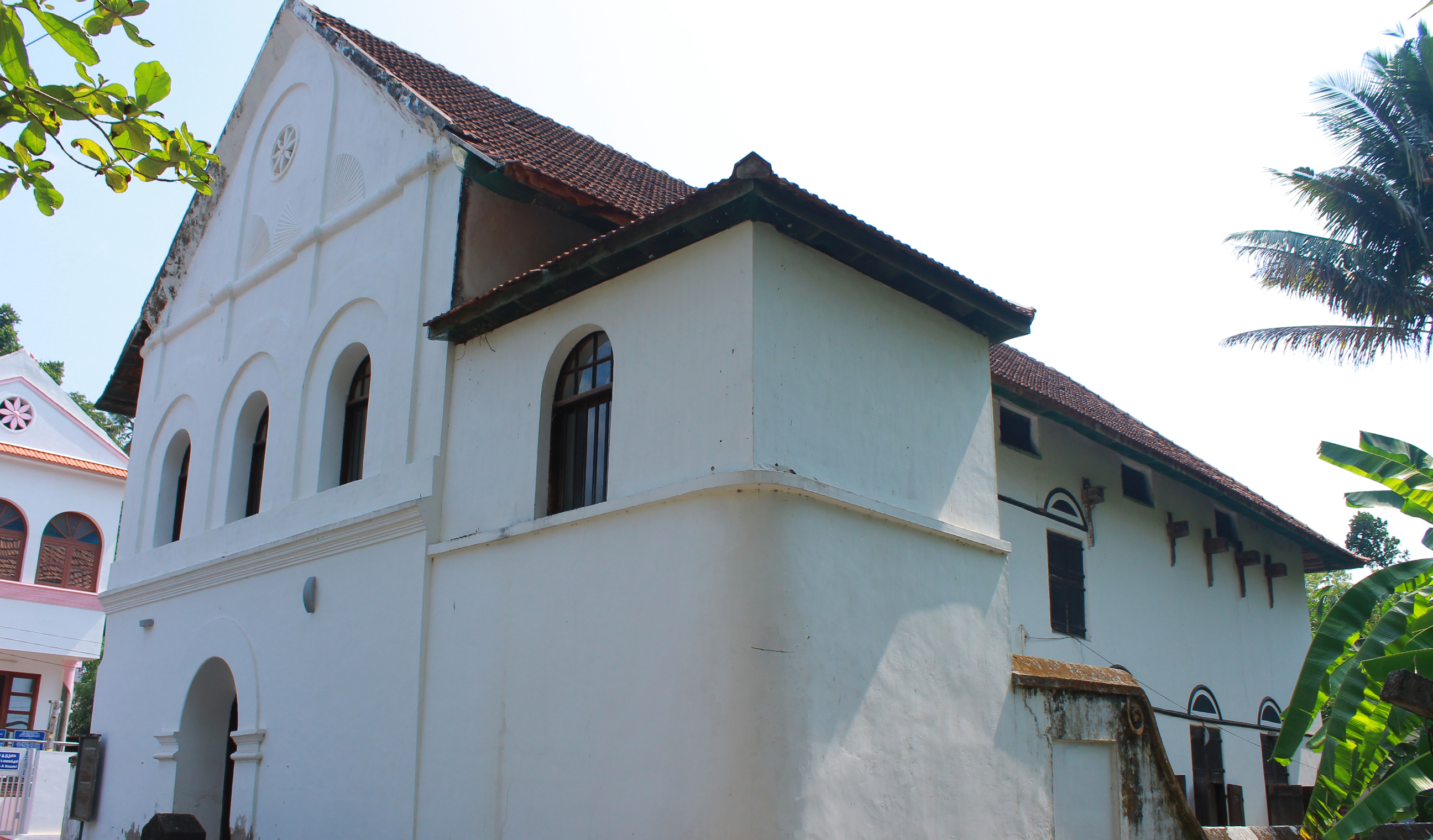
The Chendamangalam Synagogue, now the Kerala Jews Lifestyle Museum, restored as part of the Muziris Heritage Project. Photo by Anoopsanthakumar, Wikimedia Commons, CC BY-SA 4.0.
Visitors to Kerala who want to see Jewish heritage sites are no longer limited to the well known Paradesi Synagogue in Kochi’s Jew Town. About an hour north of the city, near the town of Kodungallur, the Kerala state government has restored two former synagogues and turned them into public museums as part of the Muziris Heritage Project, a large conservation and cultural tourism initiative launched in the mid 2000s.
The Muziris Heritage Project
The Muziris Heritage Project takes its name from Muziris, the ancient port thought to have stood near present day Kodungallur and to have hosted Jewish, Roman, Arab, and Chinese traders in antiquity. The Government of Kerala developed the project to protect and present the region’s layered history, including its Jewish, Christian, Muslim, and Hindu heritage sites, as a connected cultural landscape rather than a set of isolated monuments. Two former synagogues, at Paravur and at Chendamangalam, are now among the project’s flagship museums.
Paravur Synagogue: The Kerala Jews History Museum
The Paravur synagogue, built in 1615, is one of the largest and most complete surviving synagogue buildings in Kerala. It once served the Jewish community that settled near the Paravur market, on a street that is still known locally as Jew Street. The building includes a porch with two rooms, a spacious front yard, wooden stairs and doors, and a carved wooden chamber, blending Jewish liturgical requirements with Kerala architectural style.
After the community’s departure for Israel, the synagogue stood unused until the Kerala government restored it and reopened it as the Kerala Jews History Museum. Displays and short documentary films inside now walk visitors through the arrival, settlement, occupations, and eventual emigration of Kerala’s Jewish community, and certified guides are available on site. The museum is generally open from 10 a.m. to 5 p.m., and sits close to the Paravur-Kodungallur road, with Cochin International Airport about 20 kilometers away.
Chendamangalam Synagogue: The Kerala Jews Lifestyle Museum
The Chendamangalam synagogue has a longer and more complicated history. Jewish families who had lived in Kodungallur and Palayur built a synagogue at Chendamangalam in 1420, modeled on the Jerusalem Temple, after the local ruler of the Villarvattom Swaroopam granted them land near the Kottayil Kovilakam hill. A fire destroyed the original structure, and the community rebuilt it in 1614. The Cochin wing of Kerala’s Archaeological Department renovated the building again in 1938 and declared it a protected heritage site.
Inside, the museum preserves architectural features distinctive to Kerala’s Jewish community, including an antechamber called the Azara, a women’s prayer gallery reached by a spiral staircase, a raised Tebah platform where the Torah was read, and a carved teak Ark. A fragment of a tombstone dated to 1264 CE stands near the entrance, among the oldest physical traces of Jewish life in the area. Chendamangalam is also notable as a place where a temple, a mosque, a church, and this synagogue all stand within close reach of one another, a physical record of the religious diversity that shaped the region for centuries.
Visiting the Synagogue Museums Today
Neither Paravur nor Chendamangalam functions as an active house of worship any longer. Both are maintained purely as museums under the Muziris Heritage Project, staffed with guides and equipped with signboards and screens that explain Jewish life in Kerala to visitors who may have no prior connection to the community. Together with the still functioning Paradesi Synagogue in Kochi, these restored buildings form a wider trail of Jewish heritage sites across the region described in this geographic guide to Jewish India, allowing visitors to see how Kerala’s Jewish communities lived, worshipped, and eventually left, across several centuries and several towns.