
The Jewish communities of India span the entire length of the Indian subcontinent, from the southwestern coast of Kerala to the northeastern states of Manipur and Mizoram, and the western coastal cities of Mumbai and Pune. Each community settled in a distinct geographic region, shaped by trade routes, migration patterns, and the welcoming nature of local rulers.
Kerala: The Cochin Jewish Communities
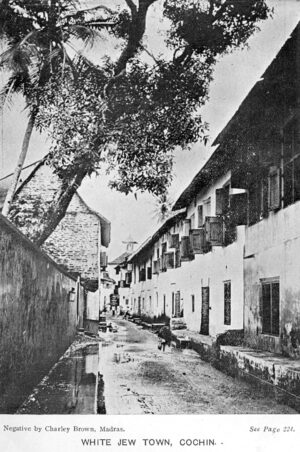
The Jews of Kerala settled primarily in the city of Cochin (now Kochi) on the Malabar Coast. The Paradesi Jews built their famous Paradesi Synagogue in the Mattancherry neighborhood of Kochi in 1568, just steps from the Dutch Palace and the spice warehouses that made Cochin one of the most important trading ports in Asia. The Malabari (Black) Jews settled in a separate area of Cochin and in towns like Ernakulam, Parur, Chennamangalam, Mala, and Chendamangalam throughout Kerala.
Key locations for Cochin Jewish history include:
- Mattancherry (Kochi): Home to the Paradesi Synagogue, built in 1568, and the “Jew Town” neighborhood which retains its historic character with antique shops and spice merchants.
- Ernakulam: The Kadavumbhagam Synagogue, the oldest Malabari Jewish congregation, originally located here.
- Chendamangalam: A small village outside Kochi that was home to a large Malabari Jewish community. The synagogue here, built in 1614, still stands and has been recently restored.
- Parur: Another center of the Malabari Jewish community with its own synagogue.
Maharashtra: The Bene Israel
The Bene Israel are concentrated in the state of Maharashtra, centered on Mumbai (formerly Bombay) and Pune (formerly Poona). Their traditional home villages, known as the Konkan Coast, run along the narrow coastal strip between the Western Ghats and the Arabian Sea.
- Mumbai: The largest concentration of Bene Israel today. Several synagogues in Mumbai serve the community, including the Magen David Synagogue in Byculla and the Sha’ar Harahamim (Gate of Mercy) Synagogue in Mandvi, the oldest synagogue in Mumbai built in 1796.
- Pune: A significant Bene Israel community developed in Pune during British colonial times, when many served in the Indian Army. The Ohel David Synagogue (also known as Lal Deval or the Red Temple), built in 1867, stands as the largest synagogue in Asia.
- Alibag and Konkan villages: The traditional homeland of the Bene Israel stretches along the Konkan coast south of Mumbai, including the villages of Navgaon, Panvel, Revdanda, and Murde.
West Bengal: The Baghdadi Jews of Calcutta
The Baghdadi Jews of Calcutta (now Kolkata) settled in what was then the capital of British India. They built some of the city’s most magnificent synagogues and became prominent in the jute trade, banking, and real estate.
- Calcutta (Kolkata): The Magen David Synagogue (1884) on Canning Street and the Beth El Synagogue (1856) on Pollock Street are the two main surviving synagogues. The Jewish cemetery at Narkeldanga is one of the largest Jewish cemeteries in Asia.
Northeast India: The Bnei Menashe
The Bnei Menashe community is found primarily in the states of Manipur and Mizoram in northeastern India, near the borders with Myanmar and Bangladesh. Their remote location in the hills of the northeast set them apart from mainstream Indian society for centuries.
- Imphal (Manipur): The capital of Manipur is home to a significant Bnei Menashe community.
- Aizawl (Mizoram): The capital of Mizoram also has a substantial Bnei Menashe community with a synagogue and active Jewish religious life.
Indian Jews in Israel Today
Today, the vast majority of Indian Jews live in Israel, following waves of aliyah (immigration to Israel) that began in earnest in 1948 when Israel became a state. Indian Jewish communities are concentrated in cities like Tel Aviv, Jerusalem, Beer Sheva, and Dimona, as well as in specific moshavim (cooperative villages) including Nehalim, Aviezer, Meshar, and Shahar, which were established specifically for Indian Jewish immigrants.