
Understanding the Indian Jewish Experience in Historical Context
The story of India’s Jewish communities cannot be properly understood without appreciating the specific historical circumstances that shaped it. Judaism arrived in India through multiple routes over many centuries, creating communities that were diverse in their origins, their practices, and their social positions but united by their adherence to Jewish tradition and their identification with the Jewish people. The Bene Israel of Maharashtra, possibly descended from Jewish settlers who arrived before the Common Era; the Cochin Jews of Kerala, present for at least two thousand years under the protection of Hindu rulers; and the Baghdadi Jews of Calcutta and Bombay, arriving in the late eighteenth century from Iraq and the broader Middle East — each community had its own distinct history but shared the experience of being Jewish in India.
What makes the Indian Jewish story distinctive in the broader context of Jewish history is the nature of the host society in which these communities developed. India under Hindu rule provided a social environment quite unlike the Christian Europe or Muslim Middle East where most Jewish communities spent the Common Era. The absence of organized anti-Jewish persecution, the recognition of Jews as a legitimate minority community with rights to self-governance in religious matters, and the broadly tolerant character of Hindu social philosophy all contributed to a Jewish experience in India that was, by the standards of most Jewish diasporic history, remarkably peaceful.
India and Israel: A Special Bond
The relationship between India and Israel, shaped in significant part by the connections created by the Indian Jewish communities, is one of the most important bilateral relationships in the contemporary geopolitical landscape. India and Israel established full diplomatic relations in 1992, ending decades of Indian support for Palestinian causes that had prevented formal recognition of Israel. Since then, the relationship has grown rapidly, encompassing defense cooperation, technology transfer, agricultural development, and deepening people-to-people connections driven by the large Indian Jewish community in Israel and the growing Indian presence in Israel’s technology sector.
The Indian Jewish communities of Israel serve as a human bridge between the two countries. Their presence in Israel keeps alive the memory and the reality of Jewish life in India, while their connections to family and community in India maintain personal ties that give meaning to the diplomatic relationship. For both countries, the Indian Jewish story is evidence that the relationship between Indian and Jewish civilization has deep roots that long predate the modern political relationship — roots that make the contemporary friendship between the two countries feel like the fulfillment of an ancient connection rather than a new arrangement.
Related Reading
- The Four Communities of Indian Jews: An Overview
- The Bene Israel of Maharashtra
- The Jews of Cochin
- The Baghdadi Jews of Mumbai and Kolkata
- Books on the Jews of India
When a Bene Israel Jewish family from Mumbai marries a partner from another community, whether that partner is from a different Indian background, a Western Jewish tradition, or another culture entirely, the wedding celebration often becomes an occasion for the creative blending of culinary and cultural traditions that reflects both the openness of contemporary life and the persistence of specific heritages. The phrase “matzo balls in my vindaloo” captures this intercultural creativity with characteristic Indian Jewish humor: the combination of an Ashkenazi Jewish Passover food with a fiery Goan curry in a single dish is simultaneously absurd and deeply meaningful, a joke that encodes the real experience of negotiating between different cultural worlds.
The Indian Jewish Wedding Tradition
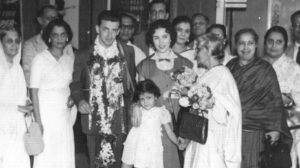
Traditional Bene Israel weddings were elaborate multi-day affairs that combined Jewish religious ceremony with the social customs of Maharashtrian community life. The henna ceremony, known as the mehndi in Indian tradition and adapted by the Bene Israel with its own specifically Jewish ritual elements, preceded the wedding and involved the beautification of the bride and the gathering of women from both families for singing and celebration. The wedding ceremony itself incorporated both the Hebrew religious rites required by Jewish law and the Indian cultural elements that had become part of the Bene Israel tradition over centuries.
The wedding feast, always the most elaborate meal in a community’s culinary repertoire, featured the full range of Bene Israel specialties. Fish dishes, chicken preparations, rice cooked with aromatic spices, and the sweet coconut-based desserts that mark Bene Israel celebrations all appeared on the wedding table. The combination of Hebrew blessings over the food and the specifically Indian spice combinations in the dishes themselves created a sensory experience that was uniquely Bene Israel.
Intercultural Weddings Today
Contemporary Indian Jewish weddings, particularly those in Israel and the wider diaspora, often involve partners from different cultural backgrounds. The wedding of a Bene Israel person with an Ashkenazi Israeli, an American Jew of Eastern European descent, or someone from a completely non-Jewish background requires negotiation between different culinary and cultural traditions that can produce either confusion or creativity, depending on the spirit in which the families approach the challenge.
The most successful intercultural Indian Jewish weddings are those that treat the blending of traditions as an occasion for celebration rather than compromise. A wedding menu that includes both Bene Israel chicken curry and Ashkenazi gefilte fish, both Indian sweets and Western pastries, says something positive about the willingness of both families to honor what the other brings. The food becomes a medium through which the two cultures acknowledge each other and commit to a future that will contain both.
What Gets Preserved, What Gets Lost
The intercultural wedding is also a site where questions about cultural transmission are negotiated, often without explicit discussion. Which traditions will the couple maintain in their home? Whose family’s recipes will become the standard for holiday celebrations? What language will children learn for their Jewish education? These questions, resolved gradually through the daily negotiations of life together, determine what of the Indian Jewish cultural heritage will survive into the next generation. The wedding, with all its ritual and festivity, is the beginning of this long process of mutual adaptation and creative synthesis.