
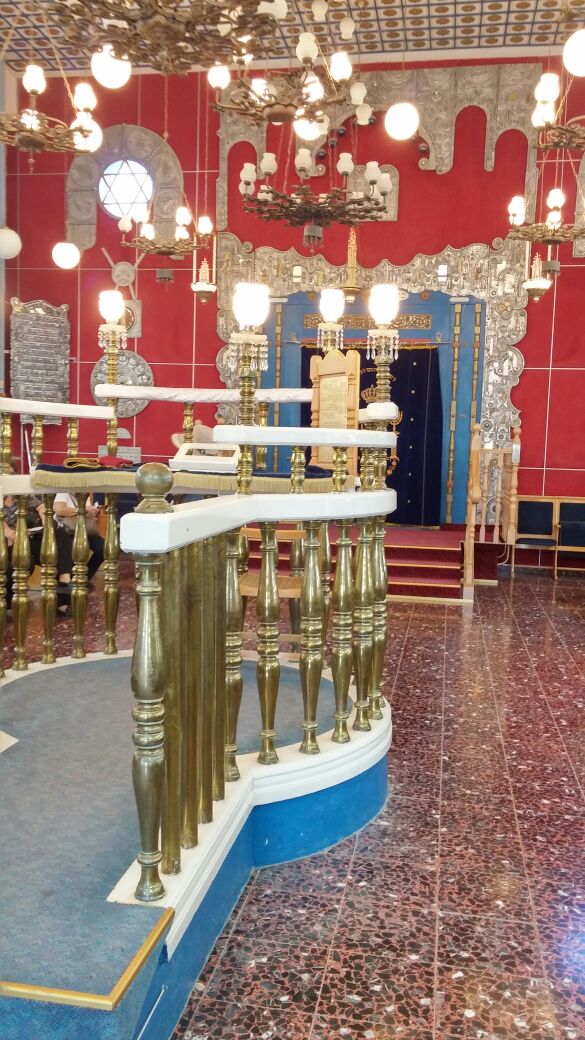
The Jews of India: A Story of Three Communities, edited by Orpa Slapak and published by the Israel Museum in Jerusalem in 1995, is the catalog of a major museum exhibition that brought together objects, photographs, and scholarly essays documenting the material and religious culture of India’s three historic Jewish communities: the Cochin Jews of Kerala, the Bene Israel of the Konkan coast and Bombay, and the Baghdadi Jews of Bombay and Calcutta. At 215 pages, the catalog remains one of the most substantial single-volume treatments of Indian Jewish material culture produced by any major museum, drawing on the Israel Museum’s own holdings alongside loans and photographic documentation gathered specifically for the exhibition.
An Exhibition Built Around Objects
As a museum catalog rather than a conventional scholarly monograph, The Jews of India organizes its material around physical objects: ceremonial silver, textiles, illuminated marriage contracts, synagogue furnishings, and devotional items that Cochin, Bene Israel, and Baghdadi Jewish families carried with them, or that were left behind in Indian synagogues, as the communities underwent mass emigration to Israel in the decades following the country’s founding in 1948. Many of the objects documented in the catalog had themselves traveled the same migratory path as their owners, arriving in Israel as part of household collections brought by Cochin, Bene Israel, and Baghdadi families resettling from India, before eventually finding their way into the Israel Museum’s own collection or into the hands of contributors who loaned pieces for the 1995 exhibition.
This object-centered approach gives the catalog a documentary character distinct from more narrative histories of Indian Jewry. Rather than tracing migration patterns, demographic change, or communal institutions primarily through text, Slapak’s catalog lets physical artifacts carry much of the historical argument: a Torah ark from a Cochin synagogue, a Bene Israel wedding costume, a Baghdadi Jewish ceremonial Kiddush cup, each object serving as evidence of both the distinctiveness of each community’s regional adaptation and the underlying continuity of Jewish religious practice that all three communities maintained across centuries of separation from the wider Jewish world.
Three Communities, One Exhibition
The decision to present all three of India’s historic Jewish communities within a single exhibition and catalog reflected a broader museological and scholarly recognition, gaining momentum through the 1990s, that Indian Jewry could not be adequately understood by studying any single community in isolation. The Cochin Jews, whose roots in Kerala are traditionally dated back roughly two thousand years and who developed distinctive relationships with the region’s caste-based social structure; the Bene Israel, who trace their origins to a shipwreck on the Konkan coast and whose relative isolation from normative rabbinic practice was gradually corrected through contact with Cochin Jews and later European visitors beginning in the eighteenth century; and the Baghdadi Jews, whose merchant families arrived from Iraq and Aleppo beginning in the late eighteenth century and built substantial trading networks across Bombay, Calcutta, and greater Asia, each followed a genuinely distinct historical path to becoming part of what outside observers, and eventually the communities themselves, came to think of collectively as “the Jews of India.”
By juxtaposing objects and essays from all three communities within a single catalog, Slapak’s project allowed readers and museum visitors to observe both the sharp differences, in language, regional custom, and even physical appearance, that distinguished Cochin, Bene Israel, and Baghdadi Jews from one another, and the underlying threads of shared religious practice, dietary law, life-cycle ritual, and eventual attachment to the state of Israel, that justified treating them as a coherent subject for a single museum exhibition.
A Museum’s Role in Preserving Diaspora Heritage
The Israel Museum’s undertaking of this project reflects the broader role major Israeli cultural institutions have played in documenting and preserving the material heritage of Jewish diaspora communities that, through mass emigration to Israel over the second half of the twentieth century, effectively transplanted their remaining physical culture from their countries of origin to Israeli soil. For India’s Jewish communities specifically, whose members emigrated overwhelmingly to Israel between the 1950s and 1970s, the Israel Museum’s holdings and its 1995 exhibition catalog represent one of the most significant institutional efforts to catalog and interpret this transplanted heritage, offering both the small population of Indian Jews still living in India and the far larger emigrant community now settled in Israel a single authoritative visual and scholarly record of what these three communities created and carried with them across their long histories.
A Lasting Reference Work
Three decades after its 1995 publication, The Jews of India: A Story of Three Communities remains a frequently cited reference for researchers, museum curators, and general readers seeking a single, well-illustrated introduction to the material culture of Cochin, Bene Israel, and Baghdadi Jewry side by side. Its object-based approach complements more text-driven scholarly and documentary works on Indian Jewry, offering a visual dimension, photographs of synagogue interiors, ceremonial silver, textiles, and manuscripts, that narrative histories alone cannot fully convey, and cementing its place as one of the essential reference works for anyone approaching the study of India’s Jewish communities through their surviving material heritage.
Documenting a Community in Transition
The timing of Slapak’s exhibition, mounted in 1995, roughly four decades after the peak years of Indian Jewish emigration to Israel, meant that the catalog was produced at a moment when direct access to the generation who had actually lived in India before emigrating was still possible, but increasingly limited to older adults whose memories of pre-emigration life were growing more distant with each passing year. This gave the project a particular urgency: many of the objects and much of the contextual knowledge needed to interpret them correctly depended on a generation of Indian-born, Israeli-resident Cochin, Bene Israel, and Baghdadi Jews who could still explain how a given ceremonial object had been used, where it had come from, and what it had meant within the specific communal context of Kerala, the Konkan coast, or Bombay and Calcutta before their own emigration.
In this sense the catalog functions as more than an art historical document; it is also a work of applied memory preservation, produced through consultation with community members and family collections at a point when doing so was still feasible in a way it may not be for future curators attempting similar projects a generation or two further removed from direct experience of Jewish life in India itself.
Complementing Later Scholarship
Slapak’s 1995 catalog predates, and in some respects anticipated, later object- and ritual-focused scholarship on Indian Jewry, including Shalva Weil’s 2006 edited volume India’s Jewish Heritage: Ritual, Art and Life Cycle, produced for Mumbai’s Marg Publications. Read together, the two works, one an Israeli museum’s catalog produced primarily from objects that had already migrated to Israel with their owning families, the other an India-based publisher’s anthology focused on material still standing or held within India itself, offer complementary vantage points on the same underlying subject: how ceremonial objects, synagogue architecture, and life-cycle ritual served as vehicles of continuity for India’s Jewish communities across centuries of relative isolation, and how that material inheritance has since been divided between the country where it originated and the country to which the overwhelming majority of its communities eventually relocated.
For contemporary readers, the enduring value of The Jews of India: A Story of Three Communities lies in its accessibility: unlike specialist academic monographs focused on a single community, Slapak’s catalog offers a single, richly illustrated point of entry into all three of India’s historic Jewish traditions at once, making it a useful starting point for museum visitors, students, and descendants of Cochin, Bene Israel, and Baghdadi families alike who want a visual and material introduction to the full breadth of Indian Jewish heritage before turning to the more specialized community-specific scholarship that has continued to expand in the decades since the exhibition first opened.