
In 2001, University Press of New England published Jewish Portraits, Indian Frames: Women’s Narratives from a Diaspora of Hope, by the Calcutta-born scholar and activist Jael Silliman, working in arrangement with Seagull Books. The book traces four generations of Silliman’s own Baghdadi Jewish family in Calcutta through the voices of its women, offering a rare first-person account of a community whose more conventional histories – focused on merchant fortunes, synagogue architecture, and communal leadership – have tended to center men’s public lives rather than women’s domestic and social experience.
A Family History Told Through Women’s Voices
Silliman’s own family origins trace to Aleppo, in present-day Syria, part of the same Judeo-Arabic-speaking merchant diaspora that produced Calcutta’s mercantile Baghdadi Jewish elite – families such as Sassoon, Ezra, Elias, Gubbay, Belilios, and Judah, whose wealth from trade in cotton, jute, spices, and opium funded the city’s grandest synagogues. Rather than retelling that familiar story of commercial success, Silliman structured her book around the recorded testimony and recollection of the women in her own family across four generations, using their voices to reconstruct a domestic and social history of Calcutta’s Baghdadi Jewish community that conventional archival sources – trade ledgers, synagogue records, colonial administrative documents – were never designed to capture.
This method allowed Silliman to document aspects of communal life that fall outside the usual focus of economic and institutional history: how Baghdadi Jewish women in Calcutta managed households that straddled Judeo-Arabic tradition and British colonial society, how marriages were arranged and experienced, how the community’s dietary laws and domestic religious practice were maintained across generations, and how women in particular navigated the community’s eventual mass emigration after Indian independence in 1947 and the establishment of Israel in 1948 – a decision that, for many families, fell disproportionately to women to manage as households were dismantled and relocated across continents.
Calcutta’s Baghdadi Community as Backdrop
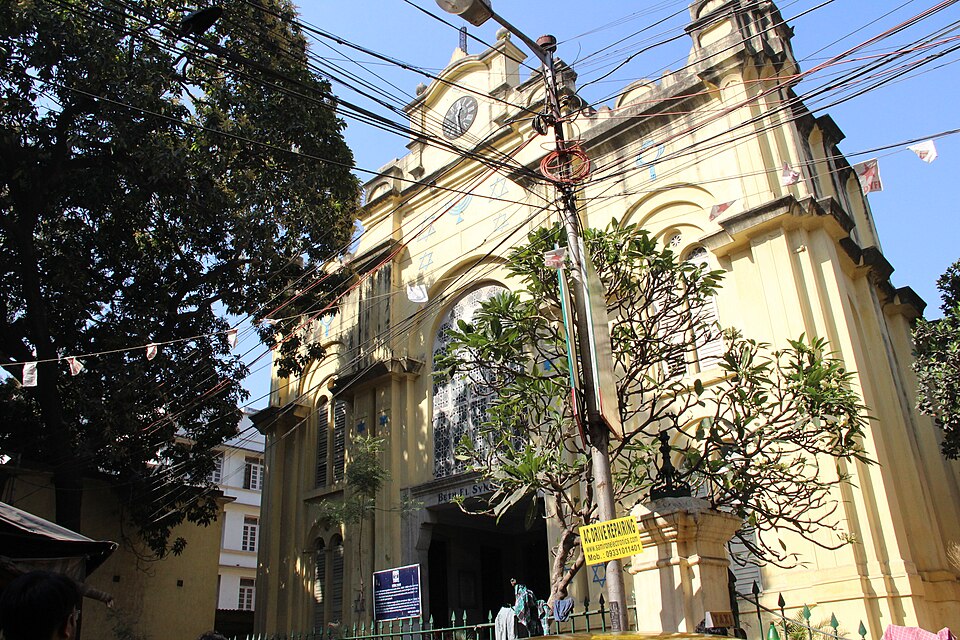
The community Silliman’s family belonged to had been established in Calcutta since 1798, when the merchant Shalom Obadiah Cohen, born in Aleppo, arrived in the city and began a pattern of Baghdadi and Aleppo-born Jewish settlement that would make Calcutta the hub of a trading diaspora stretching from Baghdad to Rangoon, Singapore, Hong Kong, and Shanghai. At its wartime peak during the Second World War, the community numbered over 6,000, swelled by refugees from smaller Baghdadi Jewish communities elsewhere in Asia fleeing Japanese invasion. Synagogues including the Maghen David and Beth El, built and endowed by the community’s merchant elite, anchored a religious and social life that Silliman’s book renders not through institutional history but through the domestic memory of the women who lived within it.
By the time Silliman was collecting this testimony, that community had already undergone the rapid post-1947 emigration that reduced Calcutta’s Baghdadi Jewish population to a small fraction of its historical size, with most families relocating to Australia, Canada, Great Britain, Israel, and the United States. This gives the book’s oral-history method a particular urgency: the women whose voices Silliman recorded were, in many cases, among the last generation to have direct memory of Calcutta’s Baghdadi Jewish community as a functioning, demographically substantial religious and social world, rather than as a historical memory maintained mainly by descendants scattered abroad.
Part of a Larger Body of Work
Jewish Portraits, Indian Frames was not an isolated project for Silliman but part of a sustained engagement with Calcutta’s Jewish heritage that has continued across her career. She has since presented on “Recalling Jewish Calcutta” at Skidmore College’s Jacob Perlow Lecture Series and spoken on “Archival Cartographies: Multi-layering Calcutta’s Baghdadi Jewish Community” at an international conference on the art, culture, and heritage of the Jews of India held at the Indira Gandhi National Centre for the Arts in New Delhi. This ongoing work situates her 2001 book as an early and formative contribution to a wider, still-developing effort – by Silliman and by other researchers and family members – to build a lasting public archive of Calcutta Baghdadi Jewish life before the last generation with direct memory of the community passes on.
A Different Kind of Historical Source
Read alongside more institutionally focused histories of Calcutta’s Baghdadi Jews, such as Flower Elias and Judith Cooper’s community-authored account of the same community’s merchant families and synagogues, Silliman’s book fills a distinct gap: where Elias and Cooper documented the community’s public institutions and prominent families, Silliman documented its private, domestic, and specifically female experience, using oral testimony methods closer to feminist oral history than to conventional communal chronicle. The two books, produced roughly a quarter-century apart, together give a fuller picture of Calcutta’s Baghdadi Jewish community than either could provide alone – one oriented toward the synagogues, trade networks, and communal leadership that defined the community’s public face, the other toward the household relationships and personal decisions that defined its private one.
For readers interested in the human dimension of the Baghdadi Jewish diaspora’s dispersal from India, rather than only its institutional and economic history, Silliman’s book remains one of the few sustained efforts to record that dimension directly in the words of the women who lived through it, at a moment when doing so was still possible.
Silliman’s Later Career and Its Roots in This Project
Jewish Portraits, Indian Frames also marked a turning point in Silliman’s own career trajectory, coming after her doctoral studies in education at Columbia University and preceding a career largely devoted to gender, reproductive rights, and international development work. Her subsequent book, Undivided Rights: Women of Color Organize for Reproductive Justice, co-authored with Marlene Gerber Fried, Loretta Ross, and Elena Gutierrez, won the 2005 Gustavus Myers Outstanding Book Award, placing Silliman among a small number of authors who have written substantively both on Indian Jewish family history and on entirely separate fields of American social justice scholarship. This dual career gives her 2001 book on Calcutta’s Baghdadi Jewish women a methodological grounding in feminist research practice that a writer working exclusively within Jewish studies or South Asian history might not have brought to the same project.
Silliman went on to publish several further works exploring Calcutta and Indian themes through fiction and memoir, including The Man With Many Hats (2013), The Teak Almirah (Milestone Books, 2016), Where Gods Reside (Niyogi Books, 2018), and ADDA! The College Street Coffee House (Notion Press, 2020), suggesting that the family history she first documented in Jewish Portraits, Indian Frames continued to shape her creative and scholarly work for two decades afterward, even as her professional career moved into entirely different fields.
Documenting a Community Through Its Departures
A recurring theme throughout Silliman’s account is the experience of leave-taking itself: the practical and emotional work of closing a household, deciding what possessions could be carried into emigration and what had to be abandoned or sold, and maintaining family and religious continuity across the sudden geographic dispersal that followed 1947 and 1948. Because this experience touched nearly every family in Calcutta’s Baghdadi Jewish community within the span of a few decades, Silliman’s account of her own family’s departures functions as something close to a representative case study of a pattern repeated, with variations, across the community as a whole – even though her book makes no claim to be a comprehensive or statistically representative survey of that wider experience.
A Book Rooted in Two Cities
Silliman’s own biography – dividing her adult life between New York City and Calcutta – mirrors the transnational structure of the family history she documents, in which the same family maintained active ties to both the city its ancestors had built a life in and the cities its descendants scattered to after the community’s decline. This lived experience of maintaining a foot in both worlds appears to have shaped her decision to focus the book on domestic continuity and family memory across dispersal, rather than treating emigration as a single, final rupture after which the community’s story effectively ends. For Silliman, and for the women whose testimony she recorded, Calcutta’s Baghdadi Jewish community did not simply disappear in the decades after independence; it was carried forward, in altered form, in the households, memories, and continuing family relationships of the women who had once lived within it.
That framing gives Jewish Portraits, Indian Frames a somewhat different emotional register than the elegiac tone common to much writing about India’s vanishing Jewish communities. Rather than presenting Calcutta’s Baghdadi Jews purely as a community in terminal decline, Silliman’s account, built from direct family testimony, treats the diaspora itself – the dispersed households in New York, London, Sydney, and Tel Aviv that trace their origin to the same Calcutta streets and synagogues – as a legitimate continuation of the community’s story, carried forward through the women who managed its transition from one geography to several.
This is, ultimately, what distinguishes Silliman’s book within the broader literature on Indian Jewish history: it is less a history of a community’s ending than a family’s account of its own continuation.
That distinction is worth keeping in mind for any reader approaching the book expecting only a chronicle of decline: what Silliman actually offers is a record of endurance, told at the scale of a single family, standing in for a much larger and still only partially documented communal story.