
In 2016, the Kolkata-based researcher and writer Dalia Ray published The Jews of India through Renaissance Publishers, extending a body of documentary work she had begun fifteen years earlier with The Jewish Heritage of Calcutta (Minerva Associates, 2001). Where her first book focused narrowly on the surviving synagogues, cemeteries, and institutions of her own home city, The Jews of India broadened that documentary approach to all three of India’s historic Jewish communities – the Bene Israel, the Cochin Jews, and the Baghdadi Jews – treating each as a distinct heritage worth recording in its own right rather than folding them into a single undifferentiated narrative.
A Heritage-Documentation Approach
Ray’s background as a chronicler of Calcutta’s physical Jewish heritage – its synagogues, cemeteries, and surviving communal buildings – shapes the distinctive angle of her broader survey. Rather than writing primarily as an academic historian working through archival sources, Ray approaches India’s Jewish communities the way a heritage documentarian approaches any endangered physical and cultural legacy: cataloguing what still stands, noting what has already been lost, and recording testimony from the diminishing number of community members still living in India while that testimony remains available to collect. This method places her book in a tradition closer to heritage conservation writing than to conventional academic history, complementing rather than duplicating the more narrowly scholarly surveys of Indian Jewry produced by academic historians such as Nathan Katz and Joan Roland.
This distinction matters because India’s three Jewish communities have left behind a physical heritage – synagogue buildings, cemeteries, ritual objects, domestic architecture – that is disappearing at a different pace than the demographic decline of the communities themselves. A synagogue can continue standing, and its ritual objects can continue to exist, for decades after the last resident congregation capable of using them for regular worship has emigrated or passed away. Documenting that physical heritage before it deteriorates further, independent of whether an active congregation still exists to maintain it, is a task with its own urgency, separate from the study of the communities’ history and social structure that occupies most academic writing on the subject.
The Bene Israel of Bombay and the Konkan
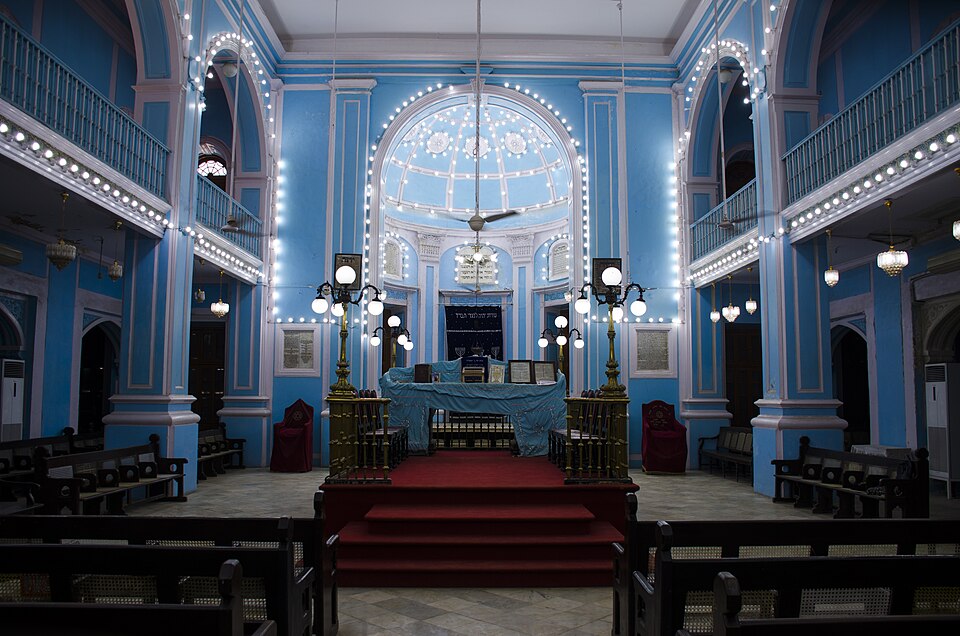
Ray’s survey necessarily engages with the Bene Israel, India’s largest historic Jewish community, whose origin tradition holds that fourteen shipwreck survivors reached the Konkan coast near the village of Navagaon in ancient times, fleeing persecution in Judea. Concentrated for centuries in Konkan villages before relocating to Bombay, Pune, and other cities from the late eighteenth century onward, the Bene Israel built synagogues across Bombay – including the Byculla neighborhood’s Magen David Synagogue, among the largest and most architecturally significant synagogues built by any Jewish community in Asia – as their numbers and prosperity grew through the nineteenth and early twentieth centuries. A heritage-focused survey like Ray’s has particular reason to dwell on buildings such as Magen David, since their scale and craftsmanship offer some of the most visible physical evidence of how substantial the Bene Israel community’s presence in Bombay once was, in a way that population statistics alone cannot fully convey.
The Cochin Jews of Kerala
In Kerala, Ray’s survey would necessarily address the Paradesi Synagogue in Kochi’s Jew Town, among the most visited Jewish heritage sites in India today, alongside the several Malabari synagogues that once served the wider Cochin Jewish community in towns such as Ernakulam, Parur, Chennamangalam, and Mala. The Cochin community’s own copper-plate grant of privileges to the medieval merchant leader Joseph Rabban gives this community a documentary claim to antiquity that a heritage-focused book can treat as a physical artifact in its own right, alongside the synagogue buildings themselves, the community’s distinctive tiled floors and hanging lamps, and the Judeo-Malayalam manuscript traditions that Cochin Jewish women in particular maintained through devotional songs passed down across generations.
The Baghdadi Jews of Bombay and Calcutta
The Baghdadi Jewish community gives Ray’s book its most direct connection back to her earlier work on Calcutta specifically. Baghdadi Jewish merchants, arriving first in Calcutta from 1798 and building parallel communities in Bombay, constructed some of the grandest synagogues in the Baghdadi Jewish diaspora – Calcutta’s Maghen David and Beth El synagogues among them – funded by merchant families such as Sassoon, Ezra, Elias, and Gubbay, whose wealth derived from trade in cotton, jute, spices, and opium across a network stretching from Baghdad to Shanghai. Having already documented Calcutta’s Baghdadi Jewish heritage in detail in her 2001 book, Ray was well positioned to place that community’s surviving synagogues and cemeteries in comparative context alongside Bombay’s parallel Baghdadi Jewish institutions when she expanded her documentary project to cover the whole of Indian Jewry.
Why a Documentary Survey Complements Academic History
Books like Ray’s serve a function that purely academic histories often cannot: they create an accessible visual and descriptive record of what remains of India’s Jewish heritage at a moment when very few resident community members remain to maintain or explain it firsthand. As emigration to Israel and elsewhere has reduced all three communities to a small fraction of their historical populations, responsibility for the physical maintenance of synagogues, cemeteries, and ritual objects has increasingly fallen to heritage trusts, tourism authorities, and a handful of remaining community members and their descendants abroad, rather than to functioning resident congregations. A documentary survey conducted while some of that transitional generation could still describe how a synagogue had once been used, or which cemetery held which family’s graves, captures information that risks disappearing entirely once no one remains who experienced the community’s active religious life firsthand.
Read alongside more narrowly focused works – her own earlier book on Calcutta, or community-authored histories such as S.S. Koder’s account of Cochin or Flower Elias and Judith Cooper’s history of Calcutta’s Baghdadi Jews – Ray’s broader survey functions as a connective document, allowing a reader to see India’s three historic Jewish communities’ surviving heritage sites in relation to one another rather than only within the boundaries of a single city or region.
Cemeteries as Overlooked Heritage
One category of heritage that documentary surveys like Ray’s are especially well positioned to address, and that purely textual academic histories sometimes pass over quickly, is the Jewish cemeteries scattered across India’s port cities and former colonial centers. Calcutta, Bombay, and Kochi each retain Jewish burial grounds containing gravestones spanning two centuries or more, inscribed in Hebrew, English, and sometimes Judeo-Arabic or Judeo-Malayalam, recording the names of merchant families, religious leaders, and ordinary community members whose synagogue records may not have survived even where the cemetery itself has. These sites face a particular kind of neglect distinct from the challenges facing synagogue buildings: a cemetery has no obvious ongoing use once burials cease, no congregation to advocate for its restoration, and often only a handful of overseas descendants with any personal stake in its maintenance. Photographing and transcribing what remains legible on these gravestones, before weathering and urban development erode them further, is precisely the kind of documentary task a heritage-focused survey is positioned to prioritize in a way that a conventional academic monograph organized around historical argument rather than physical preservation might not.
The Question of Audience
Ray’s choice to publish through a Kolkata-based commercial press rather than an international academic publisher also shaped who her book was likely to reach first: a readership within India, including descendants of the very communities she was documenting, heritage tourists visiting synagogue sites in Mumbai, Kochi, and Kolkata, and researchers who might not otherwise encounter the more specialized academic literature on Indian Jewry published by university presses abroad. That domestic orientation is itself a meaningful complement to the international academic literature on Indian Jewish history, much of which has been written by scholars based in the United States, Israel, or Europe and published primarily for university libraries and specialist readers rather than for the general Indian public encountering this heritage in their own cities for the first time.
This domestic framing also carries practical stakes for heritage preservation itself. Restoration funding, government heritage listings, and tourism infrastructure for sites such as the Paradesi Synagogue or Bombay’s Magen David Synagogue depend substantially on domestic Indian institutions and, increasingly, on India’s own heritage tourism industry, rather than solely on the diminishing Jewish community itself or on overseas Jewish philanthropy. A book written primarily for an Indian audience and published by an Indian press arguably does more to build the domestic constituency that actual preservation work depends on than an academic study aimed at specialist readers abroad, even if the latter carries more weight within Jewish studies as a scholarly discipline. In that sense, Ray’s book functions simultaneously as a historical record and as a quiet advocacy document for continued heritage preservation, aimed at exactly the domestic audience with the most practical ability to affect whether these synagogues and cemeteries survive for another generation.
For readers approaching India’s Jewish heritage for the first time, Ray’s book therefore serves best as a companion to on-the-ground visits to the surviving synagogues themselves, filling in the historical and architectural context that a plaque or guided tour cannot always provide, and connecting what a visitor to Kochi’s Jew Town or Mumbai’s Byculla neighborhood can see in person to the wider story of all three of India’s Jewish communities.