
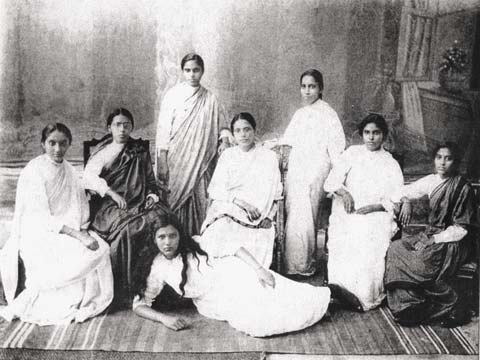
In 1913, Rebecca Reuben, a young Bene Israel educator who had just completed her studies in Hebrew and Jewish education at the University of London and Cambridge University, published a short but significant pamphlet titled The Bene Israel of Bombay. Printed initially by the University Press and later reissued by Cambridge University Press, the twenty-page work was one of the earliest accounts of the Bene Israel community written by a member of the community itself, rather than by the British missionaries and colonial administrators who had produced most prior descriptions of Bene Israel life and religious practice.
An Extraordinary Life Behind a Modest Book
To understand why Reuben’s short pamphlet carries outsized historical importance, it helps to understand who she was. Born in 1889 in Shimoga, in what is now Karnataka, Rebecca Reuben Nowgaokar came from a family deeply embedded in Bene Israel communal and intellectual life. Her paternal grandfather, Rubenji Suri Nowgaoker, had been a Marathi poet in the early nineteenth century, while her maternal grandfather, Avraham Samuel Nagavekar, was among the first academically trained professionals to emerge from the Bene Israel community, himself the son of Major Samuel Moses Nagavekar, a senior officer who had served during the Indian Revolt of 1857. Her father was a lawyer and later a judge, and her mother was among the first women from the community to complete a university degree — a household, in other words, defined by an unusually strong commitment to education across multiple generations.
Reuben’s own educational path was remarkable in its own right. Educated at a multilingual girls’ boarding school in Pune that taught in Marathi, Sanskrit, and English, she learned Hebrew from her father during school holidays and, in 1905, became the first woman to achieve the highest score on the entrance examinations to Mumbai University. Rather than pursuing the science career her exam results might have supported, she chose education, eventually travelling to England to study pedagogy at the University of London before continuing to Cambridge University, where she studied Hebrew and Jewish studies under the noted scholar Israel Abrahams.
Writing From Inside the Community
It was upon her return to India in 1913 — the same year her pamphlet on the Bene Israel of Bombay appeared — that Reuben began the long teaching career that would define her public life. She taught first at general schools, including the very boarding school in Pune she had attended as a student, before being appointed principal of a teacher training college in Baroda in 1920. She later returned to Bombay to focus specifically on Bene Israel community education, eventually directing the community’s School Committee from 1922 to 1950, a role in which she shaped the education of Bene Israel children across nearly three decades of enormous change in India, from the late colonial period through independence in 1947.
This combination — a trained Hebraist and pedagogue, writing about her own community’s history and customs rather than observing it from outside — is precisely what makes The Bene Israel of Bombay historically valuable despite its brevity. Unlike the accounts produced by nineteenth-century Christian missionaries such as John Wilson, whose own study of the Bene Israel was shaped by conversionary interests, or later academic ethnographers writing decades afterward, Reuben’s pamphlet offered an early, insider’s articulation of Bene Israel identity, communal structure, and religious life, produced by someone with both the scholarly training to engage international Jewish studies discourse and the lived experience of belonging to the community she described.
A Life That Bridged India and Zionism
Reuben’s engagement with Jewish education did not stop at documenting the past. In 1947, in the pivotal year before Israeli statehood, she travelled to Mandatory Palestine on a mission from the Mumbai Zionist Association, representing Indian Jews at the first international conference on Hebrew education in the diaspora, held that year in Jerusalem. Her recorded reflections on the visit reveal a woman deeply moved by what she witnessed, describing the sight of a language and land being renewed. This Zionist commitment ran alongside, rather than in tension with, her lifelong dedication to Jewish life and education within India — she remained in Bombay even as much of the Bene Israel community emigrated to Israel in the years following 1948, continuing her educational and public service work in the city until her death in 1957.
Situating the Pamphlet Within Bene Israel Historiography
Reuben’s 1913 work should be read alongside, rather than as a replacement for, other foundational texts on the Bene Israel community: John Wilson’s nineteenth-century missionary account, Haeem Samuel Kehimkar’s 1937 communal history The History of the Bene Israel of India, and later twentieth-century ethnographic and academic studies produced by researchers such as Schifra Strizower and Shirley Isenberg. Where those works range from missionary observation to book-length academic synthesis, Reuben’s contribution is distinguished by its brevity, its early date, and above all by the standpoint of its author: a Bene Israel woman, trained in Hebrew scholarship at Cambridge, writing about her own people at a moment when very few members of the community had access to that kind of international academic platform.
For researchers and general readers interested in the Bene Israel community’s own historical self-understanding — as opposed to accounts filtered entirely through outside observers — Reuben’s pamphlet, brief as it is, remains a foundational primary source. It stands not only as an early scholarly document but as a testament to the broader life of a woman who spent more than four decades shaping Bene Israel education, bridging rigorous international Jewish scholarship with a lifelong, practical commitment to the community into which she was born.
Education as Communal Preservation
Reuben’s decades-long tenure directing the Bene Israel School Committee in Bombay placed her at the center of a community grappling with how to preserve Jewish religious identity and Hebrew literacy while its members increasingly participated in a broader, English-medium colonial and later post-independence Indian society. The schools she oversaw had to balance several goals at once: teaching Hebrew and religious tradition to the level required for synagogue life and eventual emigration to Israel, providing a general education adequate for participation in Bombay’s professional economy, and maintaining a distinct communal identity in a city where Bene Israel families lived alongside Hindus, Muslims, Parsis, and Christians. This balancing act, largely invisible in a short 1913 pamphlet written before most of that institutional work had even begun, nonetheless grew directly out of the same impulse that produced the book: a conviction that the Bene Israel community’s history, religious practice, and identity deserved serious, informed documentation and transmission rather than being left to fade or to be described solely by outsiders.
Reuben was also known to have written short stories and contributed translations of Indian folk literature into Hebrew for community newspapers, a body of work that, like her 1913 pamphlet, remains far less discussed than it deserves. Taken together, her writing and her decades of institutional leadership represent one of the most sustained individual contributions to Bene Israel communal life in the twentieth century, and her early pamphlet stands as the first documented expression of that lifelong project.
Copies of the original 1913 and later Cambridge editions of The Bene Israel of Bombay are today held mainly in specialist university and Judaica library collections, making the pamphlet difficult for general readers to access directly. Its significance, however, lies less in its physical rarity than in what it represents: one of the first moments in which a Bene Israel voice, trained in the same Hebrew and Jewish studies scholarship used by European and American academics, spoke directly to that scholarly world about her own community, rather than being spoken about by it. For anyone tracing the intellectual history of the Bene Israel community and the broader question of how Indian Jewish communities came to narrate their own histories, Rebecca Reuben’s short 1913 work marks an essential, if easily overlooked, starting point.