
Published in 1975 by the Christopher Publishing House, On the Banks of the Ganga: The Sojourn of Jews in Calcutta is a 568-page history by Rabbi Ezekiel N. Musleah, a Calcutta-born rabbi who went on to a long career leading historic American congregations. Decades before more recent documentary studies of Jewish Calcutta appeared, Musleah produced what remains one of the most substantial single accounts of the city’s Baghdadi Jewish community, drawing on his own upbringing inside that community as well as archival research into its two-century history.
A Rabbi Writing His Own Community’s History
Ezekiel N. Musleah was born in 1927 into Calcutta’s Jewish community and later emigrated to the United States, where he built a rabbinic career of considerable standing. In 1964 he joined Congregation Mikveh Israel in Philadelphia, one of the oldest and most historic Sephardic congregations in America, serving as its minister until 1979. He then moved to the Historic Congregation B’nai Abraham, also in Philadelphia, where he served from 1979 to 1982. He died in 2020 at the age of ninety-three. On the Banks of the Ganga, published in 1975 while Musleah was still serving at Mikveh Israel, represents the major scholarly project of his career, an attempt to set down, comprehensively and from the inside, the history of the community into which he had been born.
That insider perspective distinguishes Musleah’s book from later documentary studies of Jewish Calcutta produced by researchers approaching the subject from outside the community. Musleah had direct, lived access to the synagogues, family networks, and communal memory of Calcutta Jewry at a point when the community, though already in decline from its wartime peak, still retained many members with firsthand knowledge of its nineteenth and early twentieth century heyday.
Tracing the Community to Its Founder
The book’s historical narrative reaches back to the origins of Calcutta’s Baghdadi Jewish community in the person of Shalom Cohen, a Baghdadi Jewish merchant who is credited with founding the community after a peripatetic career as a court jeweler, serving first the Nawab of Awadh and later Ranjit Singh, the Sikh Empire’s founding leader, in Punjab. Communal memory recalled Cohen being granted the honor of riding alongside the Nawab of Awadh on his personal elephant, an anecdote emblematic of the close, often personally intimate relationships Baghdadi Jewish merchants cultivated with the courts and rulers of the Indian subcontinent as they built trading networks that eventually stretched from Baghdad through Surat and Bombay to Calcutta and onward across Asia. Musleah situates Calcutta’s Jewish community within this broader pattern of Baghdadi Jewish mercantile migration, while giving close attention to the specific institutions, the synagogues, cemeteries, and family networks, that Cohen’s foundational community and its successors built in the city over the following two centuries.
An Authoritative and Often-Cited Source
In the decades since its publication, On the Banks of the Ganga has become one of the standard references cited by later historians researching Calcutta’s Jewish community and its institutions. Historical accounts of Calcutta landmarks such as the Park Street Cemeteries and the city’s colonial-era civic institutions have drawn on Musleah’s research, and the book continues to appear in bibliographies and citation lists of subsequent scholarship on Baghdadi Jewish history in India, a testament to the thoroughness of Musleah’s original archival work at a time when many of the primary sources he consulted, communal records, synagogue registers, and the testimony of elderly community members, were still readily accessible in a way they might not be for researchers today.
A Book from Calcutta’s Peak Before Its Decline
Musleah wrote at an important juncture in the community’s history. By 1975, Calcutta’s Jewish population had already fallen dramatically from its wartime peak of more than six thousand members, as emigration to Israel, Britain, Australia, Canada, and the United States following Indian independence and the birth of the Jewish state steadily thinned the ranks of a community that had once supported multiple synagogues, schools, and charitable institutions. Musleah’s own emigration and rabbinic career in America mirrored this broader pattern even as he devoted himself to documenting the community he had left behind, producing what amounts to both a scholarly history and, in retrospect, something close to a memorial record of a community already well into its decline by the time the book appeared.
Why the Book Endures
At 568 pages, On the Banks of the Ganga remains one of the most comprehensive single-volume treatments of any of India’s Jewish communities, considerably longer and more detailed than most of the documentary and academic studies that followed it. Its combination of an insider’s access to communal memory with the rigor of sustained archival research has made it a foundational text for subsequent scholars and writers addressing Calcutta’s Baghdadi Jewish history, from academic historians to the more recent generation of documentary researchers and memoirists who have continued to record what remains of a community that, like so much of India’s Jewish population, has largely emigrated over the past century, leaving Musleah’s history as one of the fullest surviving records of what that community once was.
The Merchant Families and Their Institutions
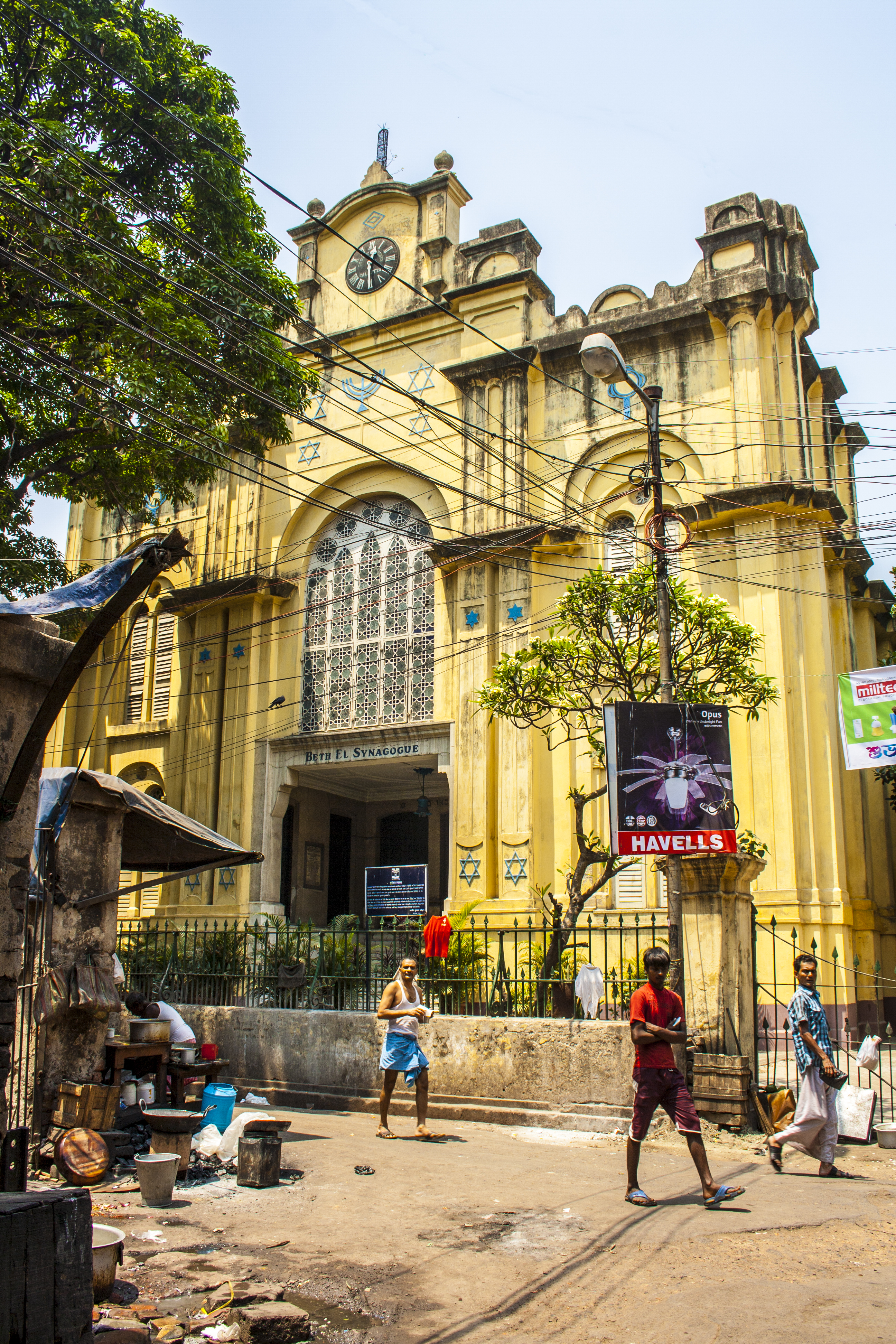
Much of Musleah’s narrative traces the rise of the mercantile families who came to dominate Calcutta’s Jewish communal life in the nineteenth century, among them the Ezra, Sassoon, Elias, Gubbay, Belilios, and Judah families, whose fortunes in the cotton, jute, spice, and opium trades funded the construction of the city’s major synagogues and endowed schools and charitable institutions that served the community for generations. The Magen David Synagogue on Canning Street, built in 1884 by Elias David Ezra in memory of his father David Joseph Ezra, and the older Neveh Shalome and Beth El synagogues, all receive sustained attention in Musleah’s account, which treats these buildings not simply as architecture but as expressions of a communal identity built through commerce and sustained through religious and philanthropic institution-building over roughly two centuries.
Musleah also documents the wider network these Calcutta families maintained across Asia, linking the city’s Jewish merchants to counterparts in Rangoon, Singapore, Hong Kong, and Shanghai, and back to the Middle Eastern centers of Baghdad and Aleppo from which the community’s founders had originally come. This transnational dimension of the book, tracing how a single trading diaspora knit together Jewish communities across an entire continent, distinguishes Musleah’s history from more narrowly local accounts and situates Calcutta’s Jewish story within the much larger, and still understudied, history of Baghdadi Jewish mercantile networks across colonial Asia.
Writing History from Within American Rabbinic Life
It is worth noting the somewhat unusual circumstances under which Musleah produced his history: not as an academic based at a university with institutional research support, but as a working congregational rabbi in Philadelphia, researching and writing about a community he had left behind on the other side of the world. This dual life, serving one of America’s oldest Sephardic congregations while simultaneously documenting his native Calcutta community, gave Musleah’s book a distinctive character, combining the devotional attentiveness of someone writing about his own heritage with the documentary thoroughness of a trained researcher determined to get the details of names, dates, and institutions right for a readership that included both scholars and the scattered, emigrated members of the Calcutta Jewish diaspora itself.
That dual audience, scholarly and communal, has helped the book retain relevance long after its 1975 publication. For descendants of Calcutta’s Jewish families now living in Israel, Australia, Britain, and North America, Musleah’s history has functioned as a primary reference point for family and communal history, while for historians of Jewish Asia and of the Baghdadi trading diaspora specifically, it remains a frequently cited primary source, valuable precisely because it was written by someone with direct access to a community and a body of communal memory that has only grown more difficult to reconstruct with each passing decade.