
In 1974, the Jewish Association of Calcutta published The Jews of Calcutta: The Autobiography of a Community, 1798-1972, a history written by two members of the community itself, Flower Elias and Judith Elias Cooper. The book remains the single most detailed account of the Baghdadi Jewish community that once thrived in the city now known as Kolkata, tracing its history from the arrival of the first recorded Jewish settler through the community’s twentieth-century dispersal.
A Community Founded by a Single Merchant
The Calcutta Jewish community’s recorded history began in 1798, when the merchant Shalom Obadiah Cohen arrived in the city. Cohen had been born in Aleppo, in present-day Syria, in 1762, and had first established himself as a trader in Surat on India’s west coast in 1792 before relocating east to Calcutta, then the capital of British India and its commercial hub. Cohen’s arrival set in motion a pattern that would define the community for a century and a half: Baghdadi and Aleppo-born Jewish merchants, drawn by the trading opportunities of British-ruled Bengal, settled in Calcutta and built a community whose wealth and religious institutions were sustained overwhelmingly by international trade in cotton, jute, spices, and opium.
Cohen’s own family illustrates how quickly the community’s commercial and kinship networks intertwined. In 1805, his nephew Moses Simon Duek Ha Cohen arrived in Calcutta and married Cohen’s eldest daughter, Lunah, cementing the kind of marriage-and-trade alliance that would come to characterize the leading Baghdadi Jewish merchant families of the city for generations. As more Jewish migrants arrived from Baghdad, and in smaller numbers from Aleppo, through the early nineteenth century, the Baghdadi Jewish population came to outnumber other trading communities that had also gathered in the growing colonial capital.
The Merchant Elite and Its Global Reach
By the time Elias and Cooper’s narrative reaches its central decades, the Calcutta Jewish community had become the hub of a Judeo-Arabic-speaking Baghdadi Jewish trading diaspora that stretched across Asia. The city’s own merchant elite – families such as Sassoon, Ezra, Elias, Gubbay, Belilios, and Judah – traded in cotton, jute, spices, and opium, and used the bonds of marriage and commerce to link Calcutta to smaller Baghdadi Jewish trading communities as far afield as Rangoon, Singapore, Hong Kong, and Shanghai, as well as to the larger Jewish communities of Bombay and the Middle East. At the height of their prosperity, these Calcutta-based merchant families funded synagogues, schools, and charitable institutions not only in India but also in Palestine, Lebanon, and Iraq, projecting the community’s wealth outward across the wider Jewish world.
This pattern of Calcutta as a node in a much larger commercial and religious network is one of the central themes that Elias and Cooper’s book documents in granular, family-by-family detail, drawing on private letters, communal records, and oral recollection gathered directly from community members – a method available to the authors precisely because they were writing from inside the community they described, at a time when many of its founding families’ descendants were still alive to be interviewed.
Peak, War, and Rapid Decline
The Baghdadi Jewish community of Calcutta reached its numerical peak during the Second World War, when the population rose above 6,000 as smaller Baghdadi Jewish communities elsewhere in Asia fled Japanese invasion and internment and sought refuge in Calcutta. This wartime peak proved to be the community’s high-water mark rather than a sign of continued growth. Indian independence in 1947, and the accompanying turmoil of partition, the breakdown of the colonial trading networks that had sustained Baghdadi Jewish commerce across Asia, the severing of historic trade routes between the Middle East and Asia, and the establishment of the State of Israel in 1948 together triggered a rapid emigration that Elias and Cooper’s book captures at close range, having been researched and written while that emigration was still actively depopulating the community they were documenting.
Most of the community’s emigrants relocated to Australia, Canada, Great Britain, Israel, and the United States over the following decades. Those relatively few who remained in Calcutta maintained a distinctive Judeo-Indian identity and, in a number of documented cases, went on to hold prominent positions in India’s military, political, and artistic life. By the early twenty-first century, fewer than twenty Jews remained resident in the city, and the synagogues the community had built and endowed – the Maghen David and Beth El synagogues prominent among them – survive today primarily as heritage sites rather than as centers of an active resident congregation, maintained in large part through the efforts of the few remaining community members and outside heritage organizations rather than through natural communal continuity.
Why an “Autobiography” Rather Than a History
The book’s subtitle, The Autobiography of a Community, signals its distinctive method deliberately. Rather than presenting an outside scholarly analysis of Calcutta’s Baghdadi Jews, Elias and Cooper compiled the community’s own account of itself, weaving together family histories, synagogue records, obituaries, and personal recollection into a continuous narrative running from Shalom Cohen’s arrival in 1798 to the book’s effective closing date of 1972, by which point the community’s demographic collapse was already unmistakable. This insider vantage gives the book a level of genealogical and anecdotal detail – specific marriages, specific business partnerships, specific disputes over synagogue leadership – that an outside historian working purely from archival sources might have struggled to reconstruct, particularly for the community’s earlier decades, when documentation outside family memory was comparatively sparse.
That same insider perspective has made the book an essential primary source for later scholars of Indian Jewish history, who have drawn on Elias and Cooper’s compilation of family records much as later researchers on the Bene Israel drew on Schifra Strizower’s contemporaneous ethnographic fieldwork in Bombay, or as researchers on the Cochin community have relied on the Koder family’s private archives. In each case, a community-authored or community-derived record, produced before the community’s final dispersal, has become the foundation on which subsequent academic accounts of that same community were later built.
A Vanishing Community’s Own Record
For readers approaching Indian Jewish history for the first time, The Jews of Calcutta offers something the comparative, all-India surveys cannot: a sustained, family-level account of a single community’s rise from one merchant’s arrival to a multinational trading network, its wartime peak, and its rapid twentieth-century dissolution, told substantially in the words and records of the people who lived it. Because the book was compiled while the community’s living memory was still largely intact, it preserves genealogical and anecdotal material that would likely have been irretrievable had the project waited even one more generation – a fact that gives the 1974 publication date itself historical significance, marking one of the last moments at which such a comprehensive community-authored record could plausibly have been assembled.
Comparing Calcutta to India’s Other Baghdadi Community
Calcutta’s Baghdadi Jewish story is often read alongside that of Bombay, the other major center of Baghdadi Jewish settlement in India, and the comparison illuminates why Elias and Cooper felt a dedicated community history was necessary. Bombay’s Baghdadi Jews, whose most prominent patrons included the Sassoon family, built an extensive network of synagogues, schools, and charitable institutions that has been documented in numerous later histories and remains comparatively well known even to general readers of Indian Jewish history. Calcutta’s community, though comparably wealthy and internationally connected at its height, has historically received less popular attention, in part because its post-independence decline was faster and more thorough, leaving fewer descendants in India to sustain public memory of the community locally. Elias and Cooper’s book was written, in effect, to ensure that Calcutta’s Baghdadi Jewish history would not simply disappear along with the community itself, filling a documentary gap that Bombay’s larger and longer-surviving community did not face in quite the same urgent way.
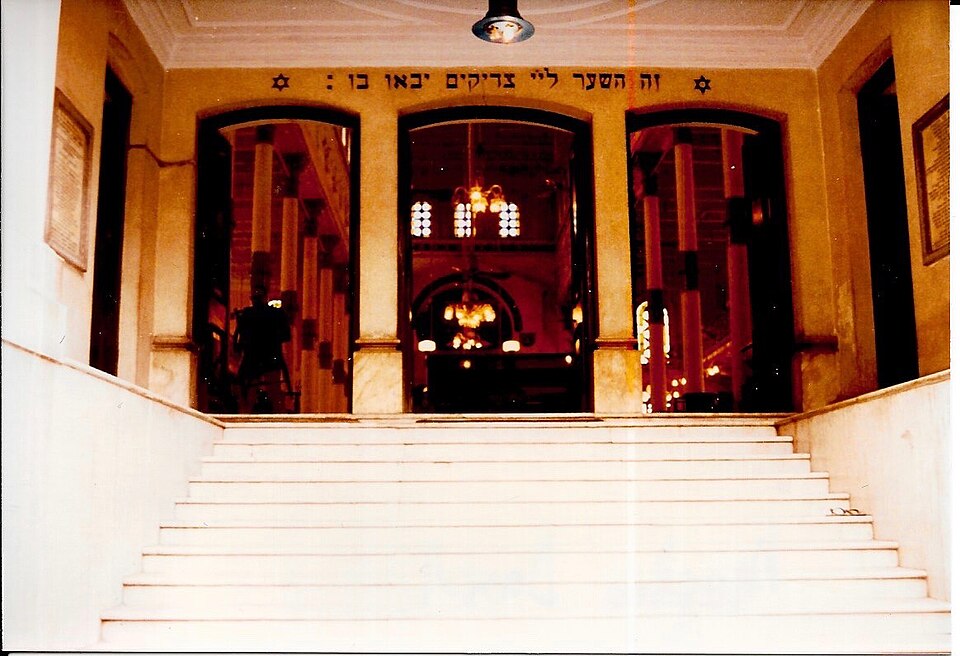
The book also documents religious life in granular detail: the founding and functioning of the Maghen David Synagogue, one of the largest synagogues built by the Baghdadi Jewish diaspora anywhere in Asia, alongside smaller congregations such as Beth El, and the community’s kosher infrastructure, Hebrew schools, and burial societies, all of which had to be built from scratch by immigrant merchant families operating far from any existing center of Sephardi or Baghdadi Jewish religious authority. Reconstructing exactly how a small merchant community assembled the full religious infrastructure of Jewish communal life – a synagogue, a mohel, kosher slaughter, a Hebrew school, a cemetery – in a colonial trading city with no prior Jewish presence is one of the quieter but more valuable contributions the book makes to the broader study of how diaspora Jewish communities establish themselves in entirely new settings.
Genealogists and family historians researching Baghdadi Jewish ancestry connected to Calcutta continue to treat Elias and Cooper’s compilation as a first port of call precisely because so much of the community’s own institutional record – synagogue registers, cemetery records, communal correspondence – has become difficult to access directly as the community itself has all but disappeared from the city. In that sense, the book functions today not only as a history to be read but as an archive to be consulted, cited by later researchers in much the way a genealogical society’s records might be cited, even though it was written and published as a continuous narrative rather than as a reference work.