
Among the works documenting the Indian Jewish diaspora’s encounter with modern art, few have received as much international attention as the paintings and exhibition catalog of Siona Benjamin, published and exhibited under the title Blue Like Me. Born in 1960 in Bombay (now Mumbai) and raised Jewish in a predominantly Hindu and Muslim India, Benjamin has become one of the most widely exhibited artists to emerge from India’s small Jewish community, and her work offers a rare visual archive of what it means to carry a multiple, layered identity across continents.
From Bombay to the American Art World
Benjamin trained first with a Master of Fine Arts in painting and a second MFA in theater set design before establishing herself as a full-time studio artist in the New York City area. Her canvases combine the visual vocabulary of Indian miniature painting with the iconography of Sephardic manuscript illumination, producing a distinctive hybrid style that she has described as an attempt to make “a mosaic of underlying meaning” out of her own biography. That biography is itself unusual: a child of the Bene Israel and Baghdadi Jewish milieu of Bombay, educated in Catholic and Zoroastrian schools, surrounded by Hindu and Muslim neighbors, and only later immersed in the specifically American Jewish institutions of her adopted country.
This layered upbringing became the explicit subject of her art rather than a biographical footnote. Benjamin has spoken of growing up with an expectation of assimilation into the broader Indian culture around her, and of how the themes of identity and mutual understanding came to dominate her painting as a result. Her work is frequently discussed alongside that of other diaspora artists who use personal history as raw material, but she is distinguished by the specific triple heritage she draws upon: Indian, Jewish, and, since her relocation, American.
Two Fulbright Fellowships and the “Finding Home” Series
Benjamin’s reputation was substantially built through two Fulbright Fellowships that allowed her to research and exhibit in India and Israel. The first, awarded for 2010-11, funded a project titled “Faces: Weaving Indian Jewish Narratives,” for which she conducted research in India; the resulting exhibition opened in October 2013 at the Prince of Wales Museum in Mumbai. The second Fulbright, in fall 2016, sent her to Israel for a project called “Motherland to Fatherland: Indian Transcultural Jews,” extending her inquiry into the layered identities of Jews with roots in more than one homeland.
Much of Benjamin’s most recognized output belongs to a body of work titled “Finding Home,” begun in the late 1990s. Within that series, a subgroup called “Fereshteh” – the Urdu word for angel – reimagines women of the Hebrew Bible as blue-skinned, winged figures rendered in the palette and pattern language of Indian devotional art. Miriam appears across three works in the series: in one, she carries a suitcase, walking – the artist suggests – out of Egypt, dressed in traditional Indian attire; in another she appears ill and encircled by demons; in a third she is shown as a Persian angel trapped in a spider’s web. Lilith, traditionally cast as a seductress and destroyer in Jewish folklore, appears in three pop-art-influenced renderings; Benjamin has explained that she reads Lilith – by legend Adam’s first wife – as also being the first feminist, and paints her accordingly as a figure of defiance rather than menace.
Style and Sources
Stylistically, Benjamin’s canvases amalgamate Persian and Indian miniature traditions with Christian and Jewish illuminated-manuscript conventions, pop-art color and composition, and figures drawn from both Jewish and Hindu mythology. She has extended this visual language beyond canvas into animation and live performance, collaborating with dancers who bring her painted characters to life on stage. The multicultural, syncretic character of her practice was itself the subject of a documentary film, Blue Like Me, directed by Hal Rifken, which shares its title with the exhibition catalog that first brought together the fullest survey of her painting for a general audience.
Her recurring focus on women – the great majority of the figures in her paintings are female – reflects a broader interest in what she has called an ecumenical and empathetic spirit she locates at the core of Jewish experience. By re-rendering biblical women through the visual grammar of Indian art, Benjamin’s paintings ask viewers to hold two traditions in mind simultaneously rather than treating Indian and Jewish identity as separate, sequential chapters of a single life.
Critical Reception and Institutional Recognition
Coverage of Benjamin’s work has appeared in a wide range of publications, including The New York Times, The Chicago Tribune, The Philadelphia Inquirer, The Financial Times, The Jewish Week in New York and New Jersey, The Boston Globe, The St. Louis Post-Dispatch, Art in America, Art New England, Art and Antiques, ArtNews, and Moment magazine. Her original paintings are represented commercially by ACA Galleries in New York City, and she has exhibited across the United States, Canada, Europe, India, and elsewhere in Asia.
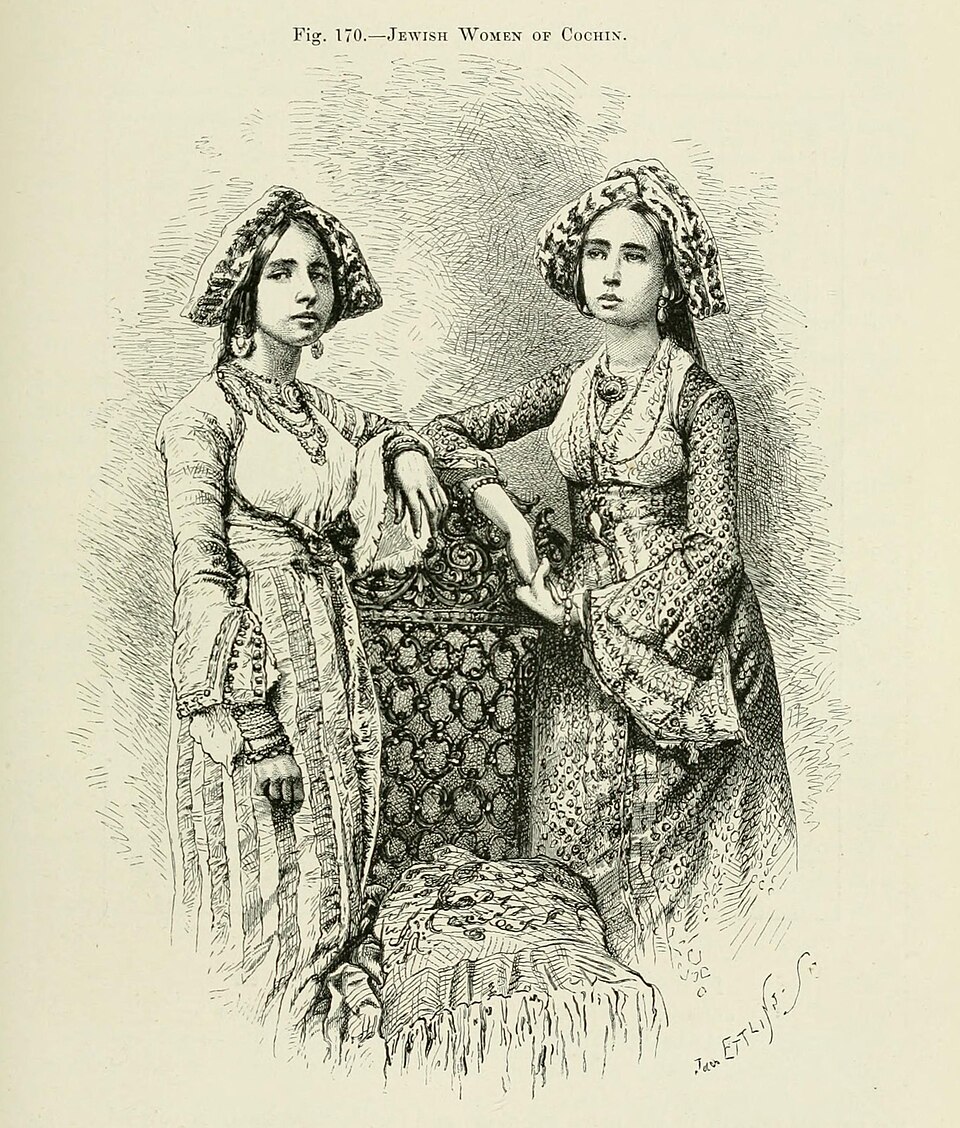
In March 2024, Benjamin’s art reached a new and younger audience through The Blue Butterfly of Cochin, a children’s book written by Ariana Mizrachi, edited in cooperation with the Indian Jewish Heritage Center, and published by Kalaniot Books. The book draws on the historical memory of the Cochin Jewish community of Kerala – among the oldest Jewish settlements in India, tracing its presence back over a millennium – and pairs that history with Benjamin’s illustrations, extending her visual language from gallery walls to a new generation of young readers learning about India’s Jewish past.
Why This Body of Work Matters for Indian Jewish Studies
Most scholarship and popular writing on the Jews of India understandably centers on the three historic communities: the Bene Israel of the Konkan coast and Bombay, the Cochin Jews of Kerala, and the Baghdadi Jews of Bombay and Calcutta. Benjamin’s career matters to that literature precisely because it demonstrates how the inherited memory of those communities continues to generate new cultural work outside the frameworks of the synagogue, the archive, or the academic monograph. Her paintings do not simply illustrate Indian Jewish history; they interrogate what it feels like to inherit more than one home at once, a question of obvious relevance to a diaspora community whose numbers in India have fallen dramatically through twentieth-century emigration even as interest in its history has grown internationally.
For readers approaching the Jews of India for the first time, Benjamin’s paintings and the catalog and film built around them offer an entry point that complements the historical and ethnographic literature: a visual record, made by a member of the community itself, of what it means to carry Bene Israel and Baghdadi heritage, Indian upbringing, and American adulthood inside a single body of work.
Reading Benjamin’s Work Alongside the Wider Literature
Benjamin’s paintings are often discussed in the same breath as a small shelf of recent books that survey the material and religious culture of India’s Jewish communities rather than their political or migratory history alone. Works cataloguing synagogue architecture, ritual objects, and communal customs from the Bene Israel, Cochin, and Baghdadi traditions have multiplied in the past two decades, driven in part by the same forces that shaped Benjamin’s own career: a shrinking resident community, an expanding diaspora eager to preserve its heritage, and a broader scholarly turn toward the diversity of world Jewry beyond its European and Middle Eastern centers. Benjamin’s contribution to this literature is unusual in that it is authored not by a historian or anthropologist but by an artist working from lived experience, translating oral memory and childhood impression directly into image rather than argument.
This distinction matters for how the work is used by teachers and researchers. Where a conventional history relies on archival documents, census records, or interview transcripts, Benjamin’s canvases function as primary sources of a different kind: they record which biblical stories, which domestic rituals, and which visual habits of an Indian upbringing survived transplantation into an adult artistic practice built in the United States. Scholars of diaspora and migration have increasingly treated such artistic testimony as evidence in its own right, standing alongside oral history interviews as a record of how displacement is actually experienced and processed by the people who live through it, rather than only how it is later reconstructed by outside researchers.
Legacy and Ongoing Relevance
Because Benjamin remains an active exhibiting artist rather than a historical figure, her body of work continues to grow, and each new fellowship, exhibition, or collaboration adds material to the visual record she has built since the 1990s. The 2024 publication of The Blue Butterfly of Cochin demonstrates that her influence has moved beyond the gallery circuit that made her name into children’s publishing, a domain where the Cochin Jewish story in particular has historically had very little dedicated material available to young readers anywhere in the world. That collaboration also illustrates a recurring pattern in the recent cultural life of India’s Jewish communities: institutions such as the Indian Jewish Heritage Center increasingly commission new creative work rather than simply archiving what remains of the old, treating culture as something to be actively renewed rather than only preserved.
For general readers coming to this subject without a background in art history, the most useful starting point is usually the documentary film built around the “Blue Like Me” title, since it places the paintings in the context of Benjamin’s own voice describing her intentions, before turning to the exhibition catalog and gallery holdings for the paintings themselves. Read together, the film, the catalog, and the later children’s book trace a single artist’s four-decade engagement with a question that runs through nearly all serious writing on Indian Jewry: how a small, geographically dispersed, and demographically shrinking community keeps its memory alive once its members no longer live in the towns and synagogues where that memory was first made.