
Three Kitchens, One Faith
Esther David’s Book Showcases the Culinary Heritage of Jews in India refers to Bene Appétit: The Cuisine of Indian Jews, published by HarperCollins India in 2021. Rather than reading as a single, unified cookbook, David’s project works more like a culinary atlas, tracing three separate Jewish food cultures that developed hundreds of miles apart, under different rulers, in different landscapes, with only the shared framework of Jewish law and memory holding them together. The Bene Israel of the Konkan coast, the Cochin Jews of Kerala’s backwaters, and the Baghdadi Jews of Bombay and Calcutta each built a distinct table, and David’s research treats these differences as the real subject of the book rather than a footnote to it.
David herself writes from within this tradition rather than observing it from outside. Born in Ahmedabad into a Bene Israel family, she grew up around the cooking of her grandmother and mother before turning that domestic knowledge into a body of published work spanning novels, memoir, and now culinary history. That personal grounding shapes the book’s approach: rather than presenting recipes as static instructions, David frames each dish as evidence of a particular community’s history, tracing how ingredients and techniques moved through migration, trade, and generations of home cooks who adapted what they had learned to new cities and new ingredients.
The Bene Israel Table and the Malida Ceremony
Among the Bene Israel, food and religious ritual are inseparable in a way that has no exact parallel elsewhere in the Jewish world. The community’s best-known culinary-religious practice is the Malida ceremony, a thanksgiving ritual dedicated to the prophet Elijah, who is remembered in Bene Israel tradition as a guardian figure often called Eliyahu HaNabi. The ceremony centers on a communal offering known as malida itself: a tray of flattened rice mixed with grated coconut, raisins, spices, and at least two kinds of fruit, blessed and then shared among those present. Scholars of the community describe the Malida ceremony as unique to the Bene Israel among world Jewry, performed at weddings, before journeys, after recovery from illness, and at other moments calling for gratitude. David’s book situates this ritual dish within a broader Konkan coastal diet built around coconut, rice, and the fish and vegetables of Maharashtra’s western shoreline, showing how the Bene Israel absorbed the flavor grammar of their Marathi-speaking neighbors while preserving a food practice that marks them as distinct.
Beyond the Malida ceremony itself, the everyday Bene Israel kitchen reflects the broader Konkan region’s reliance on coconut, kokum, and rice, adapted so that meat and dairy remain separated and that meat is slaughtered and prepared according to Jewish law. Wedding feasts and festival meals historically drew on this same coastal palette, meaning that a Bene Israel Rosh Hashanah table in nineteenth-century Bombay would have looked, in its basic ingredients, much closer to a Maharashtrian Hindu neighbor’s table than to a Baghdadi Jewish table a few kilometers away in the same city.
Cochin’s Spice Coast Cuisine
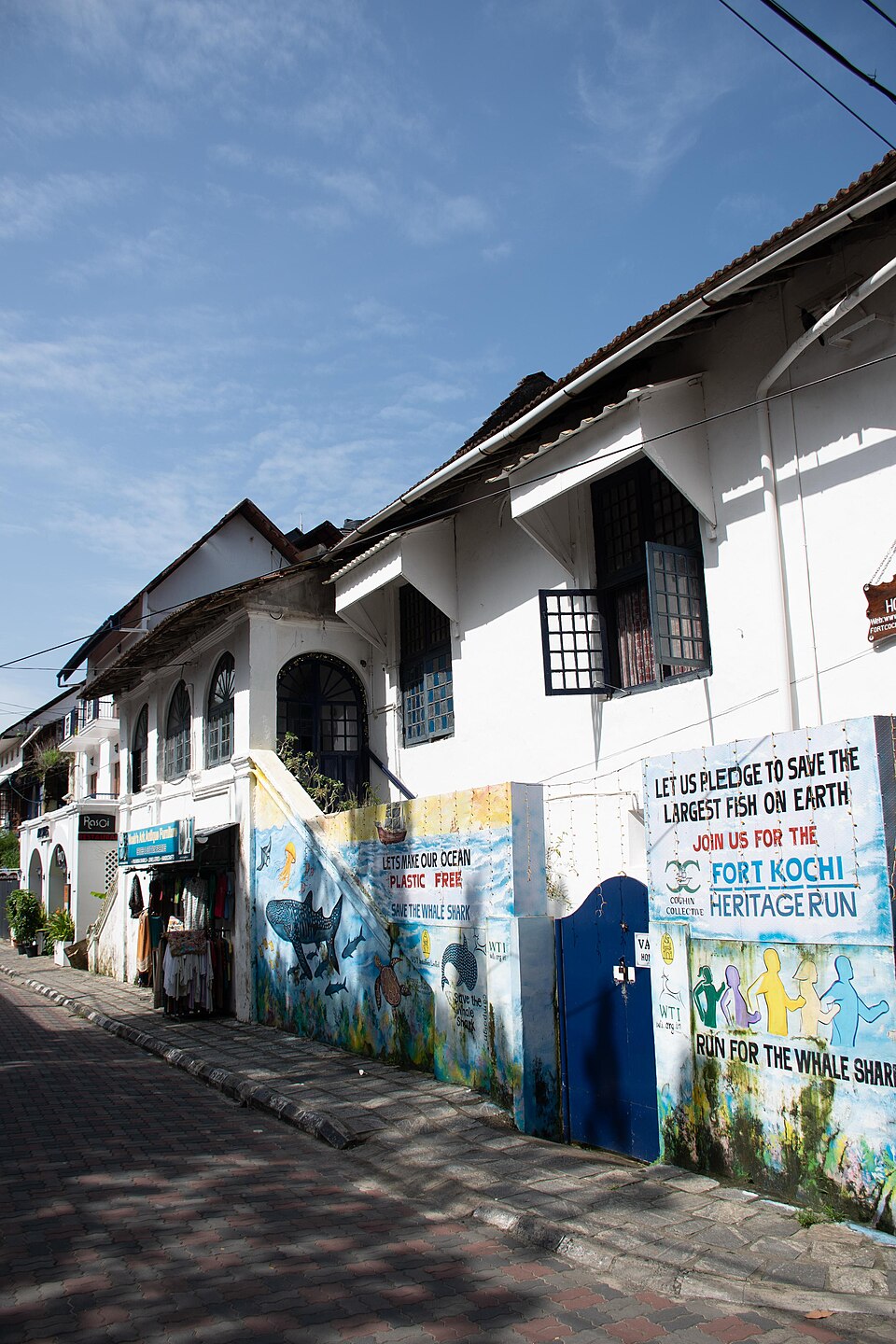
The cooking of the Cochin Jews tells a different story, one shaped by Kerala’s centuries-old role in the global spice trade. Long before European ships arrived, the Malabar Coast exported pepper, cardamom, and cinnamon to buyers across the ancient world, and the Jewish traders and settlers who lived among these spices absorbed them into a kosher kitchen built on coconut milk, rice, and the fish of Kerala’s lagoons and backwaters. David’s research describes a Cochin Jewish table that adapted the coconut-based curries and rice preparations common across Kerala to the requirements of kashrut, producing dishes that a Malayali neighbor would recognize instantly while still following Jewish dietary law in the separation of meat and dairy and the exclusion of shellfish and pork. The physical setting reinforced the culinary one: Kochi’s old Jew Town, centered on the street still known today as Jew Street next to the Paradesi Synagogue, sat at the heart of a spice-trading district whose warehouses and markets shaped what ended up in Cochin Jewish kitchens for generations.
Sabbath and festival cooking among the Cochin Jews also carried a distinctive slow-cooking tradition suited to a day when no fire could be lit or extinguished, echoing the broader Sephardic and Middle Eastern practice of preparing a dish before sundown on Friday that would then rest, warming gently, until the Sabbath meal the next day. David’s book documents how these slow-cooked preparations, built around rice, coconut milk, and fish or chicken, were passed down through the small number of families that remained in Kochi as the community’s population declined from several hundred at mid-century to a mere handful of residents today.
Baghdadi Cuisine: A Fusion of Empires
The Baghdadi Jewish table, by contrast, arrived in India already formed by a different history. Baghdadi Jewish cuisine is fundamentally a hybrid cuisine shaped by Arab, Turkish, and Persian influences from Iraq, which then absorbed a further layer of Indian influence after merchant families like the Sassoons and Ezras settled in Bombay and Calcutta from the eighteenth century onward. The result, as documented by food historians and reflected in David’s research, includes dishes such as Baghdadi-style beef curry, a distinctive Baghdadi biryani, and Baghdadi Jewish parathas, alongside a local variation on tandoori chicken that substitutes lemon juice for the cream used in the standard Indian recipe. Baghdadi Jewish communities that later moved onward to Southeast Asia carried this hybrid cuisine further, blending it again with Burmese, Singaporean, and Hong Kong influences, so that a single Baghdadi Jewish family’s recipe collection could span four or five culinary traditions in a single generation.
The wealth of the leading Baghdadi families, built through trade networks stretching from Bombay to Shanghai, also meant that their kitchens could draw on imported ingredients unavailable to the Bene Israel or Cochin communities, further widening the culinary gap between the three groups even though all three shared the same underlying dietary law. A formal Baghdadi Jewish dinner in colonial-era Calcutta, prepared for a wedding or a holiday, might combine a Persian-inflected rice pilaf with an Indian-style curry and a Middle Eastern pastry in a single meal, a combination that would have seemed entirely foreign on a Bene Israel or Cochin Jewish table of the same era.
Kashrut Across Three Regions
Keeping kosher in three different regional food economies posed different practical challenges for each community. In coastal Kerala, avoiding shellfish meant giving up a significant portion of what the surrounding Malayali cuisine treated as everyday fare, pushing Cochin Jewish cooks toward a deeper reliance on freshwater and scaled sea fish permitted under Jewish law. In Bombay and Pune, Bene Israel families built their kosher meat supply around a small number of trusted shochtim, or ritual slaughterers, within the community, a practice that also shaped social structure since access to kosher meat reinforced ties between Bene Israel families scattered across Konkan villages and their nearest urban synagogue. The Baghdadi Jewish merchant families, wealthier and more urban from the outset, could sustain fuller institutional infrastructure, including kosher butchers and bakeries attached to synagogues in Calcutta and Bombay that served the community well into the twentieth century.
David’s book treats these institutional and practical differences as inseparable from the recipes themselves, since a dish’s ingredients were always constrained by what a kosher kitchen in that particular region could actually obtain. A Cochin Jewish fish curry recipe, in other words, is not simply a set of instructions but a record of what was both locally available and religiously permissible along the Malabar Coast at a given moment in history, just as a Baghdadi biryani reflects both the trade networks that brought Persian and Central Asian rice-cooking techniques to India and the kosher butchering practices that made the meat in that biryani permissible under Jewish law.
Recipes as Living Archives
What makes this kind of culinary documentation urgent, rather than merely nostalgic, is the demographic reality behind it. All three Indian Jewish communities have emigrated in large numbers since 1948, mostly to Israel, and the population remaining in India today is a small fraction of what it once was. Synagogues, cemeteries, and photographs can be preserved as physical heritage, but foodways survive only through active transmission from one generation to the next, or through documentation of the kind David undertook. A recipe for malida, a method for a Cochin fish curry, or the proportions for a Baghdadi biryani represents an oral tradition that, once lost, cannot be reconstructed from a synagogue register or a gravestone inscription. Books like this one function as a form of rescue archaeology, recording dishes and techniques directly from the home cooks who still remember them before that knowledge disappears entirely.
Why the Differences Matter
The value of reading these three culinary traditions side by side, as David’s research encourages, is that it undercuts any temptation to treat “Indian Jewish food” as a single, uniform category. The Bene Israel Malida ceremony, the coconut-and-spice cooking of Cochin, and the Arab-Persian-Indian fusion of the Baghdadi kitchen each emerged from a distinct historical encounter between Jewish law and a specific Indian regional culture. Read together, they demonstrate that Indian Jewish identity was never singular. It was always three separate, parallel experiments in how a minority religious community could eat according to its own law while remaining thoroughly, recognizably rooted in the regional cuisine surrounding it.