
Most books about India’s Jewish communities focus on a single group, a single region, or a single era. Growing Up Jewish in India: Synagogues, Customs, and Communities from the Bene Israel to the Art of Siona Benjamin, edited by art historian Ori Z. Soltes and published by Niyogi Books in 2021, takes a different approach. It gathers essays, a personal memoir, and more than 150 photographs into a single anthology that tries to hold India’s entire Jewish story, architectural, historical, and artistic, in one volume. This Growing Up Jewish in India review looks at what the book sets out to do, how well it succeeds, and why it has become a reference point for readers curious about a community that rarely gets this much sustained attention.
Growing Up Jewish in India Review: An Anthology, Not a Single Narrative
The book’s structure is part of what makes it distinctive. Rather than a single author walking through history from start to finish, it is built from contributions by several voices, including a foreword by Ralphy Jhirad, founder of the Bene Israel Heritage and Genealogical Research Centre, and a preface by writer and editor Erica Lyons. Jhirad’s foreword introduces a shorthand that recurs throughout the book: the “BBC Jews of India,” referring to the Bene Israel, Baghdadi, and Cochin communities. Grouping these three very different populations under one label is useful for readers new to the subject, though it also raises an early question the book has to answer: what, if anything, actually unites them beyond geography?
Where Did the Bene Israel Come From?
Soltes uses his own chapters to lay out the competing theories of Bene Israel origin without pretending any one of them is settled fact. Depending on which account a reader favors, the community’s ancestors arrived as traders during the era of King Solomon, as refugees from the Assyrian conquest of the northern Kingdom of Israel around 722 BCE, as arrivals connected to the Hasmonean period before the Maccabean revolt, as survivors of a shipwreck sometime in the early centuries of the common era, or as migrants from Persia or southern Arabia around the fifth or sixth century. The honest answer, which the book states plainly, is that there is little hard evidence for any single version. What the book does well here is resist the temptation to pick a favorite theory and present it as history. Instead it treats the uncertainty itself as part of the story, which is a more intellectually honest choice than many popular histories make.
That same chapter traces how the Bene Israel, isolated from world Jewry for centuries, were approached by Christian missionaries after the British took control of Bombay. The missionaries hoped to draw the community toward mainstream Protestant Christianity by pointing out how far its practices had drifted from rabbinic Judaism elsewhere. The book argues this effort largely backfired: exposure to outside scrutiny pushed many Bene Israel toward a firmer, more studied connection to Jewish tradition rather than away from it.
The Synagogues That Give the Book Its Backbone
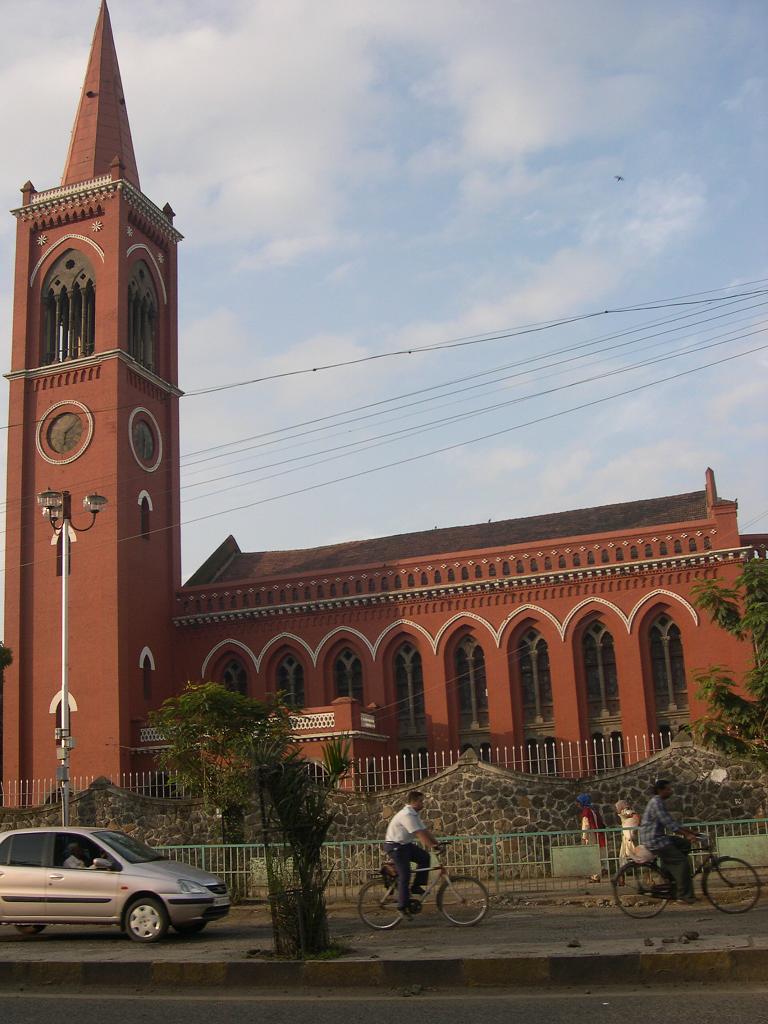
If the historical debates form the book’s intellectual core, its synagogue chapters are its visual heart. The book moves geographically and denominationally through India’s major Jewish buildings: the Art Deco Magen Abraham Synagogue in Ahmedabad, the sky-blue Magen David Synagogue in Mumbai with its distinctive four-tiered clock tower, and the Ohel David Synagogue in Pune, a red-brick, Gothic Revival building commissioned by the Sassoon family in 1867 that is often cited as the largest synagogue in Asia. On the Malabar coast, the book covers the Cochin Jewish communities and their eight historic synagogues, including the Paradesi Synagogue, burned by the Portuguese in the seventeenth century and rebuilt with the blue-and-white tiled floor and gilded bimah that visitors still see in Kochi’s Jew Town today.
What comes through in these chapters is how differently each community expressed the same basic institution. The Baghdadi synagogues, funded by wealthy merchant families like the Sassoons and Ezras, borrowed heavily from European ecclesiastical architecture. The older Cochin synagogues are plainer and more vernacular. The book is careful to note that the wealthy Baghdadi families who usually dominate the historical record represented only part of that community, and that roughly half of Baghdadi Jews in India lived modestly and depended on communal charity.
Siona Benjamin’s Chapter: The Book’s Most Personal Turn
The book’s subtitle promises “the art of Siona Benjamin,” and her chapter is where the anthology shifts from history to memoir. Benjamin, a Bene Israel painter born and raised in Bombay who is now based in the United States, contributes family photographs and a first-person account of growing up between Jewish, Indian, and eventually American identities. Soltes follows her chapter with his own analysis of her paintings, many of which reimagine biblical women such as Lilith and Miriam through a visual style that borrows equally from Bollywood poster art and the flat, bold color blocking associated with pop artists like Roy Lichtenstein. It is an unusual pairing for a book that otherwise reads as cultural history, but it works, because it grounds the book’s larger claims about hybrid identity in one person’s lived and painted experience rather than leaving them abstract.
Critical Reception
The book has drawn steady attention since its release. The Asian Review of Books ran a favorable notice shortly after publication, and the online journal Borderless has featured both a review of the book and ongoing coverage of Soltes’ work. Academic interest has continued well past the initial release window: a 2025 review in the journal of the Australian Association for Jewish Studies discussed it alongside newer scholarship on Bene Israel historical geography, treating it as a still-relevant reference rather than a book that had already had its moment. That kind of staying power is unusual for a regional anthology and suggests the book has earned a place on reading lists for Indo-Judaic studies, not just on coffee tables.
Where the Book Falls Short
No anthology this ambitious is without friction. Moving between rigorous historical argument, architectural description, and personal memoir means the book’s tone shifts more than a single-author history would, and readers looking for one continuous narrative may find the transitions between chapters abrupt. The multiple-theory approach to Bene Israel origins, while intellectually honest, can also leave readers wanting a clearer point of view from the editor about which account he finds most persuasive. And because the book leans heavily on photographs, readers relying on an e-book edition may find some of the architectural detail harder to appreciate than readers with the printed edition in hand.
Why It Matters
These are minor complaints against what the book accomplishes. Few volumes attempt to cover the Bene Israel, Baghdadi, and Cochin communities together, fewer still pair that history with contemporary art criticism, and almost none manage to do both while remaining accessible to a general reader. For anyone following the broader story of India’s Bene Israel, Baghdadi, and Cochin Jewish communities, Growing Up Jewish in India remains one of the most complete single-volume introductions available, and its combination of scholarship and memoir is part of what makes it worth returning to years after publication.