
Related Reading
- The Four Communities of Indian Jews: An Overview
- The Bene Israel of Maharashtra
- The Jews of Cochin
- The Baghdadi Jews of Mumbai and Kolkata
- Books on the Jews of India
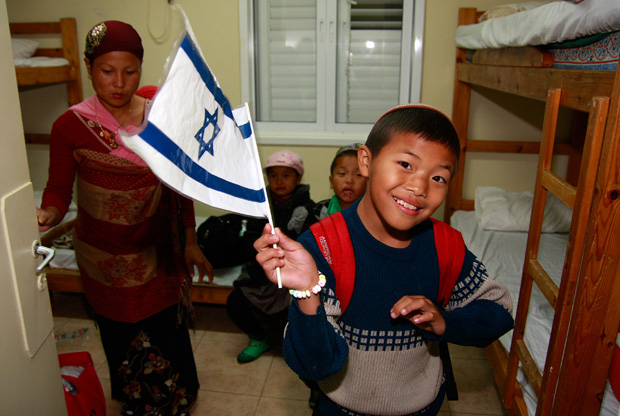
In villages and towns across the northeastern Indian states of Manipur and Mizoram, something remarkable has been happening for decades. Families have been packing their belongings, saying goodbye to the hills and valleys they have called home for generations, and boarding flights to a country most of them have never visited but have always thought of as home. The Bnei Menashe, the community that claims descent from the ancient Israelite tribe of Manasseh, have been making aliyah to Israel in significant numbers since the 1990s, and the visual story of their departure is one of the most striking in modern Jewish history.
Who Are the Bnei Menashe
The Bnei Menashe community numbers approximately seventy thousand people, of whom several thousand have already immigrated to Israel and undergone formal conversion to Judaism. They are members of the Kuki-Chin-Mizo ethnic group, indigenous to the hill country of northeastern India and western Myanmar, and they trace their claimed Israelite ancestry through oral traditions that speak of an ancient migration from the Middle East through Central Asia and China to their current homeland.
Before the arrival of Christian missionaries in the nineteenth century, the Kuki-Chin-Mizo practiced religious customs that some scholars have identified as parallels to ancient Israelite practice, including a form of sabbath observance, dietary restrictions similar to those of Jewish law, and festivals that echo the structure of the biblical agricultural calendar. These parallels, combined with oral traditions of Israelite descent, form the basis of their claim to Jewish identity.
The Aliyah Process
Unlike some other Lost Tribe communities, the Bnei Menashe have pursued their return to Israel through formal halakhic channels. Shavei Israel, an organization founded by Michael Freund that works to reconnect lost and hidden Jewish communities with the Jewish people, has been the primary facilitator of Bnei Menashe aliyah. The process involves intensive Jewish education in India, formal conversion by an authorized rabbinical court, and then immigration to Israel under the Law of Return.
The aliyah of each family or individual involves careful preparation. Communities in Manipur and Mizoram maintain synagogues and yeshivot where young people study Hebrew and Jewish law in preparation for their eventual immigration. The education is taken seriously, and the communities that have developed around this preparation have become centers of Jewish learning and cultural practice that are recognized internationally.
Life in the New Land
Bnei Menashe immigrants have settled in communities across Israel, with significant populations in cities like Kiryat Arba near Hebron, Shavei Shomron in the West Bank, and various cities in the center of the country. Their settlement patterns reflect both their own preferences and the assistance they have received from various Israeli organizations and municipalities. Some communities are fully integrated into Israeli society; others maintain a more distinct Bnei Menashe identity.
The transition to Israeli life presents challenges as well as opportunities. Hebrew, rather than Mizo or Manipuri, becomes the language of daily life. The landscape of Israel, with its Mediterranean climate and Middle Eastern geography, is radically different from the green hills of Manipur. And the social world of Israel, with its complex mix of Ashkenazi, Sephardic, Ethiopian, and Russian Jewish cultures, requires a complex negotiation of identity that the Bnei Menashe navigate with varying degrees of ease.
The Community Left Behind
For every Bnei Menashe who has made aliyah, many more remain in India, waiting for their turn or choosing to stay. The communities in Manipur and Mizoram that have formed around Jewish practice continue to grow, and the desire to immigrate to Israel remains strong among those who have not yet been able to do so. Their continued existence in India means that the connection between the Jewish world and the hills of northeastern India remains alive and growing, even as the aliyah process slowly transfers community members to Israel.
A Visual Story
The photographs of Bnei Menashe aliyah, taken at airports, at farewell ceremonies in Indian villages, and at arrival celebrations in Israel, capture one of the most moving stories in contemporary Jewish life. The faces of families leaving their ancestral homeland for a country they have only known through scripture and study, and arriving in a land that is simultaneously ancient and modern, carry a weight of history that goes far beyond the individual stories being told. They are images of a people reconnecting with a heritage that survived two and a half millennia of distance and separation.