
Related Reading
- The Four Communities of Indian Jews: An Overview
- The Bene Israel of Maharashtra
- The Jews of Cochin
- The Baghdadi Jews of Mumbai and Kolkata
- Books on the Jews of India
For Jewish children growing up in India in the mid-to-late twentieth century, the experience of Jewish identity was shaped by a unique combination of Indian and Jewish elements that could not be found anywhere else in the world. Going to synagogue on Saturday, celebrating Shabbat with foods spiced with turmeric and coconut, singing Hebrew prayers in voices that naturally incorporated the musical inflections of Marathi or Malayalam, attending Jewish school while also participating in the broader culture of Indian education and social life: these experiences created a form of childhood Jewish identity that was deeply rooted, thoroughly Indian, and irreplaceable in its specific character.
The Synagogue in Indian Life
The synagogue occupied a central place in Indian Jewish community life in a way that went beyond its purely religious function. In the Bene Israel communities of Maharashtra, the synagogue was the meeting place for community celebrations, debates, announcements, and social gatherings. Weddings, bar mitzvahs, and the mourning rituals after death all centered on the synagogue as the community’s principal gathering space. In cities like Mumbai and Pune, the synagogue was also the place where community members maintained their connections across the social distinctions of neighborhood, profession, and class that urban life inevitably created.
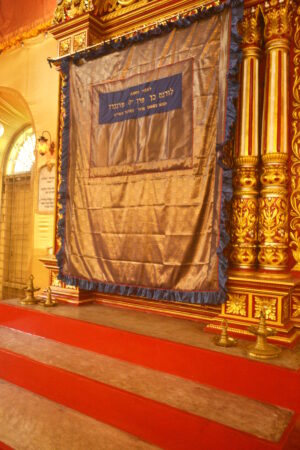
The physical buildings of Indian Jewish synagogues reflected the communities’ dual cultural identity. Many were built in architectural styles that combined European Jewish synagogue design with Indian decorative elements, producing buildings that were recognizably Jewish while also being unmistakably Indian. The decorative program of a Bene Israel synagogue might include Hebrew inscriptions alongside Indian floral motifs, European-style arched windows alongside Indian carved woodwork, and Western-style furniture alongside Indian textiles and furnishings.
Jewish Education
Jewish children in India received their Jewish education through a combination of home instruction, synagogue attendance, and formal schooling in community-run Jewish schools. The Bene Israel community in particular maintained an extensive network of schools in Mumbai and other cities that provided both Jewish religious education and general secular education to community children. These schools, established with the support of organizations like the Anglo-Jewish Association in London, became important institutions of social mobility as well as cultural preservation, providing community members with the English-language education that opened doors in the colonial and post-independence economy.
Jewish holidays were celebrated with a combination of Indian and Jewish elements that reflected the community’s dual cultural identity. Passover seders featured matzah baked in Indian ovens alongside curries and chutneys prepared according to Indian recipes. The Hanukkah menorah was lit alongside Indian oil lamps. Rosh Hashanah was celebrated with honey cake but also with Indian sweets, and Yom Kippur fasting was broken with dishes that were recognizably Indian in their spicing and preparation.
Community Customs
Every Indian Jewish community developed its own specific customs that reflected the particular Indian regional culture in which it was embedded. Bene Israel customs incorporated elements of Maharashtrian social life, including musical traditions, food practices, and lifecycle ceremonies that were shaped by the Hindu culture surrounding them while remaining distinctly Jewish in their religious content. Cochin Jewish customs incorporated elements of Keralan culture, including the use of Judeo-Malayalam language and music influenced by South Indian classical traditions.
These customs were not conscious compromises but natural developments that occurred over centuries of life together with non-Jewish neighbors. The Indian Jews who maintained them did not think of themselves as practicing a diluted or hybrid form of Judaism but as practicing the only Judaism they knew, a Judaism that had grown in India and was as authentic as any other form of the tradition.
The Passing of a World
For the generation that grew up Jewish in India before the major waves of emigration, the world they inhabited was irreplaceable and, they now know, temporary. The synagogues they attended are now largely empty. The schools they studied in have been repurposed or closed. The community celebrations that defined the rhythm of their year happen now, if at all, with a fraction of the participants and energy of earlier decades. Growing up Jewish in India was to grow up in a world that was already passing, and the memories of that world carry the particular poignancy of things that cannot be recovered.