
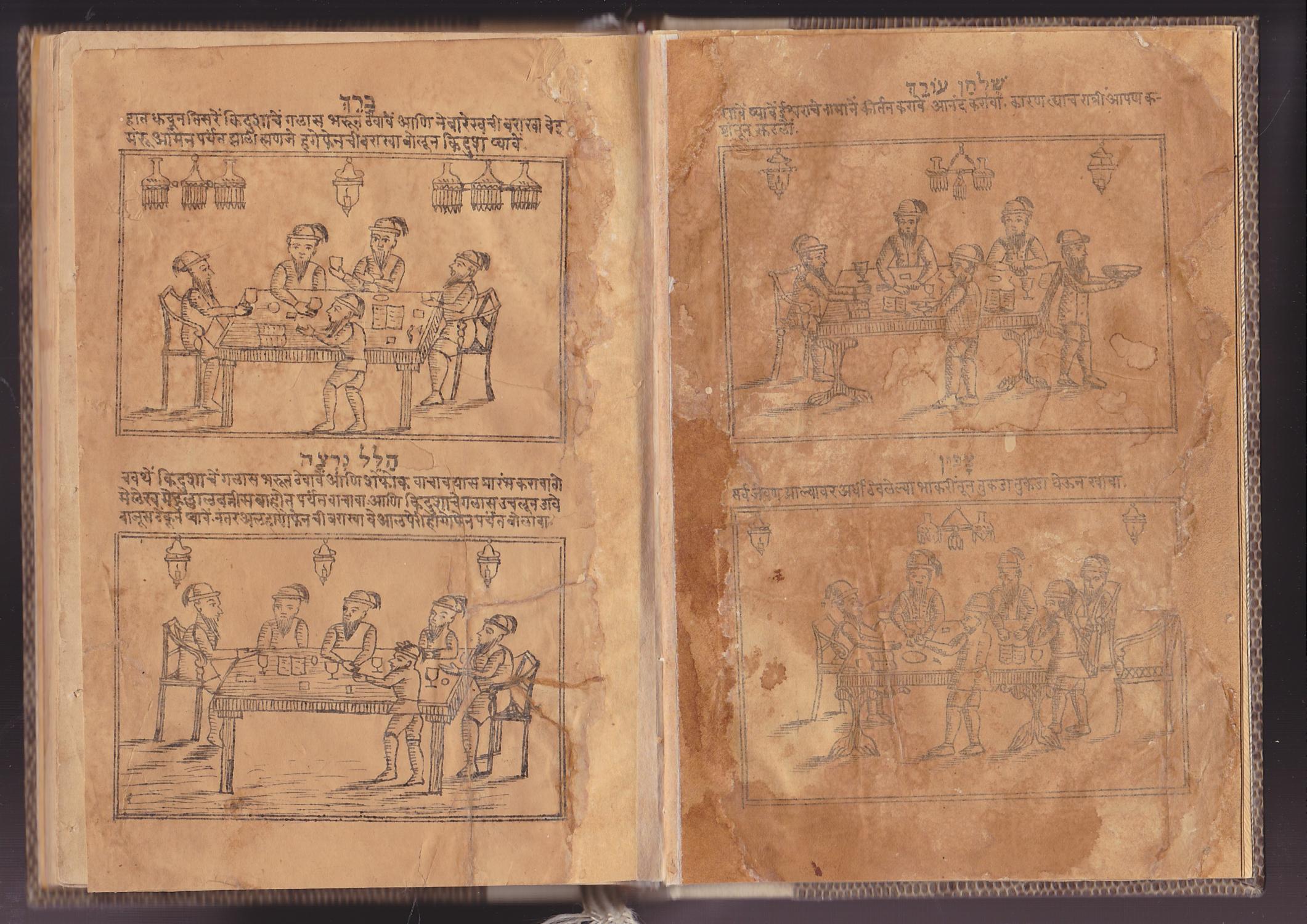
This rare Jewish-Indian Haggadah found in Salford is one of the most unusual archival discoveries in recent Indian Jewish history. In 2011, the British historian Yaakov Wise made this discovery while cataloguing archival material in Salford, England: a rare, handwritten Haggadah – the foundational Jewish text that guides the order of the Passover Seder – written in a mixture of Hebrew and Marathi. The manuscript, since referred to as the Poona Haggadah after the Indian city (today Pune) where it originated, was already some 137 years old at the time of its rediscovery, dating its creation to roughly 1874. It stands today as one of the most vivid physical reminders of the Bene Israel community’s long, distinctive relationship with the Hebrew Bible and Jewish ritual life in western India.
What a Haggadah Is, and Why This One Matters
The Haggadah is not a single fixed book but a foundational Jewish text, read aloud at the Seder table on the first night (or first two nights, outside Israel) of Passover, that fulfills the obligation every Jewish parent has to recount the story of the Exodus from Egypt to their children. Because it is read and re-read every year, in nearly every Jewish community in the world, the Haggadah has been translated, illustrated, and adapted locally for centuries, producing thousands of distinct regional editions. The Poona Haggadah is one such regional adaptation, produced for and by the Bene Israel community of Maharashtra, a group whose oral tradition holds that their ancestors were shipwrecked survivors of a group fleeing religious persecution in ancient Judea and who settled along India’s Konkan coast long before returning to broader contact with world Jewry in the eighteenth century.
The Language of the Manuscript: Judeo-Marathi
What makes the Poona Haggadah especially significant to scholars is its language. The Bene Israel community, cut off for centuries from other Jewish populations, had by the nineteenth century developed what linguists now call Judeo-Marathi, or Bene Israel Marathi – not a separate dialect in any grammatical sense, but a distinctive scribal tradition of rendering Jewish liturgical Hebrew using the Marathi language and, in some manuscripts, the Devanagari script itself. Researchers have documented several surviving examples of this practice, including a separate 1911 Haggadah in which Hebrew prayers were transliterated directly into Devanagari characters, alongside prayer books that combine Marathi-language instructions with Hebrew script. The Poona Haggadah belongs to this same broader manuscript tradition, blending Hebrew liturgical text with Marathi translation and commentary intended to make the Passover story fully accessible to a community praying in Hebrew but living, thinking, and speaking in Marathi.
From Pune to Bombay to Salford
The city of Pune, historically anglicized as Poona, was one of several urban centers – alongside Mumbai (Bombay) and Ahmedabad – to which Bene Israel families migrated from their original Konkan coast villages beginning in the second half of the eighteenth century, following renewed contact with Cochin Jewish and other Jewish teachers who reintroduced the community to normative rabbinic practice. Bene Israel families in these growing urban communities commissioned their own prayer books and Haggadot, printed and handwritten, to serve congregations that were rapidly formalizing synagogue life while still working in Marathi as their first language. How exactly this particular manuscript made its way from Pune to an archive in Salford, in the northwest of England, is itself a small window into the twentieth-century dispersal of the Bene Israel community, many of whose members emigrated first within the British Empire and later to Israel, the United Kingdom, and elsewhere following Indian independence in 1947 and the founding of the State of Israel in 1948.
A Wider Tradition of Bene Israel Liturgical Manuscripts
The Poona Haggadah is not an isolated curiosity. It belongs to a documented body of Bene Israel manuscripts that combine Hebrew and Marathi, reflecting a community that, unusually among world Jewish populations, maintained Jewish practice for centuries with only the Torah and a handful of prayers, before undergoing what scholars describe as a process of re-education in normative Judaism during the colonial period. That process did not erase the community’s Marathi linguistic identity; instead, it produced hybrid texts like this Haggadah, in which the Exodus story, blessings over wine and matzah, and the traditional Passover songs appear alongside Marathi guidance for a congregation that needed both languages to fully participate in the Seder.
For historians of Indian Jewish life, manuscripts like the Poona Haggadah are valuable precisely because they are functional, working religious objects rather than ceremonial showpieces – books that were actually opened, read from, and likely stained with wine and passed hand to hand at real family Seder tables in nineteenth-century Pune, long before anyone thought to preserve them as historical artifacts.
Why the Discovery Still Resonates
Few written records survive of the everyday religious life of the Bene Israel community during the nineteenth century, particularly from smaller urban centers like Pune rather than the much better-documented community in Bombay. A handwritten Haggadah, personal enough to have been created for one family’s or one small congregation’s use, offers a rare, intimate view of how Bene Israel Jews balanced fidelity to Hebrew liturgical tradition with their lived identity as Marathi speakers. Its rediscovery decades later and thousands of miles away, in a Salford archive, is a reminder of how far the community’s descendants eventually traveled, and how much of their documentary history now survives outside India altogether.
From Isolation to Re-Education: Why a Vernacular Haggadah Was Needed
To understand why a nineteenth-century Bene Israel congregation needed a Marathi-language Haggadah at all, it helps to look further back, to the community’s centuries of near-total isolation from the rest of world Jewry. According to community tradition, the Bene Israel had, for generations, retained only a handful of core Jewish practices – observing the Sabbath, performing circumcision, and keeping some dietary restrictions – while losing fluency in Hebrew and detailed knowledge of rabbinic law. The medieval philosopher Maimonides is sometimes said to have alluded to this very community when he wrote that the Jews of India knew “nothing of the Torah, save for the Sabbath and circumcision.”
Tradition holds that a Cochin Jewish trader named David Rahabi rediscovered the Bene Israel in their Konkan villages and, recognizing their vestigial Jewish customs, began teaching them normative rabbinic Judaism. He trained a group of local men, later known as Kajis, to serve as the community’s religious leaders and arbiters of disputes, a role that became hereditary within certain families. Later waves of instruction, delivered by Cochin Jewish and eventually Baghdadi Jewish teachers from the eighteenth century onward, gradually reconnected the Bene Israel to Hebrew liturgy, formal synagogue worship, and printed religious texts.
It is against this backdrop that manuscripts like the Poona Haggadah make sense: a congregation whose members were reclaiming full participation in Hebrew ritual life, generation by generation, needed working texts that bridged the Hebrew of the liturgy with the Marathi of everyday speech. Rather than a sign of diminished observance, the bilingual Haggadah represents the opposite – a community actively working to make an ancient Hebrew ritual fully its own in the language it actually spoke at home.
How Manuscripts Like This Survive at All
Handwritten religious books rarely survive the ordinary wear of decades of use, let alone more than a century, several thousand miles of travel, and at least one change of continent. Community Haggadot were used year after year at crowded Seder tables, and their pages routinely stained with wine, splashed with charoset, and creased by repeated handling – the very use that makes them historically valuable also makes them fragile. Manuscripts of this kind typically survive only because a family, synagogue, or later a private collector treated the book as worth preserving rather than discarding once newer printed editions became available, and because it eventually passed into the hands of an archive, library, or private collection where a researcher could later identify its significance.
That is essentially what happened with the Poona Haggadah: a Bene Israel family or community handwrote and used the book in nineteenth-century Pune, it survived long enough to be transported to England at some point in the twentieth century, likely as part of the broader story of Bene Israel emigration from India following independence, and it eventually came to rest, unidentified as anything remarkable, among archival material in Salford until Yaakov Wise recognized its significance in 2011. Its rediscovery added one more confirmed example to the small, documented corpus of Judeo-Marathi manuscripts alongside the separately recorded 1911 Devanagari-script Haggadah and various Marathi-language prayer books, deepening scholarly understanding of exactly how the Bene Israel community balanced Hebrew liturgical continuity with everyday Marathi language and identity.
Further Reading
For more on the Bene Israel community discussed in this article, see our coverage of their history and traditions, and the Wikipedia articles on Judeo-Marathi and Bene Israel, as well as the general background on the Haggadah itself.