
Indian Jewish fiction in English is a small but distinctive literary tradition, produced by a handful of writers drawn from a community that itself numbers only a few thousand people worldwide. Unlike the larger, more established canons of American Jewish or British Jewish fiction, Indian Jewish writing in English has been carried forward by a small number of individual authors, each documenting a specific community, Bene Israel, Baghdadi Jewish, or Cochin Jewish, from the inside.
Sophie Judah and the Bene Israel Short Story
Sophie Judah’s Dropped from Heaven, published in 2007 by Schocken, is one of the clearest examples of Indian Jewish fiction working in English. The book is a linked short story collection set largely in the fictional town of Jwala Nagar, modeled on the small Bene Israel communities of the Indian heartland far from the larger Jewish populations of Bombay and Calcutta. Judah’s stories follow Bene Israel families across generations, tracking the small dramas of village life alongside the larger forces, emigration to Israel, economic change, religious practice, that reshaped Bene Israel communities across the twentieth century. Critics noted that the collection filled a genuine gap in English-language fiction, since almost no earlier writer had set sustained literary fiction inside a Bene Israel community using that community’s own idiom and daily concerns as its central subject rather than as background color. Judah herself grew up within a Bene Israel family before eventually emigrating, giving her stories a level of specific, insider detail, the precise vocabulary of local trades, the small social hierarchies within a single synagogue community, the exact etiquette of a wedding or a mourning period, that an outside observer could not easily reproduce. Reviewers at the time of the book’s publication frequently compared its structure, a series of loosely connected stories sharing recurring characters and a single fictional setting, to earlier story-cycle traditions in American and Southern literature, while noting that its subject matter, a Jewish community entirely unfamiliar to most English-language readers, was almost without precedent in fiction available internationally.
Esther David’s Novels of Ahmedabad
Esther David, discussed at greater length elsewhere on this site in connection with her 2021 cookbook memoir Bene Appétit, remains the most prolific novelist working in Indian Jewish fiction in English. Her Sahitya Akademi Award-winning novel The Book of Rachel (2006) follows an aging Bene Israel woman guarding her family’s home and Jewish identity in a changing Ahmedabad, while Shalom India Housing Society (2007) takes a more contemporary, multi-voiced approach, following several Bene Israel families deciding whether to move into a dedicated Jewish housing cooperative. Her later novel Bombay Brides (2019) shifts focus to Bene Israel women who have already emigrated to Israel, examining what of their Indian identity survives the move. Taken together, David’s novels form the largest single body of Indian Jewish fiction in English by any one author. David’s fiction is distinguished from Judah’s and Silliman’s by its consistent regional focus on Gujarat rather than the more commonly documented Bene Israel centers of Bombay and the Konkan coast villages further south, giving her novels a somewhat different flavor shaped by decades of everyday exchange between a small Jewish family and the surrounding Gujarati Hindu and Jain culture of Ahmedabad. Her recurring interest in food, art, and civic institution-building, themes that appear in My Father’s Zoo as much as in her explicitly Jewish-themed novels, reflects a broader concern with how a minority family builds a lasting, visible place for itself inside a majority culture without losing its own distinct identity in the process.
Jael Silliman and Calcutta’s Baghdadi Jewish Voice
Where Judah and David write largely about the Bene Israel, Jael Silliman’s fiction gives Indian Jewish writing in English its clearest Baghdadi Jewish voice. Silliman, who grew up in a Calcutta Jewish family originally from Aleppo, has published novels including The Man With Many Hats (2013) and The Teak Almirah (2016), both set within or adjacent to Calcutta’s shrinking Baghdadi Jewish world. Her earlier academic work, Jewish Portraits, Indian Frames: Women’s Narratives from a Diaspora of Hope (2001), collected oral histories and first-person accounts from Indian Jewish women across all three communities, work that fed directly into her later turn toward fiction. Silliman has also built Recalling Jewish Calcutta, a digital archive documenting the same community her novels dramatize, making her one of the few Indian Jewish writers working simultaneously in fiction, archival preservation, and journalism. Silliman’s academic training as a scholar of gender and reproductive rights, rather than as a literary writer by original profession, gives her fiction a distinct texture as well, one more attentive than most Indian Jewish fiction in English to the specific position of women within Baghdadi Jewish family and community structures, a concern that carries over directly from her earlier academic writing on women’s narratives and reproductive justice into her later novels and short fiction.
Poetry’s Parallel Tradition
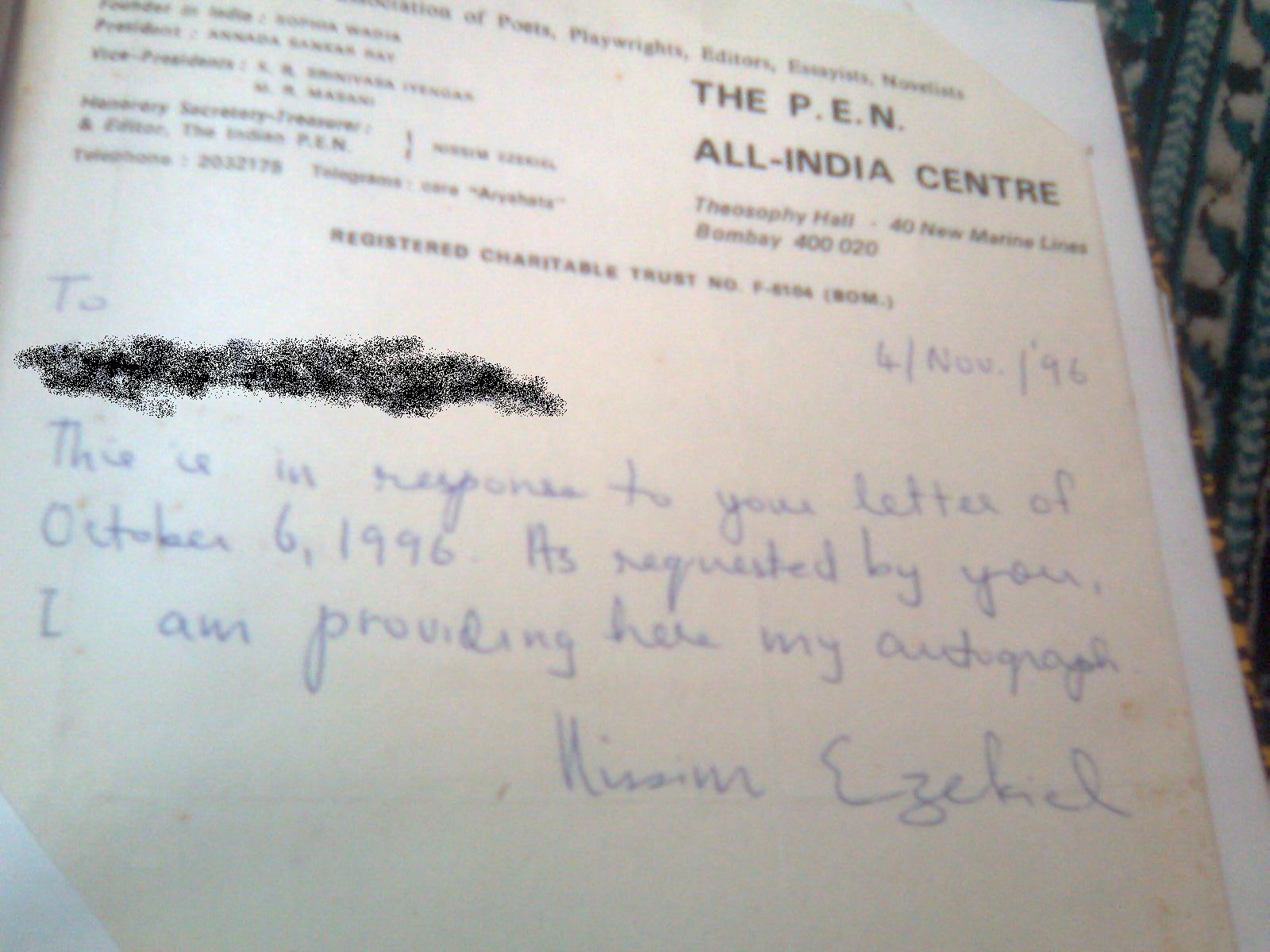
Indian Jewish fiction in English did not emerge in isolation. Nissim Ezekiel, a Bene Israel poet, playwright, and critic who won the 1983 Sahitya Akademi Award for his collection Latter-Day Psalms, is widely regarded as a foundational figure in postcolonial Indian poetry in English more broadly, not only within Jewish Indian writing specifically. Ezekiel’s reputation and canonical status within mainstream Indian English literature, decades before Judah, David, or Silliman published their fiction, demonstrated that Indian Jewish writers could reach a national literary audience without setting aside their specific communal identity, a precedent that later prose writers built on directly. Ezekiel’s early success also mattered practically for the writers who followed him: it established, well before Judah’s or Silliman’s debut books appeared, that Indian literary institutions such as the Sahitya Akademi were willing to recognize and reward work by Jewish Indian authors on its own merits, without treating Jewish subject matter as too narrow or unfamiliar an interest for a national audience.
A Literature of Documentation
What unites these otherwise quite different writers is a shared sense that fiction functions partly as documentation. Each of India’s three Jewish communities, Bene Israel, Baghdadi Jewish, and Cochin Jewish, has shrunk dramatically since Indian independence and the founding of Israel, and each of the writers discussed here has been explicit about wanting their fiction to preserve specific, otherwise undocumented details of community life: dialect, food, ritual, and the particular texture of being both fully Indian and fully Jewish at once. This gives Indian Jewish fiction in English a slightly different character from many other diaspora literatures, closer at times to ethnography or memoir than to fiction focused purely on invented plot, even when the events and characters themselves are fictionalized. This documentary impulse is not incidental to the fiction; it is often explicit within it. Judah, David, and Silliman have each spoken in interviews and public appearances about a sense of urgency behind their writing, a feeling that if they did not put specific details of Bene Israel or Baghdadi Jewish daily life into print, those details risked disappearing entirely within a generation or two, as elderly community members passed away and younger generations, raised in Israel, North America, or increasingly secular urban India, lost fluent contact with the specific customs of their grandparents’ households. Fiction, in this sense, becomes a vehicle for preserving material that more conventional nonfiction, official histories, demographic surveys, synagogue records, was never designed to capture: the texture of ordinary conversation, the specific jokes and grievances within a family, the small humiliations and small triumphs of belonging to an unusual minority within a much larger minority religion in India.
Why This Body of Work Matters
Because Indian Jewish fiction in English has been produced by so few writers, each new novel or story collection carries outsized weight in defining how the wider world understands Bene Israel, Baghdadi, and Cochin Jewish life. As all three communities continue to shrink through ongoing emigration, the handful of novels and story collections produced by Judah, David, and Silliman may end up serving as some of the most detailed surviving records of specific Indian Jewish communities, written not by outside scholars but by members of the communities themselves. For readers outside India entirely unfamiliar with the existence of Indian Jewish communities, a single novel or story collection by Judah, David, or Silliman is frequently the very first exposure to the fact that Judaism has a centuries-long, largely unpersecuted history on the Indian subcontinent at all, a fact that runs counter to much of the popular Western narrative of Jewish history as defined primarily by expulsion and persecution. In that sense, Indian Jewish fiction in English carries a double burden unusual for a small regional literature: it must function as compelling fiction in its own right while also, often for the first time, introducing readers to the basic existence of the community it describes.
Read side by side, the work of these writers amounts to the closest thing India’s Jewish communities have to a shared literary record, produced not as a coordinated project but as the accumulated result of several individual writers each deciding, independently, that their family and community’s story deserved to exist in print.
Further Reading
For more on the individual communities and writers discussed here, see our coverage of the Bene Israel of Maharashtra and the Baghdadi Jews of Mumbai and Kolkata, as well as the Wikipedia article on Nissim Ezekiel.