
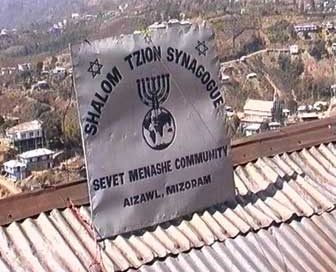
Few communities illustrate the tangled categories of race, faith, ethnicity, and nation as starkly as the Bnei Israel of India’s northeastern hill states, more widely known as the Bnei Menashe. Numbering around 10,000 people from Chin, Kuki, and Mizo ethnic groups along the India-Myanmar-Bangladesh border, the community’s decades-long journey from Christian converts to recognized, if still contested, members of the Jewish people offers a genuine case study in how these four categories can pull against each other rather than reinforcing one another.
A Vision, Not a Historical Record
The Bnei Menashe movement began in 1951, when Challianthanga, a leader in the United Pentecostal Church in Mizoram, reported a vision that his people, previously Christian converts themselves following nineteenth-century missionary activity, were actually descendants of the ancient Israelite tribe of Manasseh. The claim rested on the belief that a legendary Hmar ancestor named Manmasi was in fact the biblical Menasseh, son of Joseph, and that Hmar oral traditions, including a harvest festival song called the Sikpui Hla, preserved garbled memories of the biblical Exodus. Over subsequent decades, small numbers of community members traveled to Israel for formal religious instruction, brought back Torah scrolls and Jewish ritual objects, and gradually shifted the community’s practice from a syncretic blend of Christian and folk tradition toward normative rabbinic Judaism. This origin story sets the Bnei Menashe apart from every other Jewish community discussed on this site. The Cochin Jews, Bene Israel, and Baghdadi Jews all trace continuous, if variously documented, Jewish practice back centuries or millennia within India; the Bnei Menashe instead trace their Jewish identity to a specific mid-twentieth-century revelation experienced by a single religious leader, a origin far closer in structure to a new religious movement than to an unbroken inherited tradition. Rabbi Eliyahu Avichail of the Israeli organization Amishav, dedicated to locating descendants of the Ten Lost Tribes, investigated the community’s claims in the 1980s and gave them the name “Bnei Menashe,” formalizing an identity that community members themselves had been constructing gradually over the preceding three decades through contact with Jewish organizations abroad.
The Race Question: What DNA Testing Actually Found
Because the Bnei Menashe’s core claim rests on genetic descent from an ancient Israelite tribe, the community became an early test case for genetic ancestry testing applied to a disputed Jewish identity claim. DNA testing conducted on several hundred male community members in 2003 and 2004 did not yield the kind of genetic markers researchers might expect from Middle Eastern ancestry, and subsequent academic research from Mizoram University found that many of the customs the community points to as evidence of Jewish descent, including specific ritual songs and animal sacrifice practices, were already present in the wider Chin-Kuki-Mizo cultural region independent of any Jewish contact, with no written record connecting them to Judaism prior to the twentieth century. This finding did not end the community’s claims or its broader recognition process, since supporters of the Bnei Menashe’s Jewish identity have argued that centuries of intermarriage and population movement across the Near East and Central Asia could plausibly obscure a genetic signal even where a real ancestral connection existed, a defense common to genetic-ancestry disputes involving other claimant communities worldwide as well. The scientific ambiguity left the question of Bnei Menashe identity to be resolved primarily through religious and political channels rather than through genetics, a pattern that would repeat at each subsequent stage of the community’s recognition.
The Faith Question: Recognition Without Automatic Belonging
Despite the ambiguous genetic and historical evidence, the Bnei Menashe’s claim gained crucial religious legitimacy in 2005, when Shlomo Amar, then Sephardi Chief Rabbi of Israel, formally recognized the community as descendants of one of the Ten Lost Tribes. That recognition did not, however, automatically grant community members Jewish status under Israeli law; individuals must still undergo formal conversion, giyur, according to Orthodox procedure before they are considered Jewish for purposes of marriage, religious status, and, in most cases, before completing immigration. Faith, in the Bnei Menashe case, functions as a gate that must be actively passed through by each individual, rather than a status automatically inherited from a claimed ancestral connection. In practice, this has meant that Bnei Menashe individuals who wish to formalize their Jewish status must travel to Israel or work with visiting rabbinical courts, study Jewish law and practice in depth, and complete a conversion process that can take months or years, a substantially higher bar than the automatic recognition extended to individuals with clearer, documented matrilineal Jewish descent. Community members have generally accepted this requirement as a necessary and legitimate step rather than an insult, viewing formal conversion as the appropriate mechanism for confirming a religious identity whose ancestral basis remains genuinely uncertain.
The Ethnicity Question: Leaving One Identity Behind
Embracing a Bnei Menashe Jewish identity has generally meant setting aside, rather than blending with, the community’s prior Chin-Kuki-Mizo ethnic and religious identity, since most members were practicing Christians before the 1950s vision took hold, and the communities among whom they lived, and largely still live, in Mizoram and Manipur remain majority Christian today. This creates a genuine ethnic rupture uncommon among most other Jewish communities discussed on this site: unlike the Cochin Jews or Bene Israel, whose Jewish identity long predates any alternative religious affiliation, the Bnei Menashe’s Jewish identity represents a comparatively recent, actively chosen departure from an ethnic community’s dominant religious practice, a choice that has at times created friction with neighbors and family members who did not follow the same path. The shift has also carried practical consequences within India itself, since Bnei Menashe communities practicing Judaism have needed to establish entirely new institutions, synagogues, kosher food supply chains, Hebrew instruction, in regions of Mizoram and Manipur that had no prior Jewish infrastructure whatsoever, unlike Cochin or Bombay, where centuries-old synagogues and community structures already existed for returning or reconnecting Jewish descendants to draw upon.
The Nation Question: Aliyah Requires Special Permission
Even after religious recognition, moving to Israel has never been automatic for the Bnei Menashe. Unlike Jews with clearer documented lineage, Bnei Menashe immigrants require special dispensation from the Knesset, Israel’s parliament, to make aliyah under arrangements negotiated periodically rather than through the standard Law of Return process available to other diaspora Jews. As of December 2023, roughly 5,000 Bnei Menashe had immigrated to Israel through these special arrangements, and in November 2025 the Israeli government approved a further plan to bring approximately 5,800 additional community members to Israel for resettlement in the Galilee by 2030, at an estimated cost of about 90 million Israeli shekels covering flights, conversion classes, housing, and Hebrew language instruction. Each new wave of this migration has required fresh political approval rather than an established, permanent legal right, underscoring how contingent national belonging remains for this community even after seven decades of religious and cultural transformation. The scale of this ongoing migration, thousands of people relocating over decades through periodically renegotiated government arrangements rather than a single settled policy, has made the Bnei Menashe one of the largest sustained immigration stories connected to any Indian Jewish community in the twenty-first century, considerably larger in absolute numbers than the much older but now nearly vanished Cochin Jewish emigration of the mid-twentieth century, even though the Bnei Menashe’s claim to Jewish status remains, in relative terms, the most recently established and most actively contested of any group discussed on this site.
Why the Bnei Menashe Case Matters
The Bnei Menashe’s experience demonstrates that race, faith, ethnicity, and nation, categories often assumed to move together, can instead pull a community in different directions simultaneously. Genetic evidence has not clearly supported the community’s ancestry claims; religious recognition arrived without automatic legal status; embracing Jewish identity has meant leaving behind, rather than reinforcing, an existing ethnic and religious community; and national belonging in Israel has remained a matter of periodic special political approval rather than settled legal right. Understanding the Bnei Menashe requires holding all four of these tensions in view at once, rather than assuming that recognition on any single axis, genetic, religious, cultural, or national, resolves the others.
For scholars of religion and ethnicity more broadly, the Bnei Menashe offer an unusually well-documented, still-unfolding case of how a community can construct and sustain a claimed ancestral identity across three generations, gradually accumulating enough religious, institutional, and political recognition to achieve large-scale international migration, even in the continued absence of definitive historical or genetic proof for the founding claim itself.
That combination of durability and uncertainty is precisely what makes the phrase “narrating between race, faith, ethnicity, and nation” fit the Bnei Menashe case so precisely: the community’s story is, quite literally, an ongoing narrative constructed and renegotiated across each of these four categories simultaneously, rather than a settled fact established once and never revisited.
No other Indian Jewish community’s history remains quite so actively in motion today.
Further Reading
For more on India’s diverse Jewish communities, see our coverage of the Bene Israel of Maharashtra, as well as the Wikipedia article on the Bnei Menashe.